

At 10:48 on the morning of Sunday, February 7, 1904, a thermostat alarm went off in the John E. Hurst & Co. building. By the next day the Great Baltimore Fire had burned across about 140 acres of downtown, according to the Baltimore Fire Department’s own report. The department counted 1,526 buildings destroyed.
It wiped out the wholesale district, the banks and the docks. Fire engines raced in by train from Washington, Philadelphia and New York. Some of them arrived only to find that their hoses wouldn’t fit Baltimore’s hydrants.

Sunday morning at the Hurst building
John E. Hurst & Co. was a wholesale dry goods and notions house. Its six-story brick building had fronts on Liberty Street, Hopkins Place and German Street, which is Redwood Street today. One engine company, one hook and ladder company, a district engineer and a salvage corps company answered the alarm.
The firemen went in from German Street and found fire in the basement, apparently among packing cases, and within minutes the building exploded. Here’s how Chief Engineer George W. Horton described it in the Fire Department’s report for 1904:
…the daylight seemed to fade away, caused by the downpour of smoke through the elevator shaft, and instantly there was an explosion, the impact of which was upward and outward. The time between the receipt of the alarm and the explosion was about five minutes; the roof was lifted and every window light above the first floor was broken, and the flames shot out with a loud whistling noise.
The blast carried burning brands into the buildings next door, and seven of them were burning at once. A box of powder exploded nearly across the street, breaking more windows.
The wind was blowing twelve miles an hour from the southwest, and the streets there were only 35 and 40 feet wide. Because it was a Sunday in a commercial district, nobody was around to put out the small fires that started in yards and awnings blocks away.

Within thirty minutes of the first alarm, Horton wrote, the department knew the fire was beyond its control. Baltimore wired its sister cities for help.
Nobody ever established what started it. According to the New-York Tribune, Henry S. Hurst said he and an employee, Charles George, were the last to leave the building. That was at 5:30 p.m. on Saturday.
Hurst also denied reports that gasoline had exploded in the cellar. Horton’s own conclusion was blunt:
The origin of the great fire has not been clearly shown, but I assert, had there been a watchman employed in the Hurst building, the record of the fire to-day would read: “A slight fire in the basement of J. E. Hurst’s building among packing cases, extinguished by the watchman.”

Wind, live wires and dynamite
The fire went wherever the wind sent it. According to Horton, the wind stayed out of the southwest until 11 o’clock Sunday night, swung almost due west, and then turned northwest at noon on Monday. Between the wind and the draft from the heat, the big deluge streams were torn apart before they could reach the second stories.
The overhead wires added to the danger. The Evening Star reported that broken wires dangled in many of the streets, most of them trolley wires and many of them still live. Horton himself stepped on one and took a severe shock, the Star said, though not enough to put him entirely out of action.
He stayed in the fight until about 2 p.m., when he was moved to his night quarters at Engine Company No. 23. District Engineer August Emrich took command, later handing off to District Engineer L. H. Burkhardt for a time. Horton took charge again at 1:30 p.m. on Monday.
Washington’s chief, Chief Engineer Belt of the District fire department, had a hand in it too. The Washington Times reported that he was understood to have run the entire fire-fighting force for several hours on Sunday night. By Monday, the paper said, he was alternating with Horton.
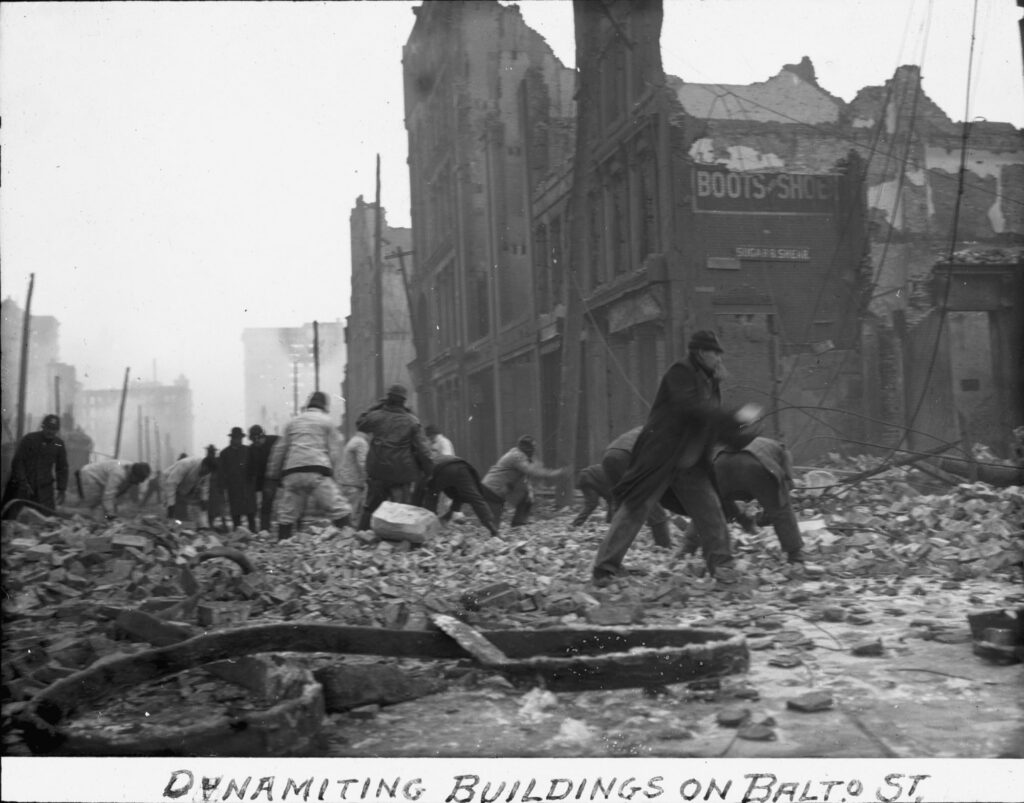
The city also turned to dynamite. Former Fire Chief McAfee, retired for several years, volunteered his services, according to the Times. A dispatch from Baltimore in the Star said he supervised the blasting of buildings in the fire’s path, with detonations that jarred the whole city.
G. W. Gail, president of the fire board, was running things from headquarters. Around 4 o’clock Monday morning he told the Star he believed the dynamiting had been entirely unsuccessful. In almost every case, he said, the flames reached a building before the wires could be set.
Help from Washington, and a hose that wouldn’t fit
Horton’s call for help reached Chief Belt at 11:10 that Sunday morning, according to the Evening Star. District Commissioner Macfarland was in church at the Church of the Covenant, and he left and told Belt to do everything possible.
The Washington Times printed Horton’s telegram: “Big fire here. Must have help at once.” Engine Companies 3 and 6 were loaded onto a special Baltimore and Ohio train with Belt, Fire Marshal Bieber and twenty firemen.
The run took 31 minutes. The Times said the special reached Baltimore at 12:37 p.m., exactly an hour after the telegram arrived. So the two papers don’t quite agree on when the call came.

At about 10:15 that night, the Star reported, Mayor Robert M. McLane wired Macfarland for more help. Engines 2 and 8 went over on a second special train. No. 7 followed before dawn on Monday, making five engines and about eighty men from the District.
Baltimore’s acting chief told the Star that the Washington men were the first to arrive after the companies from the immediate vicinity. They took a position in the face of the advancing fire, he said, and fought it untiringly.
Getting them started had been the hard part. The Evening Star explained why in an editorial on February 9, 1904, headlined “Standardize the Hose Couplings”:
The Washington steamers, on arrival, could not be put into service for some time owing to the difficulty of coupling them to the plugs. An emergency coupling was finally devised and the steamers were thus utilized. The same trouble, however, occurred in the case of some of the other outside apparatus, and thus Baltimore did not receive the maximum benefit of the assistance so promptly and heartily rendered by its neighbors.
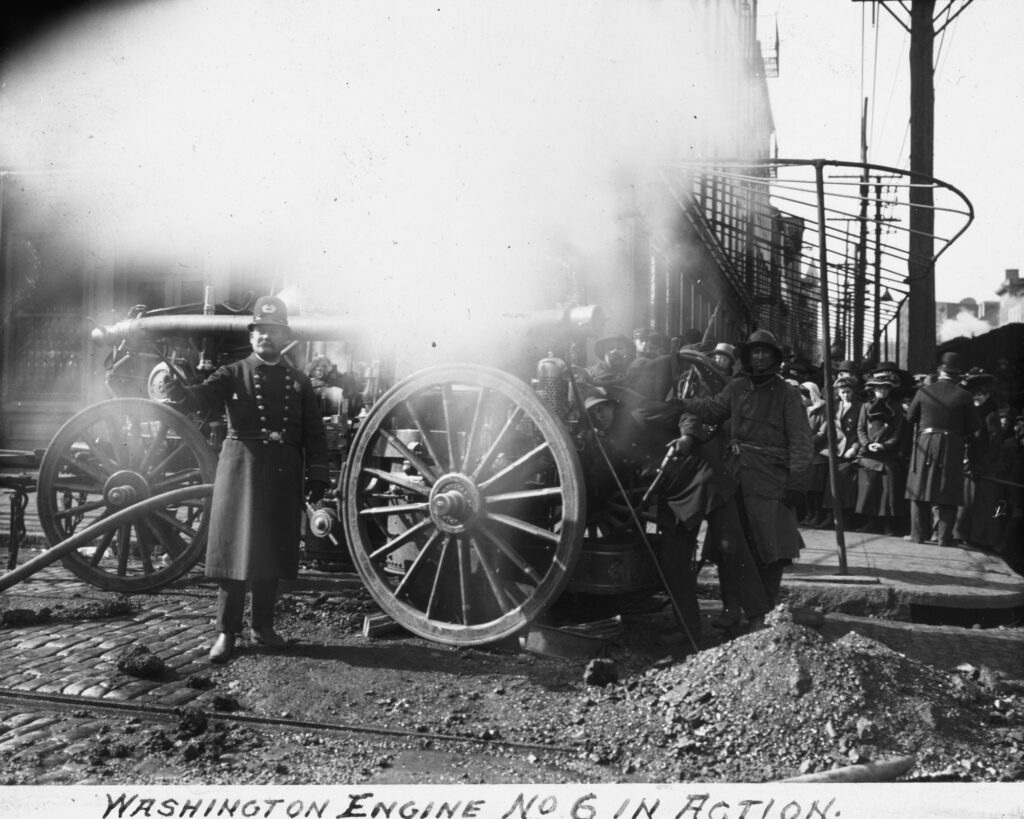
The help was right there, and for a while it couldn’t hook up. According to a 2004 report from the National Institute of Standards and Technology, the country had about 600 sizes and variations of hose couplings at the time.
The National Fire Protection Association adopted a national standard in 1905. A century after the fire, though, NIST found that only 18 of the 48 most populous U.S. cities had fully standard hydrants. Baltimore was one of them.
The outside force was large. The Fire Department counted 460 Baltimore firemen at the fire, with 24 steam engines, 8 hook and ladder trucks, a fireboat and a police boat. It also counted 771 firemen, 33 steam engines, 2 hose companies and a hook and ladder truck from other cities and towns.
Jersey City sent nine engine companies on a special train at 4 o’clock Monday morning. On Monday the B&O’s chief train dispatcher wired that the New York fire department had just arrived on fifteen cars.
Where it finally stopped
The fire burned north to Fayette Street, east to Jones Falls and south to the harbor. The Fire Department’s report and the city’s bronze tablet both say it was under control at 11:30 a.m. on Monday, February 8. That didn’t mean the flames were out, though.
The Star’s own correspondent was still watching fire in the lumber yards at 2 p.m. At 2:40 p.m. the Associated Press reported that the last places to burn were the ice house and coal yard of the American Ice Company. There, the coal yard and Jones Falls finally stopped the flames.
The AP added that it had taken twenty-seven hours to stop the fire’s progress. The Maryland Center for History and Culture puts the end at about 5 p.m.
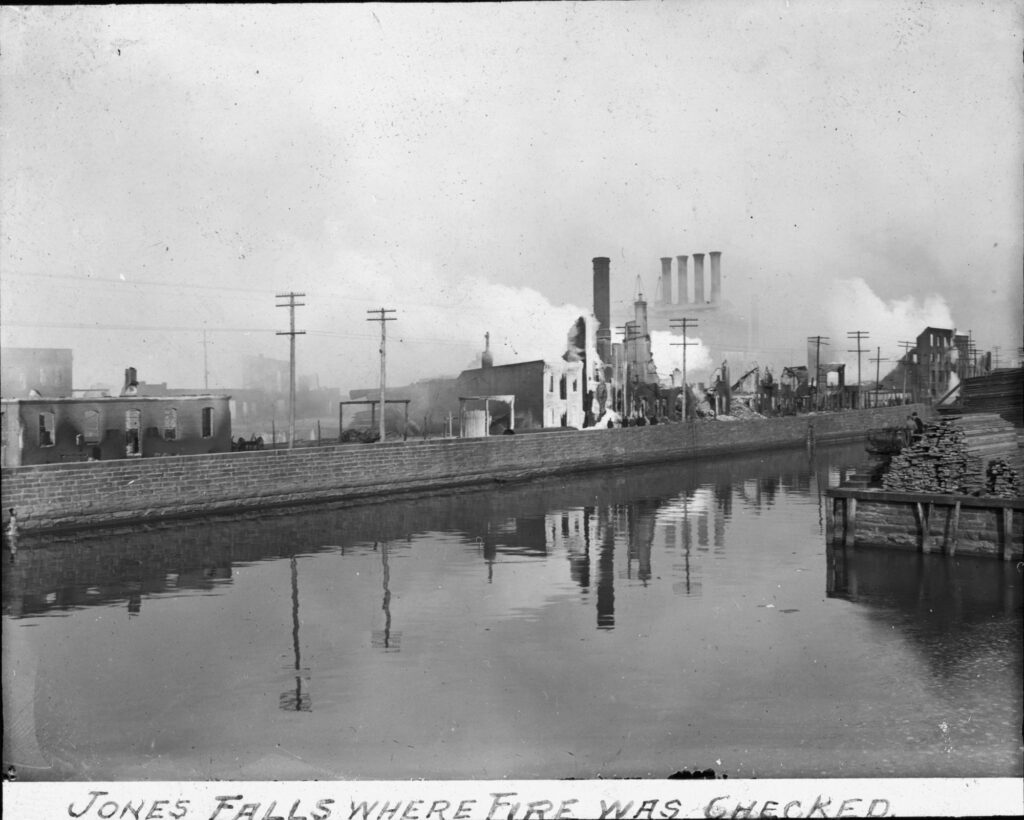
About 70,000,000 gallons of water went into the fight, and the department lost a steam engine, a hook and ladder truck and 29,900 feet of hose. Meanwhile 52 box alarms came in from other parts of the city for fires started by sparks.

The Fire Department’s report lists about 140 acres and 86 blocks burned. Its 1,526 buildings break down into 1,468 brick and 58 frame, plus four lumber yards.
The report estimated the loss at $70,000,000, with about $29.2 million paid out in insurance. The bronze tablet put up later on Market Place gives larger figures, $100,000,000 in property and $32,000,000 in insurance.
Deaths and injuries
The official record and the bronze tablet agree that nobody died. Horton’s report says that although the firemen took great risks, “no lives were lost, nor was there a bone broken.” The Fire Department’s list of 1904 fires with loss of life doesn’t include the conflagration either.
Early reports said otherwise. The Washington Times wrote on February 8 that the fire had “killed one.” The same issue said a body found in the Equitable Building was that of a fireman from York, Pa.
A wire report from Baltimore dated February 9 said that fireman, Jacob Inglefritz, was alive. He had been unconscious when he was taken to Maryland General Hospital, and he had a broken leg.
That broken leg sits awkwardly next to Horton’s “nor was there a bone broken,” and his report doesn’t say whether he meant only Baltimore’s men. The wire report itself said there had probably never been a fire of such magnitude without loss of life.
The Baltimore department’s surgeon treated 195 cases of sickness and accidents during the fire, visiting firemen included. The quarters of Baltimore’s Engine Company No. 6 served as a temporary hospital from Sunday night through February 11. The veterinarian also singled out Goliath, a horse of Water Tower No. 2, who was badly burned and nursed back to active service.
Later counts haven’t settled on zero. The 2004 NIST report says one firefighter, James McGlennen, died a few days after the fire of injuries he received fighting it. The Maryland Center for History and Culture counts one direct fatality and four deaths from illness attributed to the fire.
“We do not want money, we want business”
Offers of money came from around the country and from Europe, and McLane turned them down, at least for the time being. The New-York Tribune quoted him that the city “will not hesitate three minutes to ask assistance” if it became necessary.
On February 10, 1904, he wired Commissioner Macfarland: “Many thanks for kind words of sympathy. Assistance not needed at present. Call will be issued if necessary.”
Sherlock Swann, who chaired the Burnt District Commission, summed up the city’s answer in its 1906 report: “We do not want money, we want business.” McLane borrowed Chicago’s approach after its 1871 fire and appointed an Emergency Committee of prominent citizens on February 11, 1904. It organized the next day in the Courthouse with William Keyser as chairman and finished its work on February 22.
The legislature then passed the Burnt District Act, and on March 11, 1904, McLane appointed the commission. Its members were Sherlock Swann and Charles K. Lord, Democrats, and Reuben Foster and John T. Graham, Republicans, with the mayor as a member. When the City Council started picking apart the plan, Swann wrote, McLane announced that if any more changes were made he would veto the whole thing.
In mid-May, McLane married Mrs. Mary Van Bibber in Washington. Two weeks later, on May 30, 1904, he died at his home at 29 West Preston Street. He was 36.
Coroner Benjamin F. Hayden ruled the death a suicide and held no inquest. The Evening Star reported that the family could assign no cause.
McLane’s family physician and many of his friends disputed the finding, the Star said, though Hayden maintained there was no doubt. E. Clay Timanus, president of the First Branch of the City Council, took the oath as mayor the next morning.
Building a new downtown
The Burnt District Commission didn’t just rebuild the old streets, it widened them. Its 1906 report says the widenings and extensions added more than ten acres of street, the biggest gain on Pratt Street.
The city also acquired more than 25 acres of land for new municipal docks and piers. Voters approved the $6,000,000 dock loan at a special election on May 17, 1904, by 31,728 to 9,218.
The commission didn’t get everything it wanted. The City Council killed the widening of Baltimore Street and the leveling of the Lombard Street “hump.” Swann’s history calls those two improvements lost “in all human probability, forever.”
The commission said its main work was finished on August 10, 1905, for a net cost of about $5,600,000. By August 7, 1906, 81 percent of the ground floor space available after the widenings had been rebuilt. Counting every story, the figure was 85 percent of the floor space.
By the commission’s count, 702 buildings stood in the district by then where 1,343 had burned. Many of them were much bigger than the ones they replaced. For a look at the result, here’s Baltimore rebuilt, seen from above in 1912.

Under the streets came a real sewer system. Until then the city relied on privies, cesspools and open drains, according to a 2015 city landmark report on the Eastern Avenue Pumping Station. That report names the fire as the push that got the sewers built.
Baltimore had turned down sewer plans in 1859, 1881 and 1897. In 1905, voters approved a $10 million sewer loan by 37,177 to 25,253. The main lines and about two-thirds of the lateral sewers were finished by 1914.
What you can still see
The Continental Trust Building at Baltimore and Calvert Streets was designed by D. H. Burnham & Co. and built in 1900 and 1901. It’s One South Calvert Street today.
The Fire Department’s tally of destroyed buildings includes one sixteen-story building, almost certainly this one, but its shell came through standing. The Maryland Historical Trust’s National Register listing calls it a survivor, rehabilitated after the fire minus most of its cornice.

The fire’s own memorial is a bronze tablet beside the doors of the old Fish Market building on Market Place, home of Port Discovery today. It gives the start as 10:48 a.m. on February 7, 1904, under control at 11:30 a.m. the next day and the area as 140 acres. It closes with the line Baltimore chose to remember: “Lives lost - none.”
Lost Baltimore stories, in your inbox.
The newest story, plus a few from the archive.
Free. Unsubscribe anytime.
We use AI to help research, write and edit stories across our sites. Here’s how we use AI.Suggest a correction