

First came a “Heil Roosevelt,” and then a “Heil Hitler.” On Saturday night, May 18, 1935, about 250 people gathered at Lehmann Hall on North Howard Street. The Baltimore chapter of the Friends of New Germany, a Nazi support group, was dedicating its flags, and five of them were swastikas.
The Sun covered the rally and described the order of the cheers the next morning:
It was Paul Anders, leader of the Baltimore group, who called for the “Heil Roosevelt,” after the entire program had started with the playing of the “Star-Spangled Banner.” After the response he called for the “Heil Hitler.”
The Friends of New Germany was a national group that openly supported Nazism. The United States Holocaust Memorial Museum says it lasted from 1933 to 1936.
When it collapsed, the museum says, the German American Bund took over some of its members and property. The Sun called the Baltimore branch new. It said this was the first time the branch had the official right to fly its parent organization’s banners.
What happened inside
After the national anthem, a German band played the Torgauer March. Members from four other branches came too, from Pittsburgh, Reading, Philadelphia and Washington. They stood with arms raised in the Nazi salute as the flags were unfurled on a stage at one end of the room.
The flags came in three sets of five. There were five swastikas, five American flags and five imperial banners of the old German empire. The Sun explained that the swastika wasn’t recognized as the flag of the new Germany unless the old imperial banner flew beside it.

Those taking part in the ceremony wore uniforms the Sun said were close to those of Nazi storm troopers. They had boots, dark riding breeches and a swastika band on the sleeve. The older members wore white shirts and the younger ones wore brown.
They sang “Deutschland über Alles” and then the first verse of the “Horst Wessel” song, the Nazi party anthem. The Sun explained that under a new rule of the Hitler regime, the first couldn’t be sung in Germany without the second.
The principal speaker was Josef Schuster of New York, a district leader of the group. He spoke in German and complained that the turnout of about 250 was too small. He urged everyone in the room to sign up at least thirty new members and asked German-Americans to stand behind the government of their homeland.
Spokesmen for the group told the reporter that they stood behind the Hitler regime but didn’t necessarily endorse all of its policies. The colors were carried out to the Badenweiler March. Afterward, the Sun reported, some of those in uniform went to a lounge and held a short drill that no visitors were allowed to watch.
The protest came in the letters column
The pushback that the Sun recorded showed up on its letters page. On May 21, 1935, three days after the rally, the paper printed a letter from Bernard Moses, who wrote that he was an American-born citizen.
There is no doubt that this is the beginning of propaganda for the Hitler Government, and it should be nipped in the bud and prevented in the future.
Moses read the “Heil Roosevelt” as a gesture meant to calm Americans who didn’t see the danger. He ventured that most of the people in the hall weren’t naturalized citizens. He wrote that it was the duty of the United States Marshal to investigate and send any aliens back to the government “they love so well.”
Two days after that, A. J. Reilley added a one-paragraph letter of his own. He protested what he called the German-Hitler meeting and endorsed everything Moses had written.
The group’s defenders answered on May 26. T. Mueller insisted it wasn’t a Nazi meeting at all and that no “Heil, Hitler” went up from the audience. The Sun’s own headline had read “‘Heil Hitler’ Roars Out at Nazi Rally.”
Mueller also suggested that the drill was really the flags being furled and put away. On the same page, Eberhard Hugo Scharpf wrote that he saw no lawbreakers in the hall, only “perfect harmony.” He named Moses and Reilley as the ones spreading the wrong idea.
We found no picket line, arrests or court case connected to the rally in the Sun’s pages. In the Sun, at least, the fight over that night was carried on in print, by readers. We didn’t check the Evening Sun, the Afro-American or the Jewish Times.
A hall used by very different crowds
Lehmann Hall stood in the 800 block of North Howard Street. The Sun’s 1935 story doesn’t give a number, but other records put it at 852. An archival description gives the range as roughly 850 to 856.
According to a 1954 Sun history of the block by George C. Dorsch, Prof. Edward G. Lehmann, a dancing teacher, opened the hall on October 24, 1870. It became a center of Baltimore society, Dorsch wrote. The Sun was announcing a concert there by February 1876.
Generations of Baltimore debutantes made their bows at the hall’s cotillions, Dorsch wrote. According to him, their escorts liked to slip out for rye at Hohman’s, the public house at Howard and Armory Place.

In 1911, Dorsch wrote, the hall was sold to the Germania Maennerchor, a German men’s singing society, which put on a new front. The 1914 Sanborn fire insurance map shows Lehmann Hall and the Germania Maennerchor Club as separate buildings side by side. They stood on the west side of Howard Street, between Armory Place and Madison Street.
Dorsch also wrote that in 1918, because of World War I, there was a change of name to the Metropolitan Club. Whatever the official name, the Sun kept calling the place Lehmann Hall through 1940.

On November 11, 1919, the Harvard Club of Baltimore sponsored the first citywide celebration of the Armistice anniversary at the hall. Despite the name, it was a Jewish boys’ club. Maurice J. Grebow, who was a member, remembered it in the Sun in 1969.
White doves were released at 11 minutes past 11, he wrote, and Mayor Broening came. The East Baltimore Jewish clubs, Grebow explained, all picked the names of colleges.
In the mid-1930s, the Baltimore Open Forum held lectures in the hall too. On January 28, 1934, more than a year before the flag dedication, the forum heard Dr. Alphonse Goldschmidt. He was an exiled professor whose books had been burned by the Hitler regime, and he described what the Nazis were doing to Germany’s universities.
Baltimore’s German clubs used the hall heavily in the 1930s. The Maryland Center for History and Culture describes a German movie theater, a rathskeller, bowling alleys and a dance floor there. It says the Deutscher Ring, an organization of German-American clubs, met there before moving in 1938 to the new Deutsches Haus on Cathedral Street.
So the stage where the Friends of New Germany unfurled their swastikas had also hosted a Jewish boys’ club and an anti-Nazi exile.
Sieg heil on Howard Street, 1940
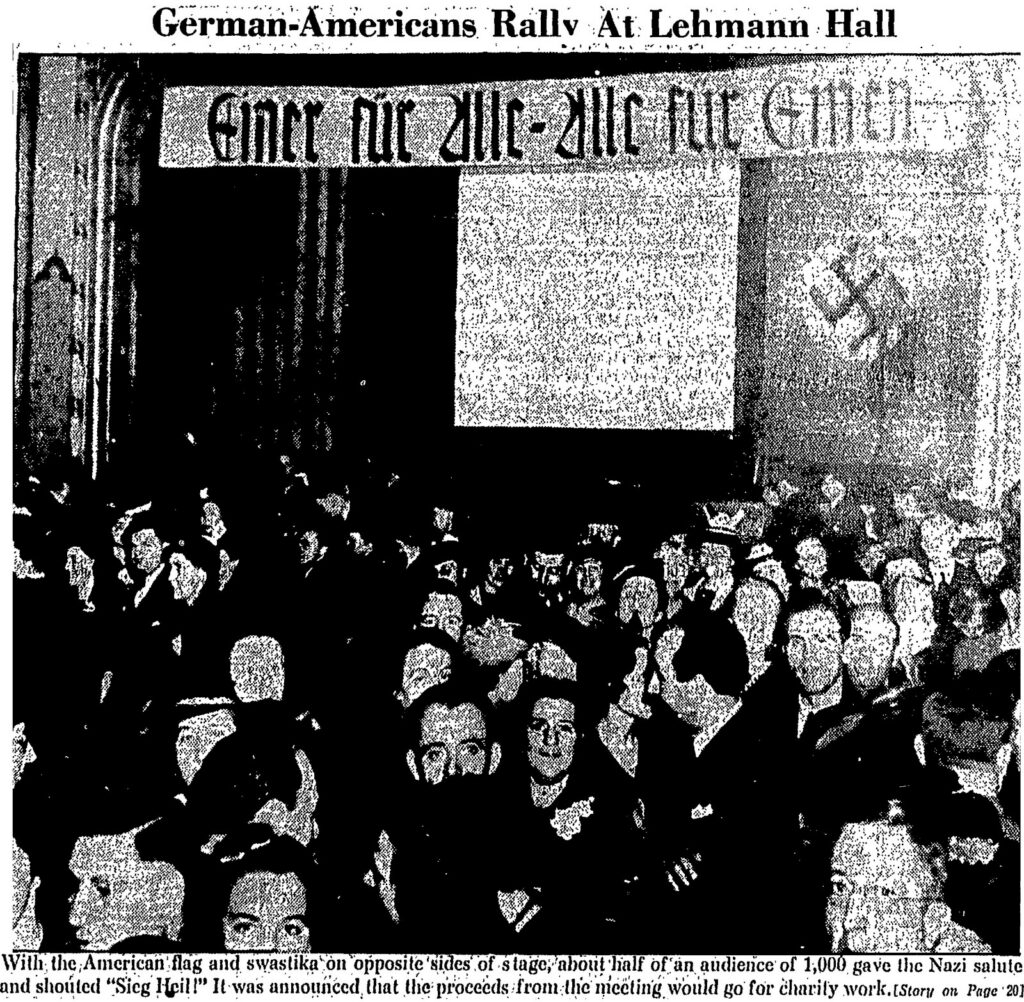
Five years later the hall was back in the news. On Sunday night, April 7, 1940, with war already under way in Europe, more than 1,000 German-Americans crowded into Lehmann Hall. They had come for a meeting called by Frederick F. Schneider, the German consul in Baltimore.
The main speaker was Dr. Friedhelm Draeger of the German Consulate General in New York. He told the crowd that England and France had forced the war on Germany.
Almost all of the audience sang “Deutschland über Alles” and the “Horst Wessel” song. The Sun reported that about half gave the Nazi salute and shouted “Sieg heil!” when Draeger finished.
Some of the criticism that followed came from other German-Americans. On April 13, 1940, the Baltimore chapter of the German-American League for Culture, an anti-Nazi group, called the “Swastika and Hitler heiling” at Lehmann Hall un-American. It described Hitler’s government as “a gangster regime.”
A reader named Joseph Eustis wrote to the Sun that seeing the swastika float beside the Stars and Stripes had to anger plenty of its readers. That was especially true, he wrote, when they remembered what had happened to Poland.
What stands there now
Dorsch wrote that the hall became a movie theater in 1941. In 1954 he reported that the Roslyn Theater, “formerly Lehmann Hall,” would disappear when Howard Street was widened. The widening would take 16 feet off its west side between Madison Street and Armory Place.
By 1969, Grebow could write that the old hall had stood on the site of Maryland General Hospital. The hospital already shared the block with Lehmann Hall on the 1914 map, and it is now the University of Maryland Medical Center Midtown Campus.
Part of the old hall’s footprint lies within the hospital campus. If Dorsch’s numbers are right, the rest is under Howard Street. People drive every day over part of the hall where those swastika flags were unfurled.
Lost Baltimore stories, in your inbox.
The newest story, plus a few from the archive.
Free. Unsubscribe anytime.
We use AI to help research, write and edit stories across our sites. Here’s how we use AI.Suggest a correction