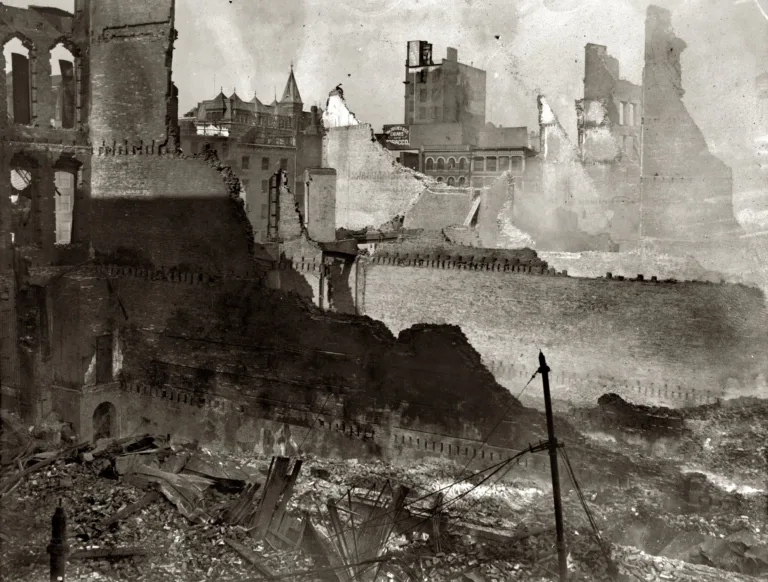


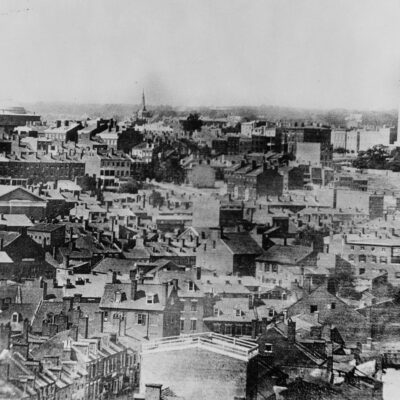
Baltimore’s Washington Monument rises above the rooftops at the right of this old photograph.
The photograph survives in the Historic American Buildings Survey collection at the Library of Congress. Its caption identifies the Washington Monument and two churches in the surrounding city: a church at Calvert and Pleasant streets and First Unitarian Church at Charles and Franklin streets.
Robert Mills designed the Washington Monument, which was constructed between 1815 and 1829. Its form is quite different from the later obelisk in Washington, D.C.: Baltimore’s monument is a column on a substantial pedestal, with a standing figure of Washington above it.
The National Register account of Mount Vernon Place points out that the finished monument was simpler than Mills’s original design. Planned bronze decoration on the column and additional sculpture on the pedestal were never carried out. The clean outline that makes the monument so easy to spot in this photograph was not the full ornamental scheme first envisioned.
One of the churches identified in the archival caption was the setting for a landmark religious address. At First Unitarian Church on May 5, 1819, William Ellery Channing delivered the sermon known as Unitarian Christianity at the ordination of Jared Sparks.
For a closer view of the monument and its setting, see these early photographs of Mount Vernon Place.

Liked this one? Get more tomorrow.
Lost Baltimore stories in your inbox most mornings: the newest, plus a few from the archive.
 This storyThe Washington Monument Above a City of Rooftops
 The Old Bay Line Steamer That Became the Exodus 1947
 Al Packer’s Ford Dealership in 1964
Free. Unsubscribe anytime.
We use AI to help research, write and edit stories across our sites. Here’s how we use AI.Suggest a correction