

Ugh, I hate to do this, stirring up old, painful memories, but … here is a list of the three worst acquisitions in the history of the Baltimore Orioles.
This was my list in 2013, so we’re keeping the argument in that era. And yes, there’s room to argue about the order, especially once we get to Dan Ford.
1. Glenn Davis
This dude literally cost an arm and a leg … actually, two arms. Pete Harnisch, Steve Finley AND Curt Schilling. At the time, we thought it was amazing (though there were some skeptics). Finley and Schilling definitely had better careers, and Harnisch gave other teams plenty of good innings. The only problem is, none of them had their finest years with the Orioles.
The deal went down on January 10, 1991. Davis had hit 34 home runs for Houston in 1989 and another 22 in just 93 games in 1990. You can see why the O’s wanted that bat in the middle of the lineup … even if the price makes you want to throw something now.

In three years with the O’s, Davis barely squeaked out the equivalent of a full year of playing time, with 185 games, 24 home runs, 85 RBIs, and a crappy .247 average. Instead of getting the slugger we expected, we watched injuries keep him out of the lineup.
Meanwhile, Harnisch finished his career with 111 wins, a 3.89 ERA, and 1,368 strikeouts. Finley played 19 seasons, had 304 homers, 1,167 RBIs, scored 1,443 runs, stole 320 bases, and had a .271 career average. Those are career totals, including their Baltimore years, but you get the idea.
Then there’s Curt Schilling. Other than the fact that he’s crazy and kind of a douche, he won 216 games, had an ERA of 3.46, struck out 3,116 batters, and kicked ass in the postseason for both the Diamondbacks and the Red Sox (i.e., bloody sock).
The Glenn Davis trade was an epic fail not only in Orioles history, but all of baseball. It’s up there with the Red Sox unloading Bagwell, Phillies and Sandberg, Tigers and Smoltz, Mets and Nolan Ryan, Cubs sending Lou Brock to St. Louis, and the Yankees unloading both Fred McGriff and Jay Buhner. I’m trying to soften the blow by sharing these.
Little known fact … Glenn Davis and former Oriole Storm Davis grew up together. No, they’re not brothers. Glenn went to live with Storm’s family as a teenager. Both were drafted by Baltimore in 1979, but only Storm signed.
2. Dan Ford
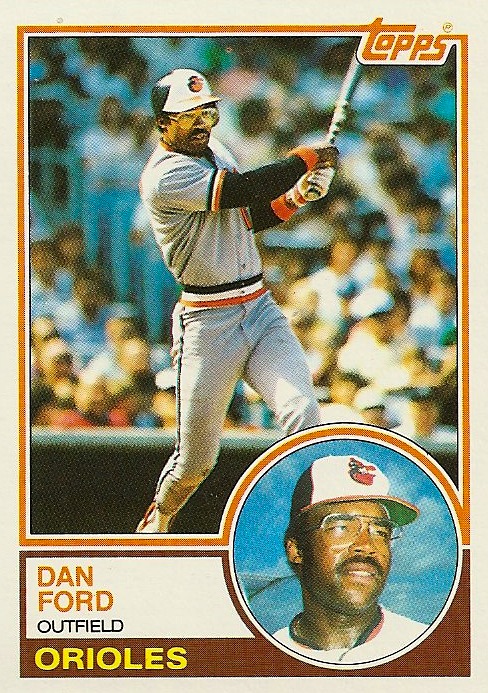
Who the hell is Dan Ford? Well, Disco Dan was a solid outfielder for the Twins in the late 70s, and he had a pretty good bat for the Angels, too. Then, on January 28, 1982, we unloaded Doug DeCinces, who had spent nine seasons with the O’s, and threw in Jeff Schneider to acquire Ford.
DeCinces went on to hit 130 home runs in six years with California, with 481 RBIs and a .265 average. In his first season there, he hit .301 with 30 homers. Watching a guy do that right after you trade him is never much fun.
Ford hit a whopping 21 homers in four years in Baltimore, with 104 RBIs and a .249 average. Knee problems took a big bite out of his time here, and the return still looks awfully thin next to what DeCinces did for the Angels.
But he deserves more than a throwaway line about the 1983 World Series. Ford batted .280 that season, and his sixth-inning homer off Steve Carlton in Game 3 started the Orioles’ comeback in a game they won 3-2. So at least we got that out of him … and that was a pretty big thing to get.
I’m still not thrilled about the trade. But Ford helped win a championship, which makes him the most debatable name on this list.
3. Albert Belle
This guy sucked in the outfield and as a person. What an unbelievably frustrating acquisition he was. He wasn’t quite as bad as Glenn Davis, and he had some strong stats. But he was such a jerk, and his tenure was cut short after the 2000 season by a degenerative hip condition.
I will admit that he was a strong addition his first year in Baltimore. He hit .297 with 37 homers and 117 RBIs in 1999. And his second year in Camden was still pretty decent, with 23 home runs and 103 RBIs. The bat wasn’t the problem. The attitude and the occasional half-ass effort in the outfield were another matter.

The O’s were terrific in 1996 and 1997, but Belle didn’t arrive until the 1999 season. His five-year, $65 million deal was supposed to help get Baltimore back to that level. Instead, an arthritic hip ended his playing career with three years left on the contract.
That was a lousy outcome, though Belle’s contract alone doesn’t explain the whole miserable decade that followed. Insurance covered 70 percent of his remaining salary. The 60-day disabled list also let Baltimore free up his 40-man roster spot during the season. It was still an expensive disappointment, but the contract wasn’t the only thing wrong with this team.
His White Sox contract had a clause requiring him to remain one of baseball’s three highest-paid players. Chicago’s refusal to meet it helped put him on the market, which is how he wound up becoming our problem.
PS. Remember when we called him Joey Belle?
To ease the pain of these three, remember when we unloaded Mike Boddicker for Brady Anderson and Curt Schilling. That wasn’t so bad. We also traded for Frank Robinson, who went on to win a Triple Crown.
Lost Baltimore stories, in your inbox.
The newest story, plus a few from the archive.
Free. Unsubscribe anytime.
This older post was revised with help from AI. Here’s how we use AI.Suggest a correction


