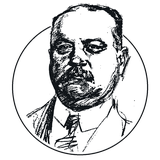


On August 5th, 1929, the Baltimore Sun ran this headline: Sam Crane, Former Oriole, Held In Shooting Affair. Two nights earlier, in a hotel barroom in Harrisburg, Pennsylvania, the former Orioles shortstop had shot his former sweetheart, Della Lyter, and John D. Oren, the man she was with. Both of them died, and Crane would be convicted of murder twice.
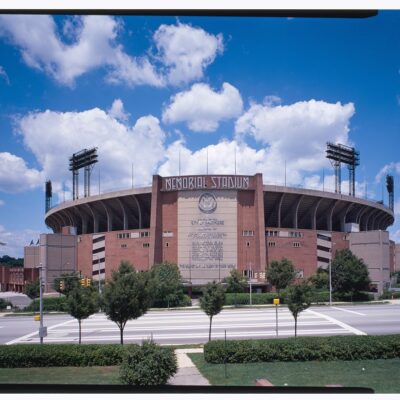
The Sun kept following the case for months, because to Baltimore fans Crane wasn’t just an ex-big leaguer. He had played shortstop for Jack Dunn’s Orioles until Dunn sold him to Washington in 1917, and he came back for part of 1918. Those were the minor league Orioles of the International League, decades before today’s American League team.
Jack Dunn’s shortstop
Samuel Byrem Crane was born in Harrisburg on September 13th, 1894, according to his SABR biography. He grew up playing sandlot and semipro ball around Harrisburg. Connie Mack brought him to the Philadelphia Athletics in 1914, but Crane couldn’t hit big league pitching.
So Mack kept sending him back down for more seasoning, and the place he usually landed was Jack Dunn’s ball club. Crane played for Dunn in 1915, when the Orioles were in exile in Richmond.
A rival major league, the Federal League, had put its own team in Baltimore. In 1916 he played for Dunn again, back in Baltimore.
He was a glove man first. On May 30th, 1916, in a doubleheader at Newark, the winning run was coming home in the ninth inning.
Crane ran behind his pitcher and threw the runner out at the plate. The Sun’s account put it this way:
While playing in to prevent a run he crossed behind Pitcher Sherman in the ninth inning of that game, scooped up Cable’s apparently safe sizzler through the box and shot it to the plate in time to get Capt. Eddie Zimmerman, who was hustling to make the winning tally. It was one of the best plays seen on a Newark ball field.
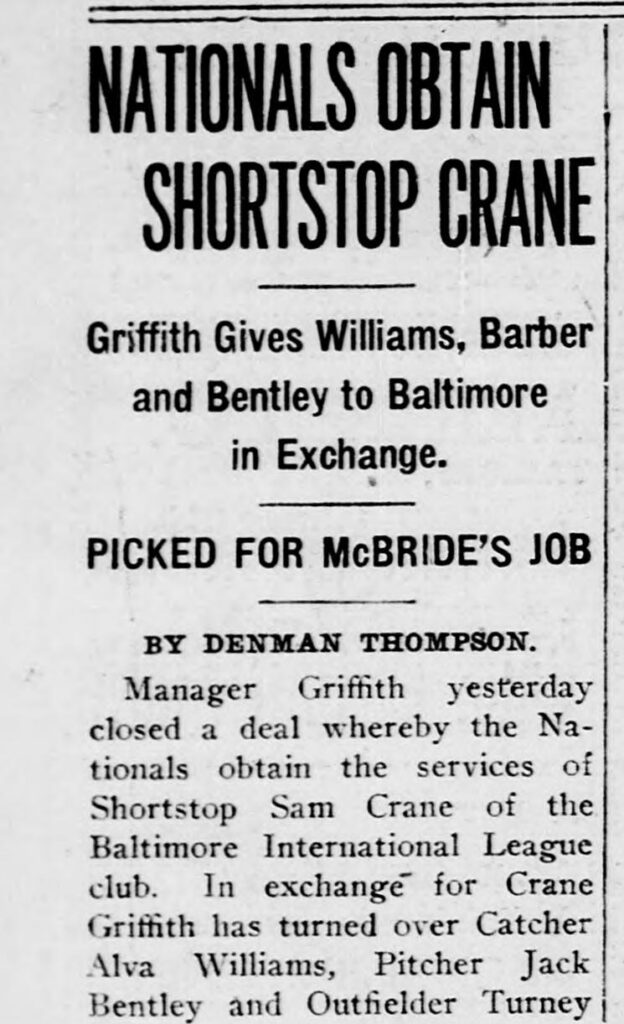
Clark Griffith of the Washington Senators liked what he saw. On January 27th, 1917, Dunn sold Crane to Washington for three players and some cash.
The players were catcher Alva Williams, pitcher Jack Bentley, a young left-hander, and outfielder Turner Barber. “Crane is the best young shortstop in the country,” Griffith told the Evening Star’s Denman Thompson.
In the end the trade paid off for Baltimore. Crane hit .179 in 32 games for Washington, according to Baseball-Reference.
Bentley, as the Sun recalled in 1929, helped Dunn win several pennants. Then Dunn sold him to the New York Giants for $65,000 and three players.
According to his SABR biography, Washington sent him to Atlanta in 1918 and Atlanta sent him to Indianapolis. That summer Indianapolis sent him back to the Orioles for a stretch.
That winter the Sun’s C. Starr Matthews wrote that Dunn could have bought “the clever shortstop” for $1,000 during the 1918 season, but passed. With World War I still on, Matthews explained, it looked as if there would be no baseball until 1920.
A career that kept slipping
Crane got more big league chances. He played two seasons with the Cincinnati Reds in 1920 and 1921 and a few games for Brooklyn in April 1922. Then he spent years in the minors with Seattle, Buffalo and Reading.
His SABR biography counts 174 major league games and a .208 batting average. The Harrisburg Telegraph summed him up as a good fielder whose hitting was mediocre.

His last professional season was 1927, with Reading. He testified later that he tore up a 1928 contract with the Buffalo club so he could stay in Harrisburg with Della Lyter. She was a divorcee who lived on State Street and worked as a clerk in the Pennsylvania State Highway Department.
Crane was married when the romance began. He had met his wife, Thelma Peterson, while he was managing in Seattle, and she divorced him there in the summer of 1929.
At his trials the state sought to show that the shooting followed Lyter’s decision to end the relationship. By then she was seeing John D. Oren, a brick salesman from New Cumberland.
The night of August 3rd, 1929
On Saturday night, August 3rd, 1929, Lyter and Oren were sitting with friends at a table in the back room of the Bria Hotel. The hotel stood at 114 Washington Street in South Harrisburg. Oren was strumming a ukulele.
At about 11:30, Crane walked in and fired his revolver. Two bullets hit Lyter. Oren went to her rescue armed only with the ukulele, swinging it at Crane’s head, and Crane shot him too.
Crane left, and a few hours later he walked into Harrisburg police headquarters. In the Sun’s AP report, he told officers, “I’m told I shot somebody.” Police later said he was too drunk to be questioned.

Oren died early Sunday morning, August 4th, about five hours after he was shot. He was to be buried in Mt. Olivet Cemetery in his hometown of New Cumberland.
The Harrisburg Telegraph reported that Lyter was fighting for her life. Her coworkers at the Highway Department, it said, stood ready to give blood for transfusions. She died on Wednesday, August 7th.
Two trials
Crane went on trial for Lyter’s death on September 23rd, 1929, before Judge William H. Hargest in Dauphin County Court. The Sun’s story the next morning, September 24th, the article our original 2021 post was built on, laid out both sides:
The State will contend that Crane entered a Harrisburg saloon on the night of August 3 with intent to kill Miss Lyter and shot her when he found her in a back room with Oren.
The defense will claim that Crane, overwhelmed with grief at his losing courtship, went into the saloon drunk and seeing the woman there with his rival, shot her in a sudden fit of uncontrollable anger.
The state asked for the death penalty. Crane took the stand in his own defense. His lawyer, Thomas D. Caldwell, argued that he was so drunk that night he had no normal control over what he was doing.
On the night of September 25th, a jury of four women and eight men found him guilty of second-degree murder. On March 26th, 1930, a second jury returned the same verdict for Oren’s death. In April 1930 he was sentenced to a total of 18 to 36 years, to be served in the Eastern Penitentiary.
Connie Mack’s long campaign
Connie Mack, Crane’s old manager, backed his requests for clemency again and again, and the families of Della Lyter and John Oren opposed them. In August 1943 the Pardon Board and Governor Edward Martin turned down his 11th plea. That June, Mack had written to the board, “I think the ends of justice have been met by Crane’s exceptionally good record.”
On September 5th, 1944, Governor Martin finally commuted the sentence on the board’s recommendation, which sent the case to the Board of Parole. Its chairman announced that Crane would be paroled on September 26th into the custody of 81-year-old Connie Mack.
Mack’s son Roy said Crane would do odd jobs around Shibe Park. He had to stay under parole supervision until August 3rd, 1955.
Crane died in Philadelphia on November 12th, 1955, a few months after that supervision ended. His hometown paper, the Harrisburg Evening News, said he left a wife and two children. It didn’t name her, but it wasn’t Thelma, who had divorced him in 1929.
What remains of the story is mostly on paper. There’s a short line of statistics in the baseball record books and a handful of Sun clippings that kept calling him a former Oriole. And there are the names of the two people who died in that back room on Washington Street, Della Lyter and John Oren.
Lost Baltimore stories, in your inbox.
The newest story, plus a few from the archive.
Free. Unsubscribe anytime.
We use AI to help research, write and edit stories across our sites. Here’s how we use AI.Suggest a correction