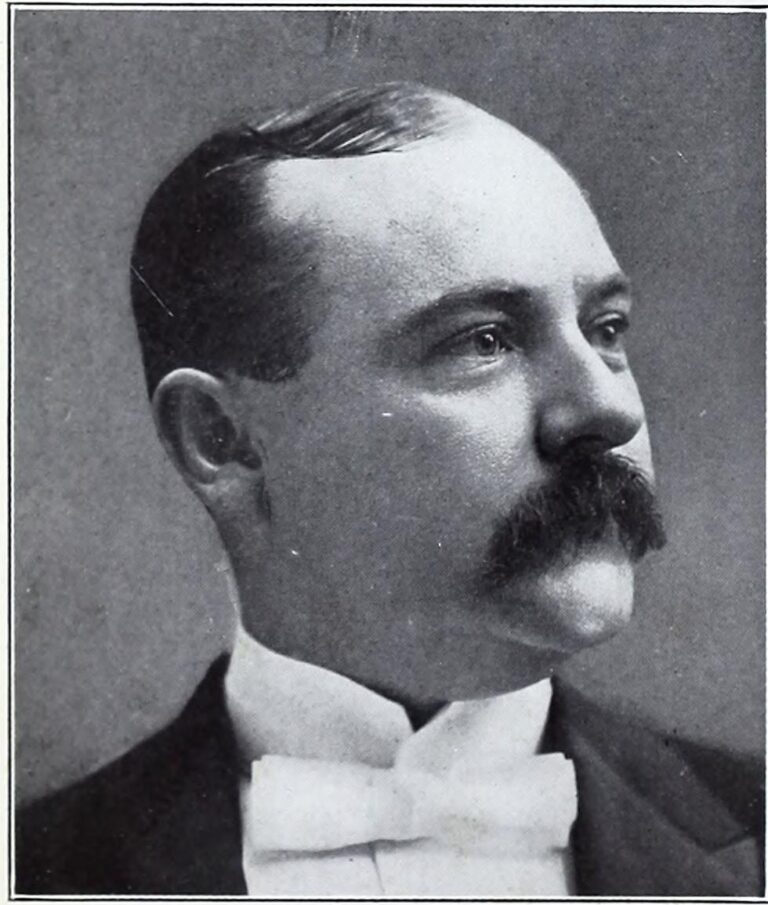


In February 1925, the Afro-American printed the names of the 68 midwinter graduates of Frederick Douglass High School, 46 girls and 22 young men. One name on that list belongs to a future Supreme Court justice: “Marshall, Thurgood.”

Thurgood Marshall, right there in the second column.
Douglass was the first public high school for Black students in Baltimore and in Maryland. It began in 1883, when the school board added two high school grades to a Black grammar school. By 1885 it was running as a separate Colored High School with its own principal.
Two grades on Holliday Street
Baltimore’s school board took over the city’s schools for Black children in 1867, but for years those schools offered nothing past the grammar grades. Black Baltimoreans pushed for a high school, and in 1882 the city authorized one.
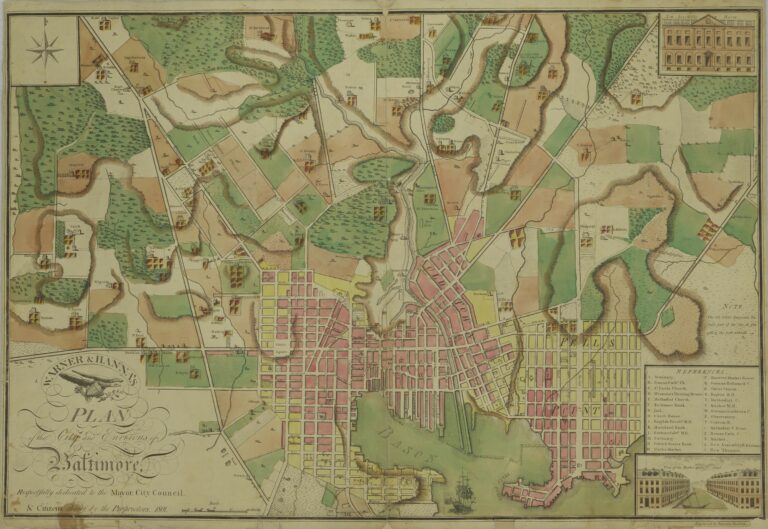
In 1883, rather than build a high school, the board added two upper grades to Colored Grammar School No. 1. That school was in the Peale building at 225 North Holliday Street.
Rembrandt Peale built it in 1814 as a museum, and it later served as Baltimore’s City Hall. In 1878 the city turned it over to the school commissioners for Male and Female Colored School No. 1.
According to the school’s National Register nomination, by 1885 the Colored High School was a separate unit inside the building. It had a principal and several assistants of its own. Its first class studied in the Peale building.
On Friday evening, June 21, 1889, those graduates received their diplomas at Ford’s Grand Opera House. The city’s 2013 landmark report says Mayor Latrobe presented them.
The New York Age’s Baltimore correspondent wrote that the house was thronged and gave credit to the principal, Dr. Staley, and his assistant, Miss Bessie Rice. He also reported that the graduates would be given teaching positions in a newly established public school, No. 9, in the northwest section of the city. That was what many Black Baltimoreans had wanted from a high school.

Saratoga Street, then Pennsylvania Avenue
Sources differ on whether the school left Holliday Street in 1888 or 1889. The 2013 landmark report, as reproduced by the school’s alumni association, describes a new building on Saratoga Street near Charles Street.
The report says it was built for a high school and grammar school of 1,200 students. That building no longer stands. The National Register nomination adds that a separate building went up for the advanced students in 1897.
In 1901 the high school moved again, to a former school at Pennsylvania Avenue and Dolphin Street, in the middle of a large Black community. The landmark report, in the alumni association’s reproduction, says its white principal and teachers were replaced by Black faculty that year.
The school also trained teachers. Coppin State University traces its origin to a teacher-training course the school board started at the Colored High and Training School in 1900. Classes began at Dolphin Street and Pennsylvania Avenue in January 1901, and in November 1909 that training school split off from the high school.
Mason A. Hawkins, himself a graduate, became principal in 1909 and stayed until 1934. Thirteen students graduated in 1901, and one of Hawkins’s last duties was presiding over a commencement for 209 seniors, according to the National Register nomination.
As enrollment grew, the Pennsylvania Avenue building could not hold it. By 1914, the landmark report says in the alumni association’s reproduction, classes had spilled into a portable, a rented house and a church.
The report quotes a 1923 letter to the school board from Dr. Howard E. Young. “No such pesthole as the Colored High School Building for white children would be tolerated for ten minutes,” he wrote.

A new school that sat empty
In 1921 the city bought the block bounded by Calhoun, Carey and Baker streets as the site of a new colored high school. It had been the home of the Maryland Industrial Training School for Girls. In 1923 the school took the name of Frederick Douglass, the abolitionist who was born enslaved in Maryland and escaped from Baltimore.
Spencer E. Sisco of the Baltimore firm Owens & Sisco designed a three-story brick building in the Collegiate Gothic style. It had limestone trim, battlements along the parapet and classrooms wrapped around a central auditorium. Parts of the old girls’ school were kept at the back as a shops building.
H. G. Perrin, the supervising engineer of the city’s Public Improvement Commission, put the total cost at $1,500,000. That included $227,000 for the ground and $1,200,000 for the main building. Perrin said the auditorium would seat 1,800 and the school would hold 2,300 pupils.
The finished building stood empty through the winter of Marshall’s graduation. Perrin told the Afro-American in March 1925 that it had been ready when it was turned over to the school board in December 1924.
But, he said, the board hadn’t asked for money to equip it. So students would wait until September 1925 in the old building, which had room for only 600.
Douglass moved in that September, according to the landmark report. It says the city gave the school number 450. That came from the 400 series used for white high schools, not the 100 series used for Black schools.
The school still carries No. 450. A Maryland Center for History and Culture photograph catalogs the Pennsylvania Avenue building as School No. 450-A, though, so the number may be older.
Students and graduates
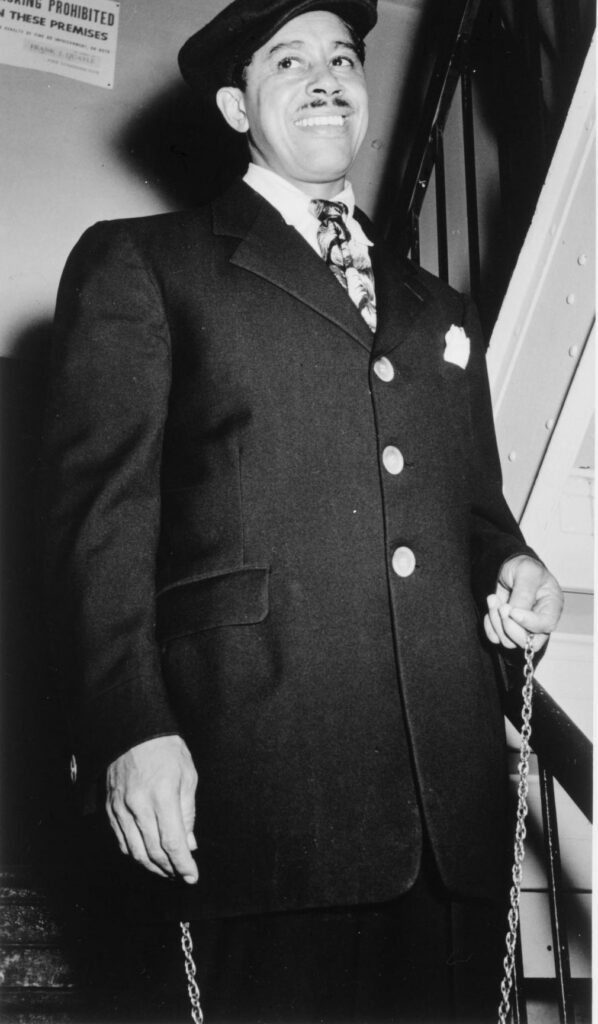
The National Register nomination includes a list of prominent students and graduates prepared by the office of historian Cynthia Neverdon-Morton of Coppin State. It names Cab Calloway, who attended from 1924 to 1927 and received his diploma in 1928. It also names attorney and civic leader Juanita Jackson Mitchell, class of 1927, Congressman Parren J. Mitchell, class of 1940, and jazz singer Ethel Ennis, class of 1950.
The same list gives 1925 as Marshall’s graduation year. City Schools’ 2026 renovation announcement says 1923, but the Afro’s list was printed the week of the ceremony, which makes it the stronger record.
Marshall became the NAACP’s chief counsel and won Brown v. Board of Education, the 1954 Supreme Court case against school segregation. After that he became the first Black justice of the Supreme Court.

A later generation added Kweisi Mfume, who graduated from Douglass in 1972 and went on to serve in Congress and lead the NAACP.
A swap made before Brown
By the early 1950s Douglass needed more room again. In November 1953, the Sun reported, the school board voted unanimously to move Western High School’s students out of their building on Gwynns Falls Parkway.
The building would be given over to Black students for high school purposes. Western would go to the old City College building at Howard and Centre streets.

That decision came six months before the Supreme Court ruled in Brown, and it was made inside a segregated system. Douglass moved into the Western building in September 1954, the same month Baltimore’s schools began to desegregate. The school board’s report for 1954 to 1956 says the building was remodeled for the Frederick Douglass Senior High School, with shops added.

The building at 2301 Gwynns Falls Parkway has been Douglass’s main home since 1954, with two breaks. From 1981 to 1984, students went back to Calhoun Street.
From 2024 to 2026, they used a swing space at 6900 Park Heights Avenue. That was during a $118 million renovation by City Schools, finished in August 2026.
A century after the Afro printed “Marshall, Thurgood” in that list of 68 graduates, the renovated Douglass had its ribbon cutting. City Schools’ announcement says Kweisi Mfume was there, and Cecilia Marshall, Thurgood Marshall’s granddaughter, spoke.
What stands at the old sites
Douglass has had a lot of addresses, starting with the Peale building on Holliday Street (1883). It moved to Saratoga Street (late 1880s), Pennsylvania Avenue and Dolphin Street (1901), Calhoun and Baker streets (1925) and Gwynns Falls Parkway (1954). It also went back to Calhoun Street from 1981 to 1984 and spent 2024 to 2026 on Park Heights Avenue.
The Calhoun Street building kept working after 1954. It housed Houston Junior High School and later Houston Woods Junior-Senior High School until 1981. Then it took in Douglass students again while the Gwynns Falls Parkway building was renovated.
By June 1988, when the building was photographed for its National Register nomination, it stood vacant, with its windows broken and its copper wiring stripped. It was listed on the National Register of Historic Places in 1989. That year the city sold it to a developer, and in 1991 it reopened as the Frederick Douglass Apartments at 1645 North Calhoun Street.
Alumni raised money in the 1990s to restore the auditorium as a cultural center, but the 2013 landmark report says that plan never came together. In 2013 the city made both of the school’s 20th-century buildings Baltimore City Landmarks, the old one on Calhoun Street and the current one on Gwynns Falls Parkway.
The Peale building on Holliday Street, where the first high school classes met, became the city’s municipal museum in 1931. It closed in the late 1990s and is now The Peale, which calls itself Baltimore’s community museum.
Marshall spent his last winter at Douglass in a building with room for only 600, while the finished one sat empty and unequipped. Twenty-nine years later, he won the case that began taking apart the segregated system that had put his class there.
Lost Baltimore stories, in your inbox.
The newest story, plus a few from the archive.
Free. Unsubscribe anytime.
We use AI to help research, write and edit stories across our sites. Here’s how we use AI.Suggest a correction