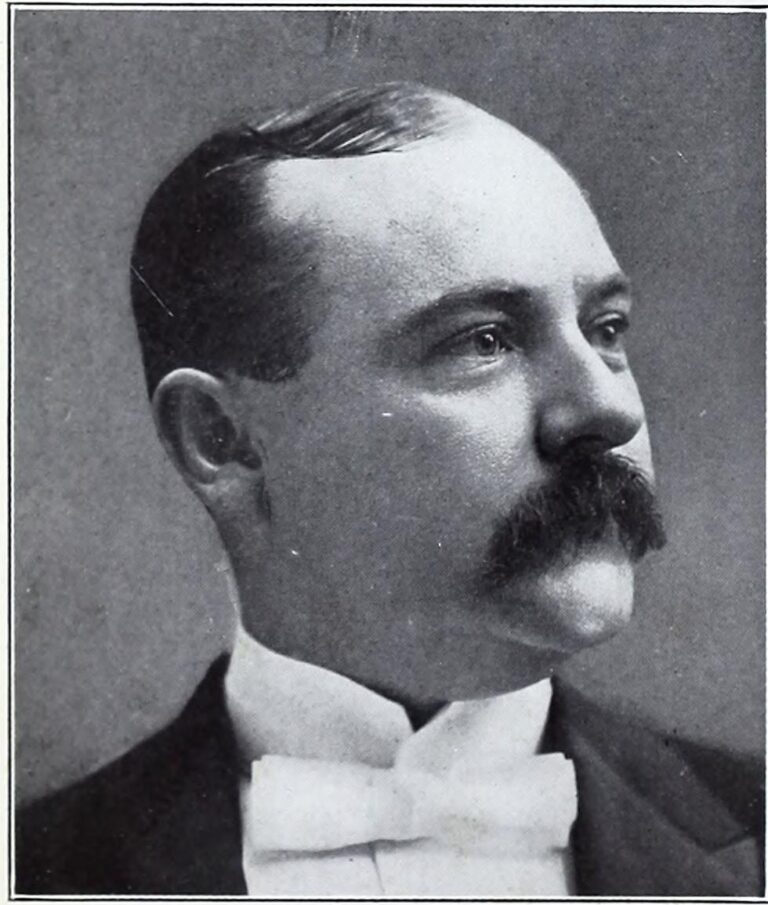

Henry B. Gilpin wanted a better view of Baltimore, and he was willing to climb a giant medicine bottle to get it.
In June 1911, The Sun reported that the president of the Gilpin Drug Company had climbed the steel framework of the bottle atop Emerson Tower. He had gone up a few days before the article appeared, while work was still underway. Getting to the top floor was the easy part. After that came a ladder to the bottle’s base, followed by a hand-and-foot climb up its steel strips.
Gilpin’s verdict was considerably more relaxed than that description makes the trip sound:
It was a dandy experience, and the view of the city was superb!
Take a look at the panorama below and you can understand the attraction. The Library of Congress dates it to around 1913, with Baltimore spread out in a complete circle from Emerson Tower. Gilpin’s climb was a separate adventure in 1911, but the photograph gives us a way to appreciate the view that drew him up there.

A bottle above the city
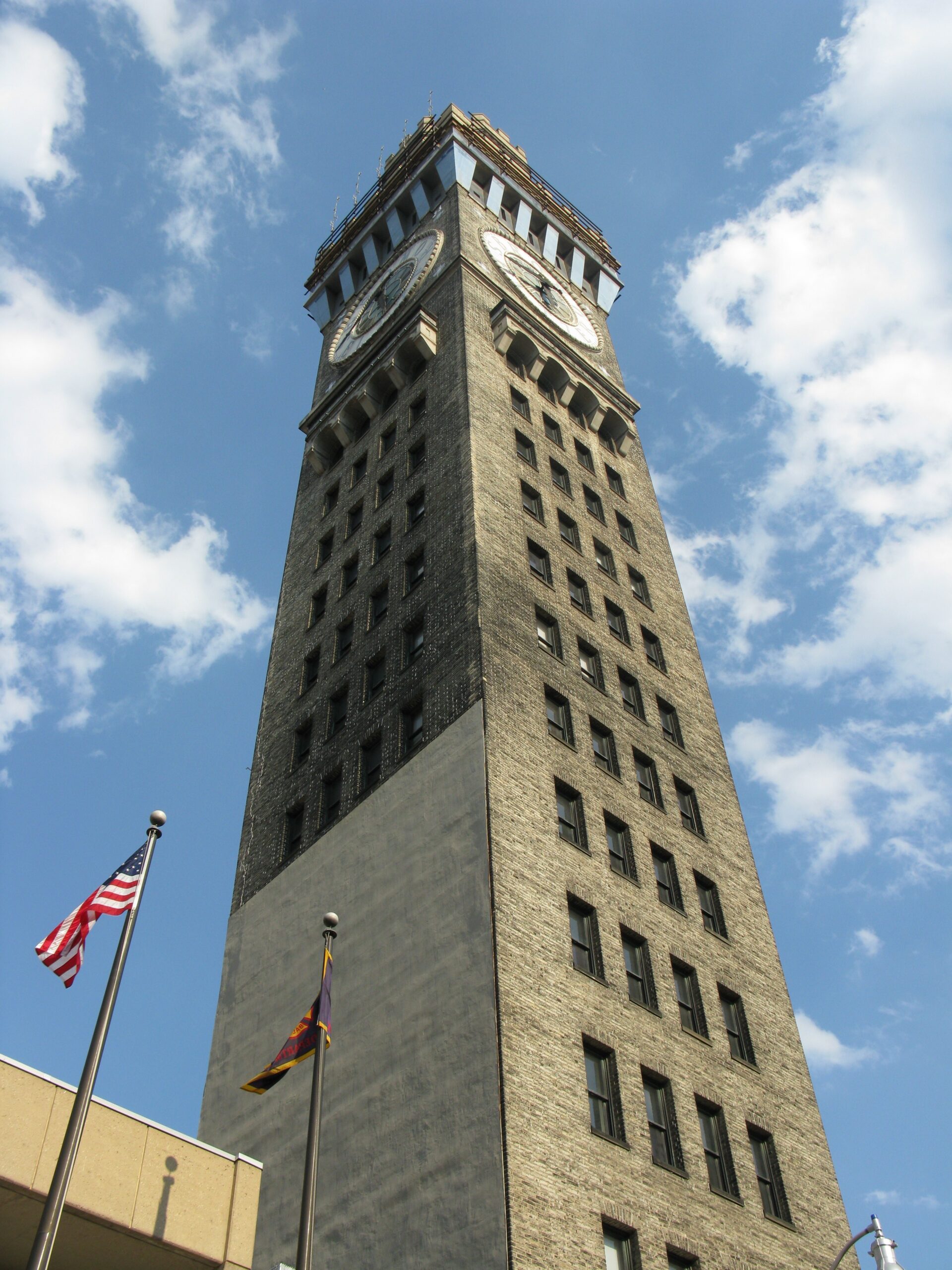
Emerson Tower went up in 1911 at Lombard and Eutaw streets. The Baltimore Museum of Industry identifies its namesake as Isaac Edward Emerson, the inventor of Bromo-Seltzer, a remedy marketed for headaches and indigestion. The museum also notes the tower’s familiar alternative name: the Bromo-Seltzer Tower.
The Emerson Drug Company’s own postcard shows what it wanted people to notice. There is the tower, there are the clock faces, and above them sits an enormous blue bottle with a crown on top. Down at street level, an illustrated streetcar looks tiny beside the building.
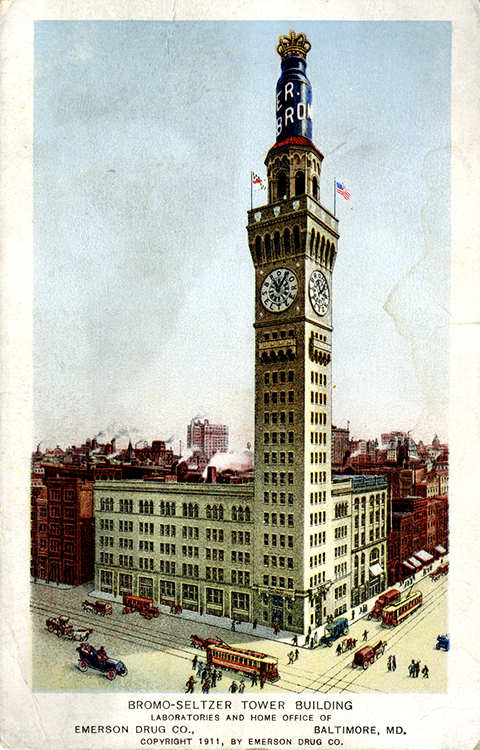
Gilpin apparently needed little encouragement to investigate. W. H. Powers, who was overseeing work on the tower, told The Sun that Gilpin approached him while Powers was watching the men working on the bottle. Powers agreed to accompany him and expected the difficult part of the ascent might change his mind.
Instead, Gilpin led the way. The newspaper reported that he had climbed ships’ masts before and did not consider this much of a risk. Powers’s description of the irregular steel strips makes it sound rather less reassuring.
The night the bottle lit up
The bottle got a different kind of attention in August 1911. On August 25, The Sun reported that it had been illuminated and revolving at the same time for the first time the previous evening.
The article follows the installation almost bulb by bulb. The lettering called for 314 incandescent lights. By five o’clock, the paper reported, all but two of the 314 bulbs were in place; both missing bulbs belonged to the letter M. Machinist Walter J. Whalen switched on the motor, with Samuel T. Williams, who had planned the structure, watching nearby.
According to the same report, the bottle made a complete revolution every half minute, driven by a three-horsepower motor. The lettering could advertise the remedy around the skyline while the bottle turned.
There was still work to do. The crown was due to receive another 240 lights, which the newspaper said would be added when it was completed. The first night’s display was still a work in progress.
Imagine being the person who had to replace a bulb in that M.
Settling a skyline argument
By July 1912, the tower was helping to keep the newspaper’s telephone operators busy. Baltimoreans were arguing about which building was tallest, and The Sun reported that callers wanted its information department to settle their bets.
The paper answered on July 28 with a ranked list. Emerson Tower came first, followed by the Maryland Casualty Tower.
The panorama lets us do our own looking. Streets cut through tightly packed rooftops, taller buildings rise above them, and water and railway tracks interrupt the blocks. It is easy to spend more time following those small details than looking at the skyline itself.
Newspaper readers had already seen a view from the tower in 1911. On May 15, 1911, The Sun published a photograph of the basin and its surroundings taken from the building by a member of its art department. The tower was already giving the paper a new place to put a camera.
The Library of Congress records a July 9, 1913 copyright deposit for the full-circle panorama. Its catalog names Frederick W. Mueller as the copyright claimant, which does not by itself establish who operated the camera. It also leaves us without an exact date for the exposure.
Compare this photograph with Spofford’s bird’s-eye view of Baltimore, published in 1912, or see the city at night from Emerson Tower in the 1920s.
The Baltimore Museum of Industry dates the bottle’s removal to 1936. The postcard preserves the view of that enormous advertisement from the street; the panorama lets us turn around and look at the city beneath it.
We use AI to help research, write and edit stories across our sites. Here’s how we use AI.Suggest a correction
On the AtlasNewSee where this happened21 S Eutaw St39.2877° N · 76.6206° W