

Rod Stewart was at Sotheby’s in New York on the night of November 2, 1999, and went home with one of Haussner’s paintings. Back in Baltimore, the founders’ daughter and the restaurant’s last owner, Francie Haussner George, listened to the results by phone.
“I thought it was great fun,” she told the Sun. “And Rod Stewart was there, waving his umbrella, whoever he is. Who is he?”
By the last gavel that night, the paintings that had hung over Baltimore’s sauerbraten and crab cakes had brought $10.1 million. That was at least $3 million more than Sotheby’s experts had estimated. For 73 years, Haussner’s in Highlandtown was where you went for hasenpfeffer and strawberry pie under gilt frames stacked to the ceiling.
A lunchroom on Eastern Avenue
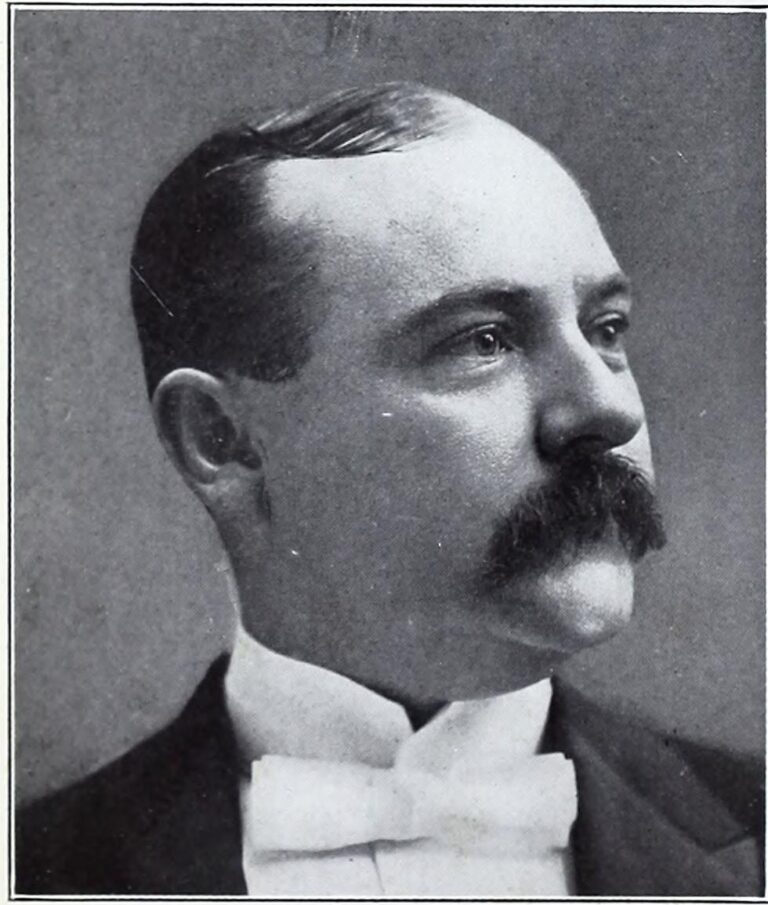
William Henry Haussner was born in Roth, Bavaria, near Nuremberg, in November 1894, according to his 1963 obituary in the Sun. He paid for his own training as a chef and restaurant manager in European establishments, the obituary said, “among them a rathskeller often frequented by the former Kaiser.”
Later accounts, including the Sun’s obituary of his wife, promoted him to cooking for Kaiser Wilhelm II himself. His own 1963 obituary never goes that far.
That obituary says he came to America in 1925 and worked a few months for a Reformed Mennonite family in Peoria, Illinois. Then he joined his brother Karl in Baltimore. (The City Review’s 1999 history of the collection gives 1926.)
In 1926 he opened a small lunchroom on Eastern Avenue. Hungarian goulash with spaetzle and red cabbage cost 40 cents there, and a two-pound charcoal-broiled sirloin went for $1.25, the Sun reported in 1999. His 1963 obituary called that first place little more than a “short-order house.”
Nobody quite agrees where that first lunchroom stood. The Sun put it across the street from the later restaurant, and one longtime customer remembered it in the 3300 block. By the late 1930s Haussner’s was on the corner of Eastern Avenue and Clinton Street.
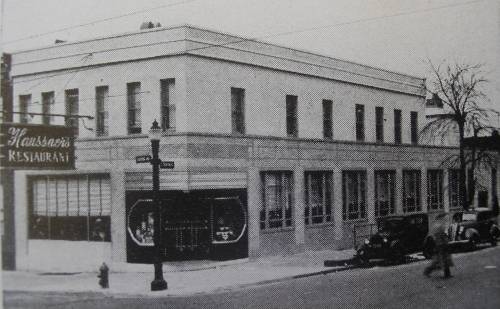
His customers were the first- and second-generation immigrant families of the East Baltimore rowhouses. In 1941 the restaurant even ran an Easter greeting in Baltimore’s Czech-language weekly Telegraf, and later a salute to Czechoslovak Independence Day. Both were signed simply “Haussner’s Restaurant, Eastern Ave. Clinton St.”
Frances
Frances Wilke was born on July 12, 1909, in Bontkirchen, a village in Westphalia. Franciscan nuns educated her at a convent school in Dusseldorf.
In 1924 she came to Baltimore to escape the economic depression in Germany after World War I, and she went to work with her brother. He ran Wilke’s Store, a grocery at Biddle and Eager streets.
She met William Haussner at a concert where she was singing. After what the Sun called “a whirlwind romance of three weeks,” they married in 1935, and from then on they ran the restaurant together. For years they lived in an apartment above it, until they bought a house in Guilford in the 1940s.
She was a hostess, oversaw the kitchen and worked days that ran as long as 18 hours. Oh, and the woman who presided over all that sauerbraten and ox tongue was a vegetarian.
She also raced Waco monoplanes in her younger years, until her husband insisted she stick to more earthly pursuits. “If I hadn’t had more guts than brains, I wouldn’t have had the life I had,” she once told the Sun.
In a 1976 interview she summed up the business this way:
“It takes endurance, courage and friendliness. Things have to be good and fresh, and you must be constantly on the alert.”
Art on every wall
The collecting started around 1940, though accounts differ on the exact year. The first painting was Eugene de Blaas’s The Venetian Flower Vendor.
According to Frances’s obituary, the couple bought it for $1,000 to mark a wedding anniversary. William’s 1963 obituary put the purchase on their fifth anniversary. It also said the picture came from the collection of the Yawkey family, owners of the Boston Red Sox.
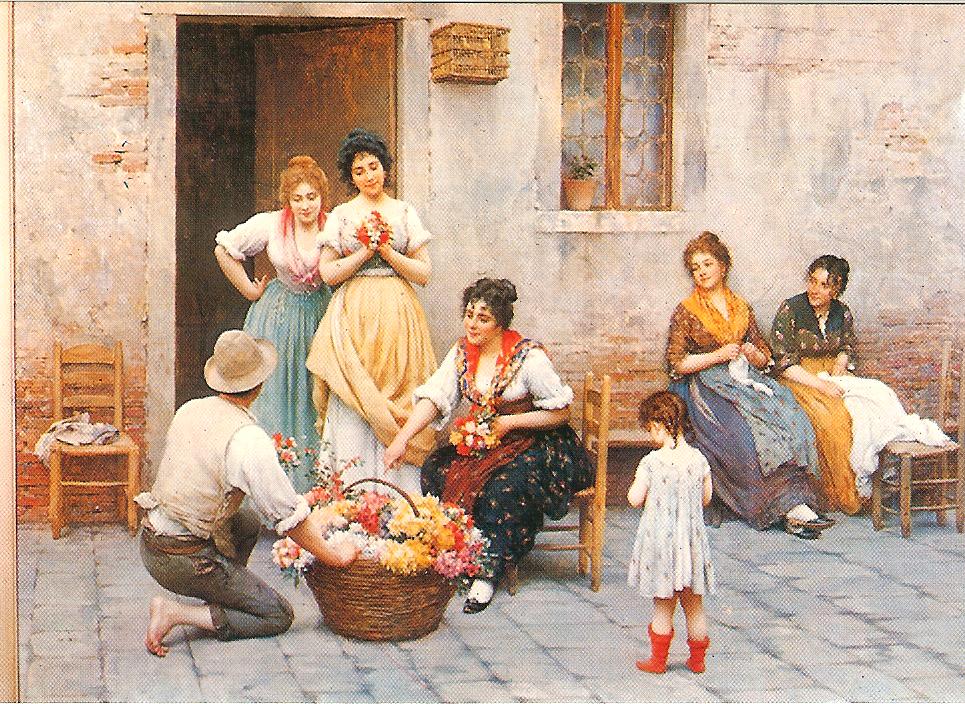
It was a good time to buy. As the Sun put it in 1996, they bought the oversized and “shamelessly old-fashioned” paintings whose value had collapsed in the late 1930s and 1940s.
The Haussners set aside $15,000 a year for art and kept buying until the last painting went up in 1963. The Sun reported in 1999 that no painting in the collection had cost them more than $3,200.
Their daughter said her mother bought from the estates and collections of the Walters family, Robert Ripley, John Ringling North, Evalyn Walsh McLean and August Belmont. The City Review added works from the estates of J.P. Morgan and the Vanderbilts. By 1999 the collection ran to roughly 780 paintings, plus sculpture, porcelain and bronzes.
The walls of the dining rooms filled up with Tyrolean villages, cardinals in red robes, Victorian children, dogs, cats, horses and cattle. A row of marble busts of the Roman emperors stared down at the diners. Buxom nudes decorated the stag bar, which didn’t admit women until the early 1970s.
“People used to laugh at my parents because they bought paintings that weren’t in fashion,” Francie George told the Sun in October 1999. Within days, the auction prices settled that argument.
Bonnie Bonnell, a painter who worked there as a waitress, told the Sun what it was like:
“You’re sitting there eating your sour beef and dumplings under a Van Dyck. You can reach out and touch it.”
The Sun added that the painting might not be a true Van Dyck.
The world’s largest painting
The strangest thing William Haussner ever bought never hung in his restaurant, at least not in one piece. It was also the one big exception to that $3,200 ceiling.
On July 30, 1952, he paid $3,400 at a storage company auction for the Pantheon de la Guerre. It was a panorama of World War I, painted in Paris during the war and billed as the largest painting in the world. It was 402 feet long and 45 feet high.
After the war it had been shipped to the United States and exhibited around the country. When the tour ended, it sat for years in storage. It was auctioned off to cover the unpaid storage bill, and he bought it sight unseen.
There was nowhere in Baltimore big enough to hang it, so in 1957 he gave it to the Liberty Memorial in Kansas City. That’s now the National World War I Museum and Memorial, which describes Haussner himself as a German veteran of World War I.
The Kansas City artist Daniel MacMorris cut the canvas apart and rearranged its figures around the American section. Then he fit the result to a wall of Memory Hall, where it was dedicated on November 11, 1959.
MacMorris sent some of the larger leftover sections back to Baltimore, and Haussner hung them in the restaurant. Diners who remember a room with life-size soldiers painted on the walls were most likely looking at pieces of it.
Sour beef, strawberry pie and the waitresses
William Haussner died at home on June 7, 1963, at 68, after a long illness. The Sun’s obituary counted H. L. Mencken among his old friends.
Frances kept running the restaurant. Over the 1970s she stepped back from the daily work, and Francie and her husband, Steve George, ran Haussner’s through its final decades.
The menu barely changed. By 1999 it still listed 112 entrees, among them sauerbraten with a Tyrolean dumpling for $11.95, baked rabbit and Smithfield ham. Over the years it also ran to ox tongue and even diamondback terrapin.
Everybody seemed to finish with the strawberry pie, its whipped cream towering in the pastry case. At its peak the restaurant served 1,600 meals on a Saturday, and the line of people waiting an hour stretched around the corner. As late as 1999 it was still serving 900 people on Saturdays.
The Sun called the waitresses “almost as much a Baltimore icon as the oil paintings.” They came from the neighborhood and wore crisp white uniforms.
They called their regulars “hon” and wheeled orders to the tables on carts draped in white napkins. Even their stations had names, and the one closest to the kitchen was “Georgia,” after Georgia Beck, who had 47 years in by 1999.
Annie Louise Barlow waited tables there for 43 years and polished her white shoes every night. Haussner’s had three servers named Louise, so she was “Louise Three.”
Dorothy E. Brown started out as a bus girl and stayed 59 years, ending up as the night cashier. “We had 400,000 customers a year and Dorothy knew 300,000 of them,” Francie George said.
In the kitchen, Walter Gilliam started making sandwiches in 1941 and rose to dishwasher, broilerman and chef. From 1952 to 1995 he went 43 years without missing a day. One dish on the menu, “Walter’s Fried Chicken,” was named for him.
The ball of string
Then there was the ball. The linen napkins came back from the laundry tied up in string. Instead of throwing it away, the staff tied the pieces together and wound them onto a ball.
Over the decades it grew to about four feet across and somewhere between 825 and 850 pounds, depending on who weighed in. How crazy is that? It sat downstairs, and its later owner said people still told him about childhood pictures of themselves sitting on top of it.
“It’s the right time”
In September 1999, the Georges announced that Haussner’s would close at the end of the month. Francie George said it was still busy on weekends and still profitable, and that her mother had approved the plan to sell the art.
“It’s the right time,” she told the Sun. “That’s something you can’t explain to anybody. It’s impossible to sum up 73 years in one sitting or more than one sitting.”
The staff was down to 95 from a peak of 210, and nearly a quarter of them had been there 20 years or longer. “We’re all going to feel like women without a country,” said Milly Aristidou, a waitress since February 21, 1957. “Life will never be the same without Haussner’s.”
The Georges donated the fully equipped building to the Baltimore International College, a culinary school. The last dinners were served in late September 1999. (A few later accounts give October 6, but the Sun’s reporting that fall put the closing in September.)
The farewell crowds got so big that the family cut the run short. On September 22, 1999, the Sun reported that people were waiting in three-hour lines for “a final forkful of strawberry pie.” The closing, it said, would come two days earlier than announced.
One rainy afternoon, 170 people stood in line around the corner of Eastern Avenue and Clinton Street. “I don’t want people’s last memory of Haussner’s to be a bad one,” Francie George told the paper.
The auctions
Sotheby’s sold seven Old Master paintings from the collection on October 14, 1999, for $451,950, nearly triple their estimates. Then came the big evening sale on November 2.
The top lot was Jean-Léon Gérôme’s After the Bath, three nudes in a white marble Turkish bath. It went for more than $1 million to a private collector from the Middle East. The Venetian Flower Vendor, the painting that started it all, brought $805,500.

Arthur John Elsley’s I’se Biggest!, a little girl and a big dog, sold for $673,500, a record for the artist. The Haussners’ granddaughter had nicknamed it “Izzie” as a child. Lawrence Alma-Tadema’s 1866 Entrance to a Roman Theater brought $640,500.
Rod Stewart bought Heinrich Heine and the Muse of Poetry by Georges Moreau de Tours, which the granddaughter had called “Dreamer,” for more than $100,000. That $10.1 million covered the November 2 evening sale alone, and a later Sun account put the New York sales at more than $11.3 million.
Sotheby’s offered about 130 more Haussner pieces, including furniture, porcelain and sculpture, on November 3. It offered Albert Bierstadt’s Lake Louise separately on December 1.
The leftovers went to Richard Opfer’s auction house in Timonium, starting that December. They ran from minor paintings and old menus to two sections of the Pantheon de la Guerre.
Opfer told Baltimore magazine in 2020 that more than 1,000 people lined up, and the magazine put the local sales at about $2 million more. Opfer planned to open his first sale with the ball of string.
“I knew it was going to be a good day when the ball of string sold for $8,000,” he recalled.
The buyer was Bob Gerber, owner of The Antique Man in Fells Point. “No way I was going to let it leave Baltimore,” he said.
Frances Haussner died on October 1, 2000, at 91.
What’s there now
The culinary school never reopened the building as a training center, and it later sold the property to a developer. The building sat empty for years through a couple of false starts.
Garver Development Group bought it in 2015, and the old Haussner’s came down in 2016. Today the corner is Highland Haus, a six-story building with 65 apartments over first-floor retail space at 3232 Eastern Avenue, which opened in 2017. The restaurant also turns up on television: Mad Men’s season three premiere, “Out of Town,” includes a scene set inside Haussner’s.
As for the ball of string, Gerber kept it for 26 years. After he closed his shop in 2025, it went to auction once more on November 22, 2025.
Ripley’s Believe It or Not! bought it for $2,000, the Banner reported, bound for its museum on the Ocean City boardwalk. That’s a quarter of what it brought in 1999.
Frances Haussner, remember, had bought paintings from Robert Ripley’s collection. Now Ripley’s owns Haussner’s ball of string, and it’s staying in Maryland.
Lost Baltimore stories, in your inbox.
The newest story, plus a few from the archive.
Free. Unsubscribe anytime.
We use AI to help research, write and edit stories across our sites. Here’s how we use AI.Suggest a correction