

The towers of the old Wiessner Brewery on North Gay Street were more than decoration: brewing requirements helped determine the building’s height.
William Edmund Barrett photographed the brewhouse in 1973, when it was known as the American Brewery, for the Historic American Engineering Record.
A brewery built to work
John Frederick Wiessner established his brewery in 1863. The much more elaborate brewhouse followed in 1887, replacing the smaller building on the same site. That is the building in the photograph, in the 1700 block of North Gay Street.
The National Register nomination, prepared in 1972, makes an interesting distinction about its design. Brewing requirements determined the building’s height and the arrangement of its interior, while the exterior gave the builders room to express themselves. You can see the result in the assortment of round and arched windows and the towers rising above the main roof.
And the showpiece was only part of the operation. The Historic American Engineering Record describes a complex spreading across both sides of Gay Street, with a boiler house, an engine room, bottling houses, offices, and a cooperage shop where barrels were made or repaired. There were storage cellars below ground, too.

From Wiessner to American Brewery
Prohibition interrupted the Wiessner operation. The 1972 nomination records an unsuccessful attempt to make near-beer, a low-alcohol substitute, before the American Malt Company took over in 1931. The building became known as the American Brewery.
By 1972, the nomination described beer still being made there, listing brands including Heibrau, Keg, American, and Arrow. Production ended in 1973.
In her 1983 engineering record, historian Monica E. Hawley described a building where most of the equipment had been removed, although some large vats remained. The report noted that a municipal use was being considered.
A new job for the old brewhouse
Humanim moved into the restored building in April 2009. The nonprofit brought employment programs and support services into a place that had spent decades without its original work.
The rehabilitation kept more than the exterior. The National Park Service’s account describes the grain silo in the central tower being cleaned and retained, along with brewing tanks adapted for the building’s new use. Historic photographs helped guide the replacement windows.
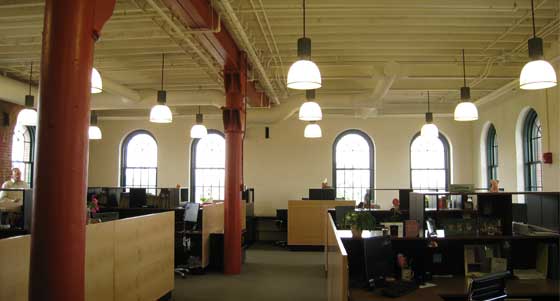
In a 2014 Baltimore Sun story republished by Humanim, Jacques Kelly described former grain-silo and fermenting-tank spaces being used for workshops. He also reported on job training and the building’s role as a meeting place for community groups.
For another look at Baltimore brewing history, see this 1944 National Brewing Company advertisement.
Lost Baltimore stories, in your inbox.
The newest story, plus a few from the archive.
Free. Unsubscribe anytime.
We use AI to help research, write and edit stories across our sites. Here’s how we use AI.Suggest a correction