
Ghosts of BaltimoreThe lost and untold stories of Baltimore

Try an address, a neighborhood, a name or a year, like “Fells Point” or “1904.”

Not sure where to start?
Topic

Photography

141 stories
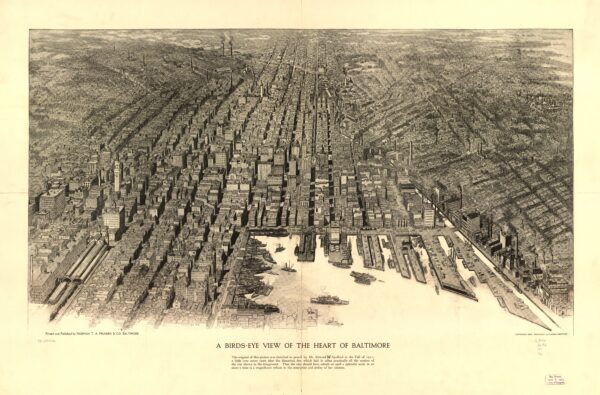
A detailed bird’s-eye drawing of Baltimore with harbor piers and boats in the foreground and downtown streets extending into the distance.
Baltimore Rebuilt, Seen From Above in 19124 min readBest Of

Seven years after the fire, Baltimore’s skyline concealed repaired skyscrapers, an interrupted Custom House and a reshaped waterfront.

Men in baggy clown suits stand in front of a giant spotted balloon wearing a flowered hat, with more handlers and balloons lined up behind them under bare trees
Toytown Parade: How Vacuum Cleaners Saved Baltimore’s First Toytown Parade7 min read

In 1936 the balloons got lost in a snowstorm. Here’s how vacuum cleaners saved Baltimore’s Toytown Parade, which marched most Thanksgivings for 30 years.

AI-colorized photograph of three-year-old Alma standing barefoot beside her seated mother and a wooden washtub in Biloxi, Mississippi, 1911.
Shipped South to Shuck Oysters: Lewis Hine’s Baltimore Children on the Gulf Coast8 min read

Lewis Hine’s caption says Bessie, 4, and Marietta, 7, shucked oysters in a Biloxi cannery in 1911. In 1900, their family lived on North Front Street in Baltimore.

Workers laying streetcar tracks at Howard and Saratoga streets, looking north, June 23, 1914.
Laying Streetcar Tracks at Howard and Saratoga in 19141 min read

Track work filled Howard and Saratoga in June 1914. That spring, United Railways announced plans to put concrete beneath its track ties while keeping streetcars running.
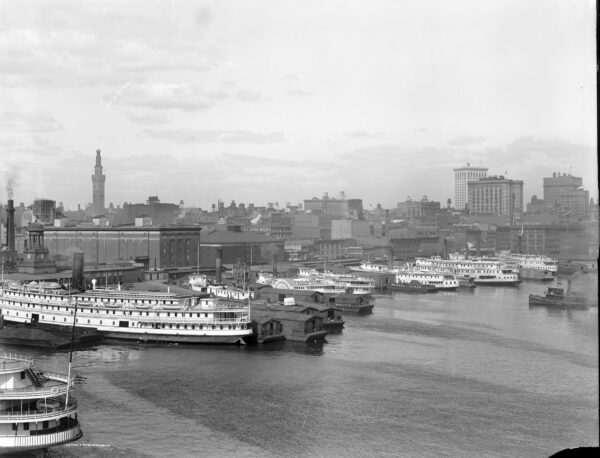
Rows of white Chesapeake Bay steamboats tied up along the Baltimore harbor, with the Emerson Bromo-Seltzer Tower and downtown buildings behind
Before Harborplace: The Light Street Wharves and the Working Basin8 min read

Before Harborplace, Bay boats tied up three or four deep on Pratt Street, and a 1,500-pound hog came off a Norfolk steamer at Light Street.

The Email

Lost Baltimore stories, in your inbox.

The newest story, plus a few from the archive.

Free. Unsubscribe anytime.

Baltimore Row Houses in April 19391 min read

Photographs from April 1939 show row houses in Baltimore.

Guilford, Fayette and Howard Streets in the 1940s1 min read

Two photographs show Guilford and Fayette streets and a view along Howard Street in the 1940s.

Ship painters gathered on a truck at Bethlehem-Fairfield shipyard in May 1943
Shipyard Painters at Bethlehem-Fairfield, 19431 min read

Arthur S. Siegel photographed these Baltimore shipyard painters in May 1943, as Bethlehem-Fairfield rapidly expanded Liberty ship production.

Gutted brick walls and heaps of rubble left by the Great Baltimore Fire, with surviving buildings behind them
The Great Baltimore Fire of 1904, From the Hurst Building to Jones Falls12 min read

How the Great Baltimore Fire of 1904 outran Washington’s engines and the city’s dynamite, and how Baltimore rebuilt 140 burned acres with wider streets and new sewers.

View of the corner of Baltimore and Liberty Streets. It was named McLane Place for Robert McClane, who was mayor of Baltimore at the time of great 1904 fire, and subsequently committed suicide. The name change did not last, and the location is now the crossing of Baltimore and Liberty Streets again. The monument to the left is that of John Mifflin Hood (1843-1906), a lieutenant in the Confederate Army, later president of Western Maryland Railroad (1874-1902). The sculpture was relocated to Preston Gardens in 1963. The store on the right is Baltimore Bargain House (later American Wholesale Corporation), a firm established by Jacob Epstein (1864-1945). Also in view is an early billboard advertisement boasting, "Pays to advertise with electric signs. Get yours now."
McLane Place on a 1914 Baltimore Postcard1 min read

A 1914 postcard shows Baltimore and Liberty streets when the intersection was known as McLane Place.

Dockworkers gathered beside a waterfront building, with the steamship Bodo and horse-drawn wagons behind them.
Payday on Baltimore’s Waterfront1 min read

Dockworkers gather beside a small waterfront building while the steamship Bodo and horse-drawn wagons fill this Baltimore photograph, copyrighted in 1905.
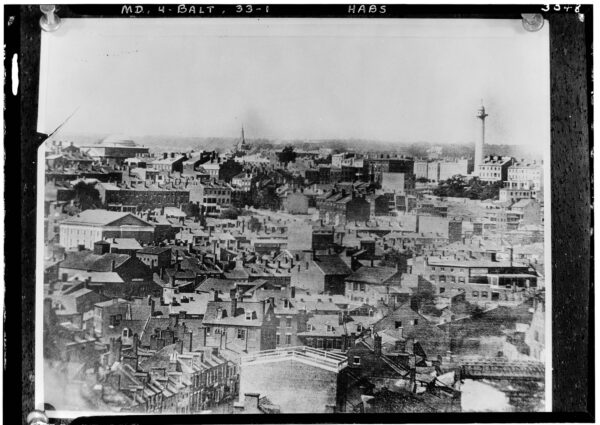
Baltimore rooftops and chimneys with the Washington Monument rising at the right and church towers in the distance.
The Washington Monument Above a City of Rooftops1 min readBest Of

An old panorama places Baltimore’s Washington Monument above a dense patchwork of roofs and chimneys. The column and the churches around it give the view some familiar landmarks.
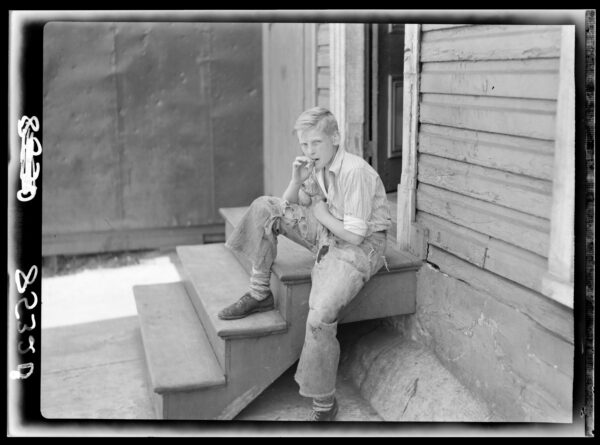
A boy smoking a cigarette while seated on wooden steps beside an open doorway.
A Boy on the Steps, Baltimore in 19381 min readBest Of

John Vachon’s July 1938 portrait catches a Baltimore boy smoking on wooden steps. The original negative and Jordan J. Lloyd’s later colorization show how differently the same moment can be presented.

Discarded tires cover a muddy harbor shore, with boats and industrial structures beyond the water.
The Tires Along the Middle Branch, January 19731 min readBest Of

Jim Pickerell’s 1973 photograph shows a tire-strewn shore along Baltimore’s Middle Branch. It was part of DOCUMERICA, the EPA’s effort to record the environment and everyday American life.

Baltimore from the sky in 1932
Baltimore from the Air on July 7, 19321 min read

An aerial photograph records Baltimore on July 7, 1932.

Glover Street, 500 Block South, ca. 1930.
South Glover Street Around 19301 min read

A photograph looks down the 500 block of South Glover Street around 1930.

St. Mary's Seminary, Mother Seton's House, 600 North Paca Street, Baltimore (1936)
Mother Seton’s House Covered in Ivy, 19361 min read

Ivy covers Mother Seton’s House at 600 North Paca Street in this 1936 photograph.

1426-1446 East Baltimore Street (Commercial Buildings), Baltimore, Independent City, MD
The Buildings at 1426–1446 East Baltimore Street1 min read

These photographs record commercial buildings in the 1400 block of East Baltimore Street.

Bernard J. "Boompy" Logue of 2527 E. Monument St. in Baltimore, MD, about 1920, on his home made bicycle.
Bernard Logue’s Homemade Bicycle and a Family Trade2 min read

A photograph of Bernard Logue on a homemade bicycle leads to a 1984 newspaper account of his family’s Baltimore bicycle shops.

Baltimore Shipyard Workers on a Break in 19432 min read

Arthur Siegel photographed Bethlehem-Fairfield shipyard workers during lunch or a rest period in May 1943.

More storiesShowing 20 of 141