

On October 4, 1991, six months before the new ballpark opened, the Sun’s front page settled what to call it. The headline gave the name, Oriole Park at Camden Yards. It said Governor William Donald Schaefer and Orioles owner Eli Jacobs had managed to “finally hash out a compromise.”
The story inside, by Mark Hyman, explained the compromise. Schaefer announced the name on his weekly WBAL radio show the afternoon before, after a weekend meeting with Jacobs.
According to the Sun, the name the governor liked most had apparently been plain Camden Yards, while Jacobs “reportedly favored Oriole Park.” For most of the talks, the paper said, those were the only two names on the table.
“It’s getting to be ridiculous. Let’s get this over with,” Schaefer said he told Jacobs.
“We named it Oriole Park at Camden Yards. That’s it,” he went on. So they used both.
The Camden half of that name came from a train station. Edward Gunts of the Sun called Camden Station “the historic train depot from which Camden Yards draws its name.” The Baltimore and Ohio Railroad opened it on Camden Street in 1857.
The B&O’s headquarters on Camden Street
On February 11, 1857, the B&O’s board of directors held its monthly meeting in a building that wasn’t quite finished. The Sun described it the next morning as the center section of the new Camden Station, begun about a year earlier. It was 60 feet wide on Camden Street, 72 feet deep and about 65 feet high, in what the paper called the Italian bracketed style.
This tower merits special attention, from its very beautiful proportions and its fine effect. … The tower will contain a plain and substantial clock to show the “railroad time” at all seasons, and besides its other uses will serve as a guide post to enquiring travellers, as it may be seen from various points on Baltimore and other distant streets of the city.
The Sun put that tower at 185 feet from the pavement. The building held the railroad’s offices too, from the ticket and freight agents on the first floor to the president and the boardroom on the second. The paper noted that in the railroad’s 30 years, the company’s officers had never all worked under one roof.
Who designed it is an open question. The 1857 Sun named the architect as Joseph F. Kemp of the B&O’s road department. Later Sun histories, in 1975, 1991 and 1992, credit the firm of Niernsee and Neilson.

Michael S. Franch, writing in the Sun in 1975, said the station opened with only its center section because the railroad scaled back its plans. Wings with three-story towers about 80 feet tall were finished by 1865.
Cracks showed up in the central tower in 1867. Franch and Gunts both wrote that the top of the spire was taken down and replaced with a shorter cupola.
Lincoln at Camden Station
In 1861 no rail line ran through Baltimore. Trains from Philadelphia ended at the Philadelphia, Wilmington and Baltimore’s President Street Station in East Baltimore, and trains for Washington left from Camden Station, across downtown. Cars were drawn between the two by horses, over tracks on Pratt Street.
That transfer lay on President-elect Abraham Lincoln’s route to his inauguration. Warned of a plot, he left Harrisburg early.
As the Sun reported on February 25, 1861, he took the sleeping car of the 11 P.M. train from Philadelphia. He passed through Baltimore about four o’clock on Saturday morning, February 23. Franch counted that secret ride among the famous passages through Camden Station.
Baltimore didn’t know about it until it was over. That afternoon crowds jammed the Northern Central’s Calvert Street Station expecting Lincoln and got his family instead.
The Sun reported that Mary Lincoln and the rest of the party went on to Camden Station. Their trunks were carted through the streets to meet the Washington train.
April 19, 1861: the 6th Massachusetts fights its way to Camden Station
Two months later the same transfer ended in bloodshed. On the morning of April 19, 1861, the 6th Massachusetts Regiment, answering Lincoln’s call for troops, reached President Street Station on its way to Washington.
The plan was to haul the soldiers in their cars along Pratt Street toward Camden Station. The station stood a short way south of Pratt at Howard and Camden streets. The pro-Southern Daily Exchange reported that nine cars got through, jeered but untouched.
Then a crowd blocked the tracks with sand and with anchors dragged from the wharves. The remaining companies had to get out and march along Pratt Street toward the station.
What followed, in Franch’s words, was an exchange of paving stones and bullets. The Exchange said the soldiers ran the last stretch down Howard Street and jumped into the waiting cars at Camden Station. Their train pulled out about a quarter to one, the paper said, and was stoned as it left the city.
The Exchange’s list of casualties the next morning came to eleven citizens and three soldiers killed, with nine soldiers and three citizens wounded. Later counts ran higher, and Franch, writing in 1975, put the dead at no fewer than 16.
Camden Station saw Lincoln one last time on April 21, 1865, when his funeral train arrived there from Washington. The Evening Star reported that people of every age, white and black, had gathered around the draped depot since dawn.
July 1877: the 6th Maryland and the fire at Camden Station
The station’s next crisis came in the Great Railroad Strike of 1877. On July 20, Governor John Lee Carroll ordered Maryland National Guard units to Cumberland, where B&O workers were on strike. Their train was to leave from Camden Station.
Franch described what happened as the troops tried to reach it. The 6th Maryland Regiment fought its way from its armory at Front and Fayette streets, leaving dead and wounded behind. The 5th Regiment was attacked as it turned into Camden Street.
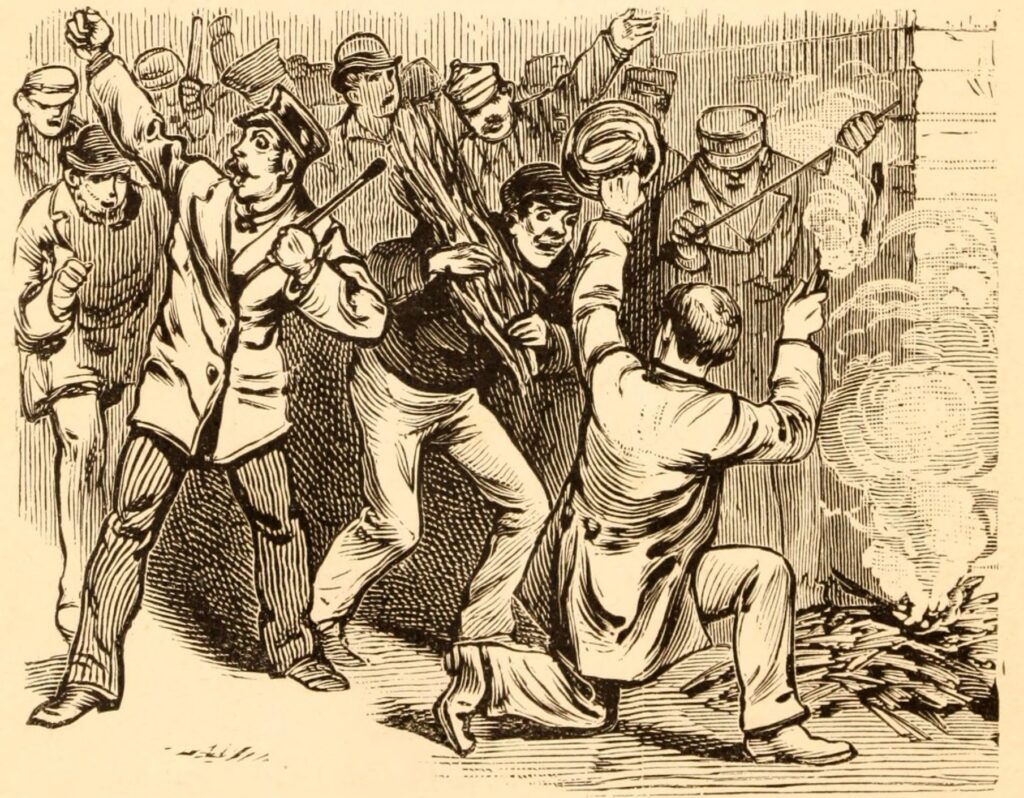
Rioters, Franch wrote, drove off the train crew, disabled the locomotive and set railroad cars on fire. Carroll was at the station. The Sun printed the telegram he sent President Rutherford B. Hayes, datelined Camden Station, July 20.
An assemblage of rioters that cannot be dispersed by any force at my command has taken possession of the Baltimore and Ohio Railroad depot here, set fire to the same, and have driven off all the firemen who attempted to extinguish the same, and it is impossible, with the force at my command, to disperse the rioters.
Franch wrote that the main building was only slightly damaged, but that the dispatcher’s office and several train sheds were destroyed. By his count, at least 9 civilians were dead and 26 soldiers wounded.
Losing the through trains
In 1896 the B&O opened a second Baltimore station, Mount Royal, along with the Howard Street tunnel, which let its through trains pass beneath Camden. Franch dated Camden’s loss of its leading role to that change, though it stayed the line’s busiest Baltimore terminal.
Parts of the building came off over the years. According to Franch, the last side-tower cupola was gone by the mid-1930s. In 1951, he wrote, the central cupola, the top floor of the remaining tower and the old train shed were removed.


The federal Historic American Engineering Record photographed the station and yards in 1970. Its pictures show a towerless center block, a big waiting room with wooden benches, and a yard full of tracks. By 1975 Franch counted only four morning and four late afternoon commuter trains.

Trains kept stopping at Camden even after the old building stopped serving them. The Sun reported in 1992 that the depot last served train passengers in the mid-1980s.
Gunts wrote in 1991 that Camden was “used only as a boarding point for passengers of the MARC commuter train line.” The building’s interior and exterior, he wrote, were “in advanced states of disrepair.”
The warehouse
The other survivor of the rail yard is the long brick warehouse along Eutaw Street. Gunts wrote in 1991 that it was designed by the firm of Baldwin and Pennington and built from 1898 to 1905. It is really six warehouses joined end to end, he explained, 51 feet wide and 1,116 feet long.
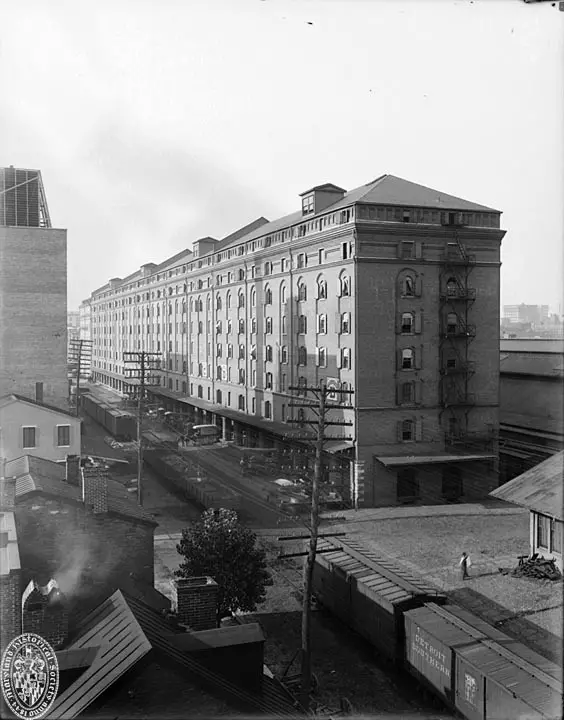
The warehouse was tied to the station itself. In 1898, Gunts wrote, the station’s west end was torn down and replaced by an office building that linked the depot to the warehouse. That connector came down in 1990, at the Maryland Stadium Authority’s request, to open a path for pedestrians between the stadium and the warehouse.

The plan before the ballpark
Before the ballpark there was a very different plan for Camden Yards. At a City Hall news conference in 1979, developers unveiled a $170 million project for 22 acres around the station, most of it B&O land. It called for up to 700 homes, a 500-room hotel, more than a million square feet of offices, shops and parking for 3,100 cars.
On October 9, 1984, Gunts reported in the Sun that the project had been abandoned and the 127-year-old station put up for sale. CSX Resources had been developing the land with the Oliver T. Carr Company of Washington. The Sun said CSX Resources managed real estate development for the B&O’s parent company.

The developers pointed to “changing market conditions” and to the city’s decision to take part of the site for expansion of the Convention Center. “When the city took its action on behalf of the Convention Center, it ripped the heart out of our plan,” Carr’s project manager, W. P. Dinsmoor White, told the Sun.
Choosing Camden Yards for the ballpark
On December 4, 1986, the Sun’s Sandy Banisky reported on the stadium site. The Maryland Stadium Authority, she wrote, was expected to recommend an 85-acre tract at Camden Yards for a baseball and football complex.
The paper called it the long-preferred site of Mayor Schaefer. Schaefer, by then governor-elect, said the choice would only confirm “what I’ve known for years.”
The Sun later counted 27 businesses and 102 properties acquired for the site. They included the Parks Sausage plant on West Hamburg Street and a doughnut bakery that turned out 7,000 doughnuts a day.
Construction began in 1989. Gunts wrote in 1991 that the architects, led by Joseph Spear of HOK, designed the stadium with a curving shell. It “never really butts up against the warehouse but is separated from it by a distance of 60 feet,” the width of Eutaw Street.

The ballpark opened with an exhibition game against the New York Mets on April 3, 1992, before 31,286 fans. Opening Day was Monday, April 6.
Schaefer cut a bright orange ribbon held by the construction workers. President George H. W. Bush threw out the first pitch, a one-hop curveball that catcher Chris Hoiles had to trap.
The Associated Press called it a $106.5 million ballpark and singled out the old B&O warehouse that hovers over the right-field wall. In a sold-out park, the Orioles beat the Cleveland Indians 2-0. Archaeologists had found the remains of a saloon run by Babe Ruth’s father under that field in 1990, a story we tell in Babe Ruth’s Baltimore.
The station that gave the park its name
The station got a new face for the ballpark. Gunts reported in April 1991 that restoration architects Cho, Wilks & Benn planned to take it back to its 1867 appearance, towers and all.
“It’s a folly,” Architectural Review Board member Phoebe B. Stanton said. Folly or not, the tower went back up. A Sun retrospective in 2016 described the result as a return to the station’s 1905 appearance instead.
The $2.2 million exterior restoration was finished in time for Opening Day, down to a re-created 185-foot clock tower. The building later housed the Sports Legends Museum, which closed in 2015, and Geppi’s Entertainment Museum. Geppi’s closed on June 3, 2018, days after Steve Geppi announced he was giving his comics collection to the Library of Congress.
In September 2019 the state opened a new $7 million Camden Station a block south of the old depot. It serves MARC commuter trains to Washington and the Light RailLink. It replaced a temporary station that had opened in 1992.
The trains moved down the block, but the old depot still stands at the head of the yards with its tower back on top. That’s the Camden in Oriole Park at Camden Yards.
Lost Baltimore stories, in your inbox.
The newest story, plus a few from the archive.
Free. Unsubscribe anytime.
We use AI to help research, write and edit stories across our sites. Here’s how we use AI.Suggest a correction


