

At 6 a.m. on Thanksgiving morning in 1936, Ben Lewis Posen had a parade scheduled for 9:30 and many of his balloons were missing. The trucks carrying them had left Binghamton, New York, the day before and gotten lost in a snowstorm.
So Posen, the advertising manager at Hochschild, Kohn & Co., came up with a plan that saved Baltimore’s Toytown Parade before it ever started. It involved the store’s housewares.
That’s the story Posen wrote for the Sun‘s Sunday magazine on November 22, 1964, and it’s a great one. The parade it rescued went on to fill Baltimore’s streets most Thanksgivings for three decades, with giant rubber monsters, clowns, bands and Santa Claus himself rolling down to Howard and Lexington.
A Macy’s man on Howard Street
Posen came to Baltimore by way of New York. He’d graduated from New York University in 1925 and worked for Macy’s for a while, then Abraham & Straus in Brooklyn. Hochschild Kohn hired him as advertising manager in 1934.
Macy’s, his old employer, had been marching on Thanksgiving since 1924. Posen liked the idea of a Baltimore parade, but the cost kept piling up. As he recalled, Goodyear made most of the big inflated figures back then, out of tough rubberized cloth, and they weren’t cheap.
Some of the balloons, which were as much as 16 feet high and 160 feet long, would cost up to $15,000 or even more at today’s prices. Even the comparatively small figures cost several hundred dollars each.
That’s 1964 dollars he’s talking about. He figured he’d need 20 or 30 of them, plus a few new ones every year to keep things fresh. In his words, “the parade idea began to run into a lot of money.”
Then, in February or March of 1936, a man named Jean Gros came to see him from Pittsburgh. Gros had inflated parade figures to rent, along with costumes and floats. Posen “jumped at the chance,” got a parade permit, hired musicians and set the start for 9:30 a.m. on Thanksgiving Day, November 26, 1936.
Lost in the snow
Here’s the catch. Many of the figures Posen rented were marching in a parade in Binghamton, New York, the day before. Workmen were supposed to deflate them right afterward, load them into vans and have them in Baltimore by 5 p.m. Wednesday.
You can guess what happened next.
A snowstorm in New York State changed those plans. The truck drivers got lost in the snow and, in several hours of driving, made a complete circle that took them back to Binghamton instead of Baltimore.
By 6 a.m. Thursday there was still no sign of them. Posen called the State Police in Maryland, Pennsylvania and New York, and nobody knew a thing. Betting that the vans would still show up, he called the store’s maintenance official, who was running the parade.
I told him to round up all the vacuum cleaners he could find and bring them out to the parade’s starting point. He must have taken display models right off the floor, because he came around right away with about fifteen or twenty of them, several extension cords and a crew of porters.
The trucks finally rolled in at 7 a.m. The crews pumped up the figures with their air compressors, and Hochschild Kohn’s vacuum cleaners did the rest.
We would just take the bag off a vacuum and attach a nozzle of a balloon to the outlet of the cleaner’s air compressor. We put a vacuum cleaner or two on each figure to be inflated, and pretty soon our parade began to look like a parade.
Meanwhile, store volunteers handed out costumes and painted clown makeup on the 100 boys who showed up at 8 a.m. to pull the balloons. The parade stepped off at exactly 9:30, right on schedule.
Posen said that first one was the only parade that ever gave them real trouble. James F. Burnside of the store’s display department took charge in 1938, and he was still running it in 1964.
“The more the children loved them”
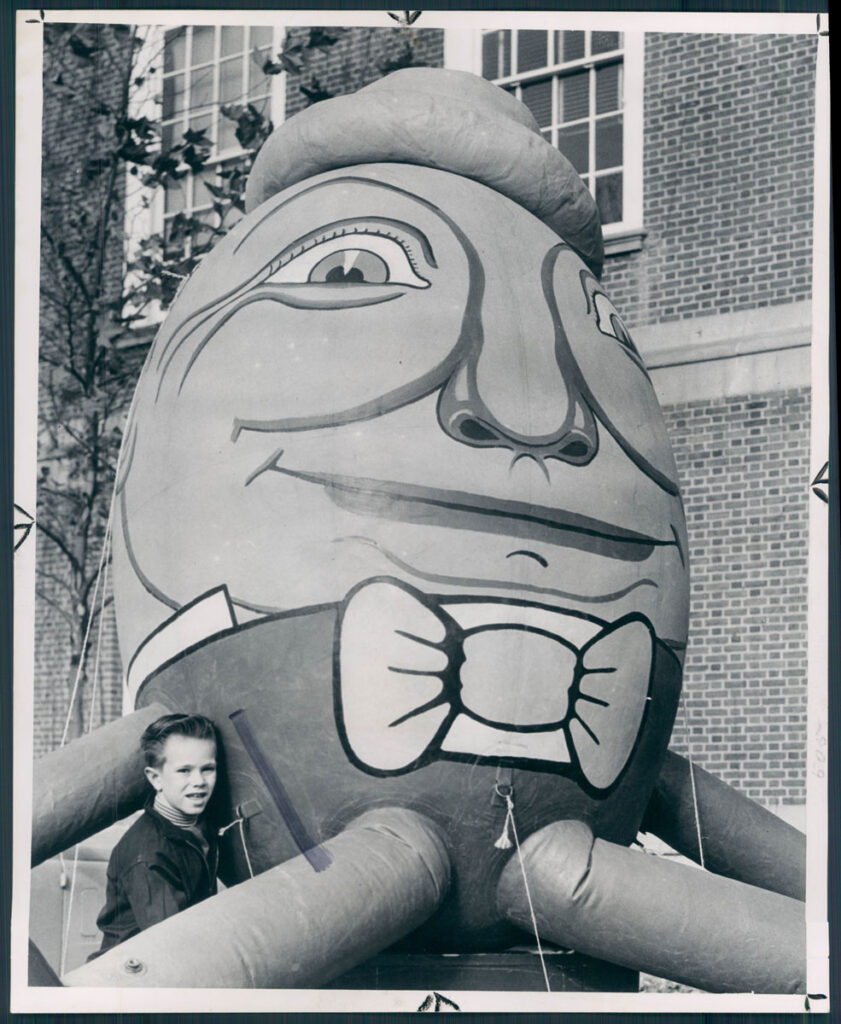
Take a look at the photos the Sun saved from those years and you’ll see that these weren’t cute little balloons. They were monsters, with horns, teeth and googly eyes. Posen admitted the store worried about that at first.
We were somewhat concerned at first with the immensity of some of the inflated figures, and their fierce appearance. We were afraid some small children might be frightened, but we found out right away that the bigger and more ferocious the beasts looked the more the children loved them.

Every year had a theme, but the Toytown feel stayed the same. One year it was fairy tales. Other years it was Mother Goose, or Alice in Wonderland.
The parade went to war, too. In 1942 it had a patriotic theme and helped sell War Bonds. Santa rode in a jeep that year, and Posen wrote that he “was not to be seen again until 1946.”
Following the parade route
Most years, according to a 2020 Sun look back, the parade lined up near the Baltimore Museum of Art and worked its way south toward downtown shopping. The exact route changed over the years.
In 1954, the city had just switched the directions of its four big north-south traffic arteries, so the parade had to shift. On November 23, 1954, the Sun laid out the new route: from Museum and Wyman Park drives down Maryland Avenue, west on Mount Royal, south on Cathedral, west on Chase, then down Howard Street to Lexington, where it would break up at Hochschild Kohn’s corner.
About 250 men and boys were lined up to pull the balloons and floats that year. We traced the route on a 1953 government map so you can follow it block by block.


A whale explodes on Cathedral Street
Not every balloon made it to Howard Street. On November 21, 1941, the Sun reported on the parade from the day before, and one star of the show didn’t survive it.
Take the fifty-foot inflated rubber whale for example. He drew hundreds of cheers as he moved slowly along the route, but when he suddenly exploded at Franklin and Cathedral streets the crowd went wild.
That same parade brought back Gulliver, held up lengthwise by a dozen or more Lilliputians, and also featured Pluto the Purp (as the Sun spelled him), Jack the Giant Killer and Superman.
It also brought back a Baltimore celebrity. The “hilariously laughing Santa Claus” who had stopped traffic along Lexington Street for four weeks the December before was back in 1941, and this time he brought Mrs. Claus. Starting the morning after the parade, Santa took up his old spot again, and instead of laughing alone, he’d “converse and laugh with his wife.”

Santa and the letters
For the kids, Santa was the main event, and Posen said so plainly.
Far and away the most popular part of any parade is the float carrying Santa Claus. Santa’s helpers have moved along the parade route every year, collecting tens of thousands of letters from children to Santa Claus. Every letter which has a name and return address is answered by Santa.
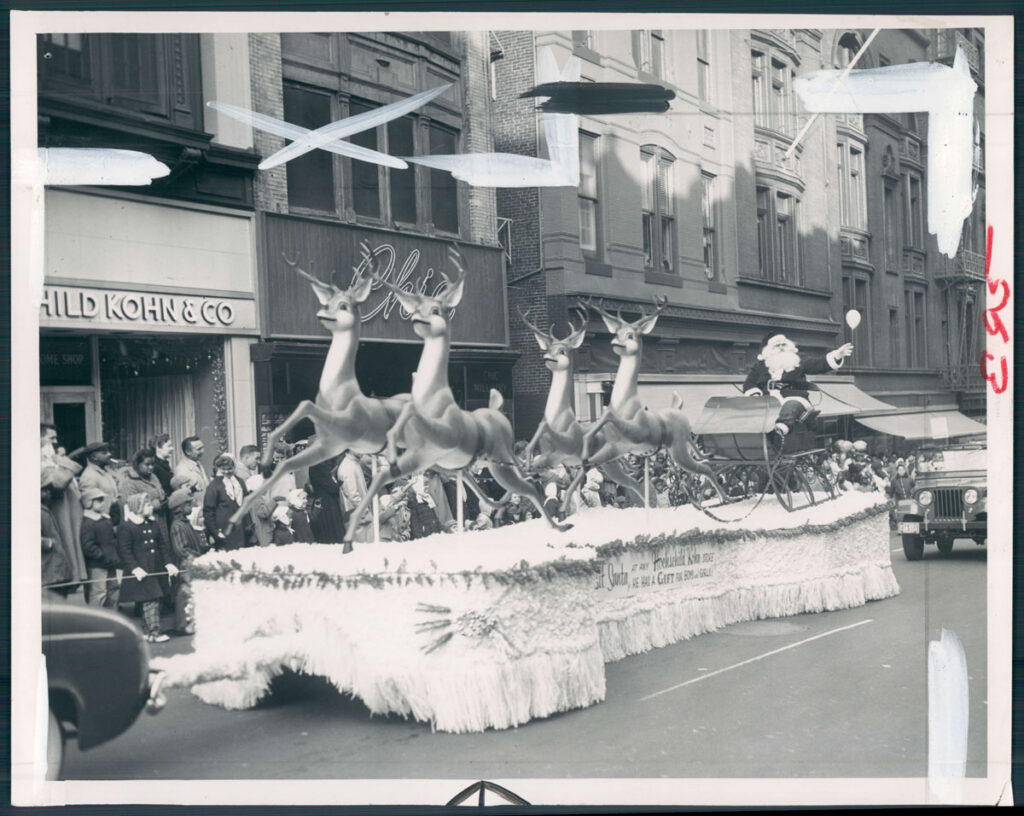
The crowds got huge. In 1961, the Sun counted close to 250,000 people, “the largest turnout in the history of Baltimore’s annual Toytown parade.” The 1961 parade started at 1:45 p.m. near the art museum and ended about two and a half hours later at Lexington Market.
The crowd stood three and four deep on the sidewalks, huddled in mufflers and blankets against the wind, and some kids climbed onto parked cars for a better look. Balloon vendors had a rough afternoon. A few got “propelled too fast across the street by their hydrogen-filled ware” and wound up in the path of oncoming cars, though the police inspector in charge knew of no injuries.
“Deteriorated balloons”
Posen retired in 1964, the year he told his story. Two years later, on Thanksgiving 1966, the Toytown Parade marched for the last time, according to the Sun‘s 2020 look back.
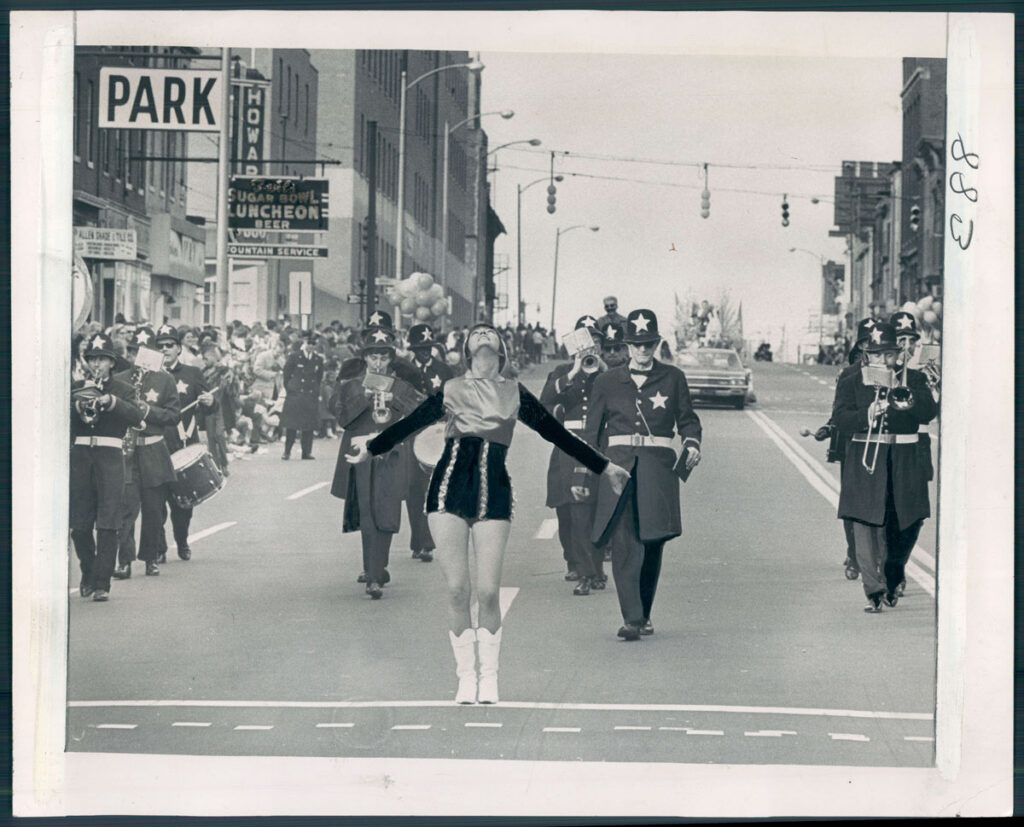
On Thanksgiving Day in 1967, the Sun ran down the holiday lineup: Calvert Hall and Loyola at Memorial Stadium in the morning, City and Poly in the afternoon, racing at Laurel. Then came the bad news. The headline put it bluntly: “Balloons Have Had It.”
“But one traditional event, the annual Toytown Parade, was canceled because of deteriorated balloons.”
The parade never came back. The monsters had simply worn out. In 1973, according to the same 2020 Sun story, what became the Mayor’s Christmas Parade started up in Hampden.
Want more of old downtown? Here’s a look at Guilford, Fayette and Howard streets in the 1940s. And if parades are your thing, check out the Elks parade on Baltimore Street in 1916.
Lost Baltimore stories, in your inbox.
The newest story, plus a few from the archive.
Free. Unsubscribe anytime.
AI helped research and write this story. Here’s how we use AI.Suggest a correction