
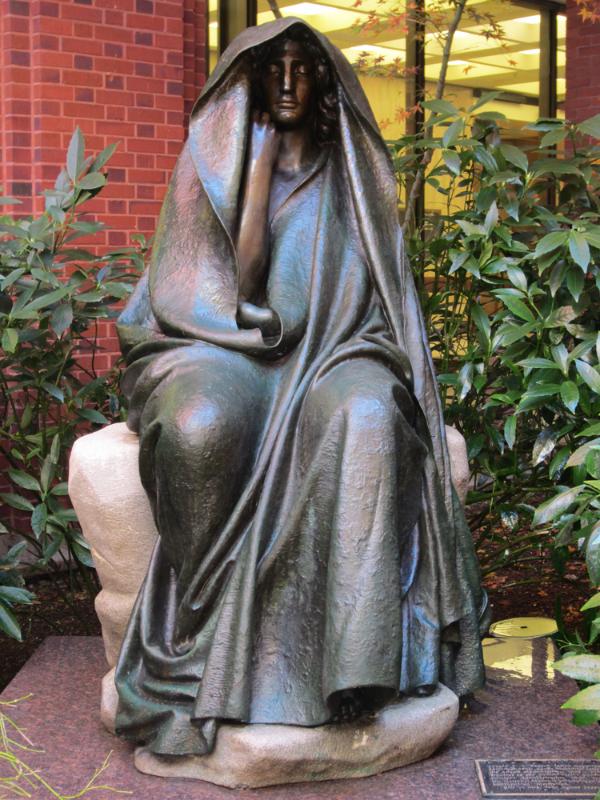
Black Aggie’s eyes glowed green or red, the story went, and if you stared into them you’d go blind. If you sat on her lap, you’d die.
That’s what residents told researchers from the Maryland Folklife Commission in the late 1960s about the hooded bronze figure that stood at Druid Ridge Cemetery in Pikesville, according to the Baltimore Banner.
The curse is folklore, but Black Aggie is real, and she’s still around. She sits in a courtyard on Lafayette Square in Washington. Her true story beats any of the ghost stories, because it starts with a knockoff.
A copy of a famous Washington grave
Black Aggie is a copy of the Adams Memorial in Washington’s Rock Creek Cemetery, one of the most famous works of Augustus Saint-Gaudens.
Henry Adams, a grandson of John Quincy Adams, commissioned it for the grave of his wife, Marian “Clover” Hooper Adams, who died by suicide in 1885. Saint-Gaudens worked on the figure from 1886 to 1891, and it was installed at Rock Creek in 1891.
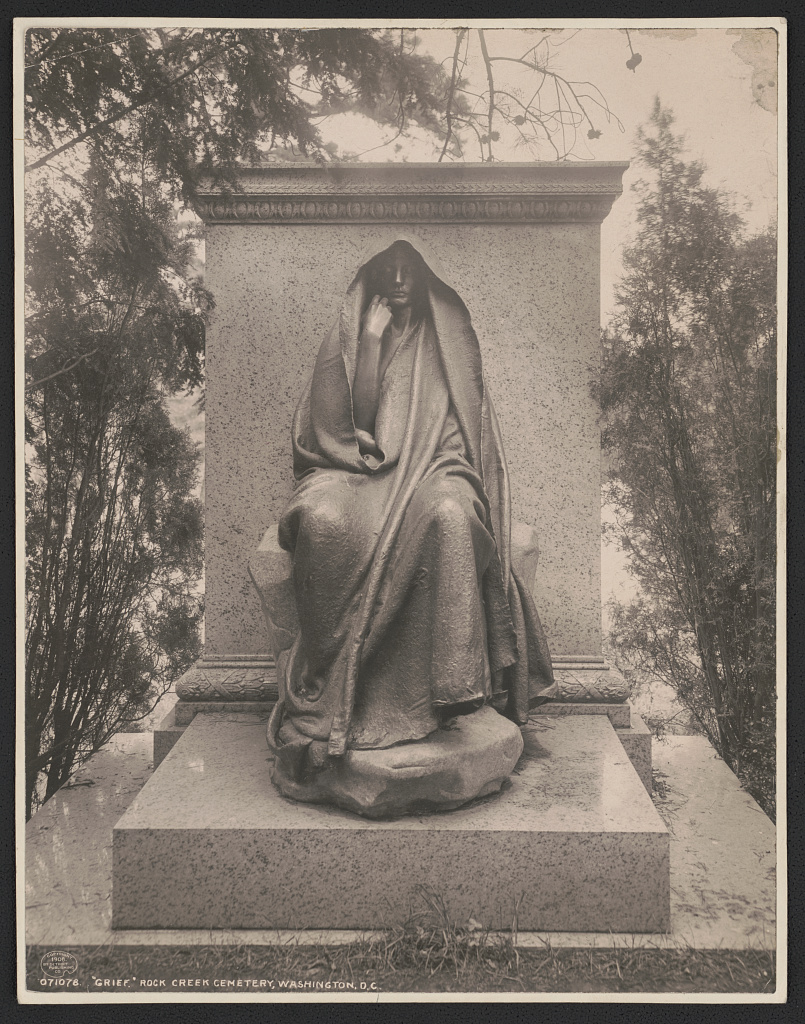
Adams insisted that the memorial carry no name, and it doesn’t. Saint-Gaudens called it “The Mystery of the Hereafter and The Peace of God that Passeth Understanding,” but by 1908 people were just calling it “Grief.”
About 15 years after it went up, a Baltimore newspaper publisher ended up with one of his own.
The general and the monument dealer
Gen. Felix Agnus had packed a lot into one life by then. He was born in Lyon, France, in 1839, and according to his Associated Press obituary he fought with a regiment of French Zouaves at the Battle of Montebello.
He came to America at 21, and when the Civil War broke out he enlisted as a private in Duryee’s 5th New York Zouaves. He was wounded at Gaines’ Mill and rose through the ranks, and by 1865 he’d been breveted a brigadier general, an honorary promotion.
He married Annie Fulton, whose father, Charles Carroll Fulton, published the Baltimore American. Agnus joined the paper after the war, and when Fulton died in 1883, he became its publisher.
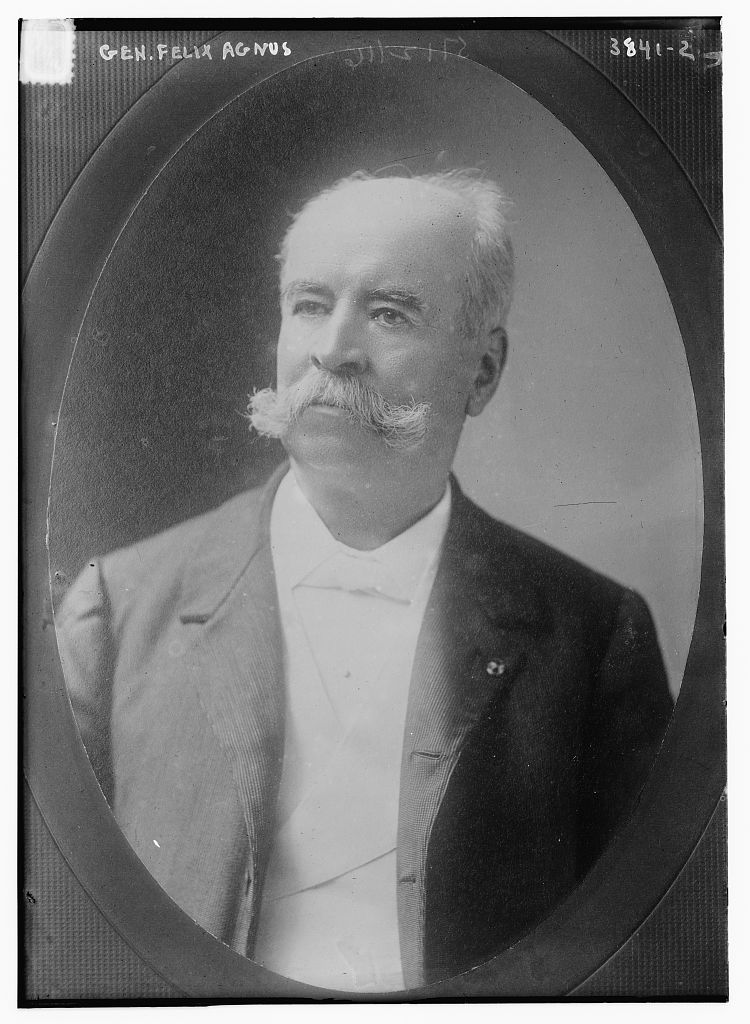
In the autumn of 1906, John Salter & Son, a monument firm in Groton, Connecticut, offered Agnus a bronze copy of the Adams Memorial, and he took the deal. He understood that Salter had bought the right from Saint-Gaudens to make replicas and sell one in each of the principal cities of the United States. According to the Baltimore Banner, he paid $3,900.
The GSA says the copy was “fraudulently sold” to him. The Banner, citing the journal American Art, reports that a lawyer for Saint-Gaudens’s widow later told him he’d been tricked.
Salter hadn’t made the bronze itself. A Buffalo sculptor named Eduard L. A. Pausch made the model, and when asked how, he said he’d made “drawings, sketches and measurements” of the monument in Washington. Bureau Brothers, founders in Philadelphia, cast it.
Saint-Gaudens died in August 1907, and that October the copy went up on the Agnus lot at Druid Ridge. Modern accounts, from the Baltimore Banner to Baltimore TV station WMAR, often put her installation in the 1920s. The Tribune’s October 1907 date is the one that fits, though, since the whole fight over her played out in 1908 and 1909.
The Tribune breaks the story
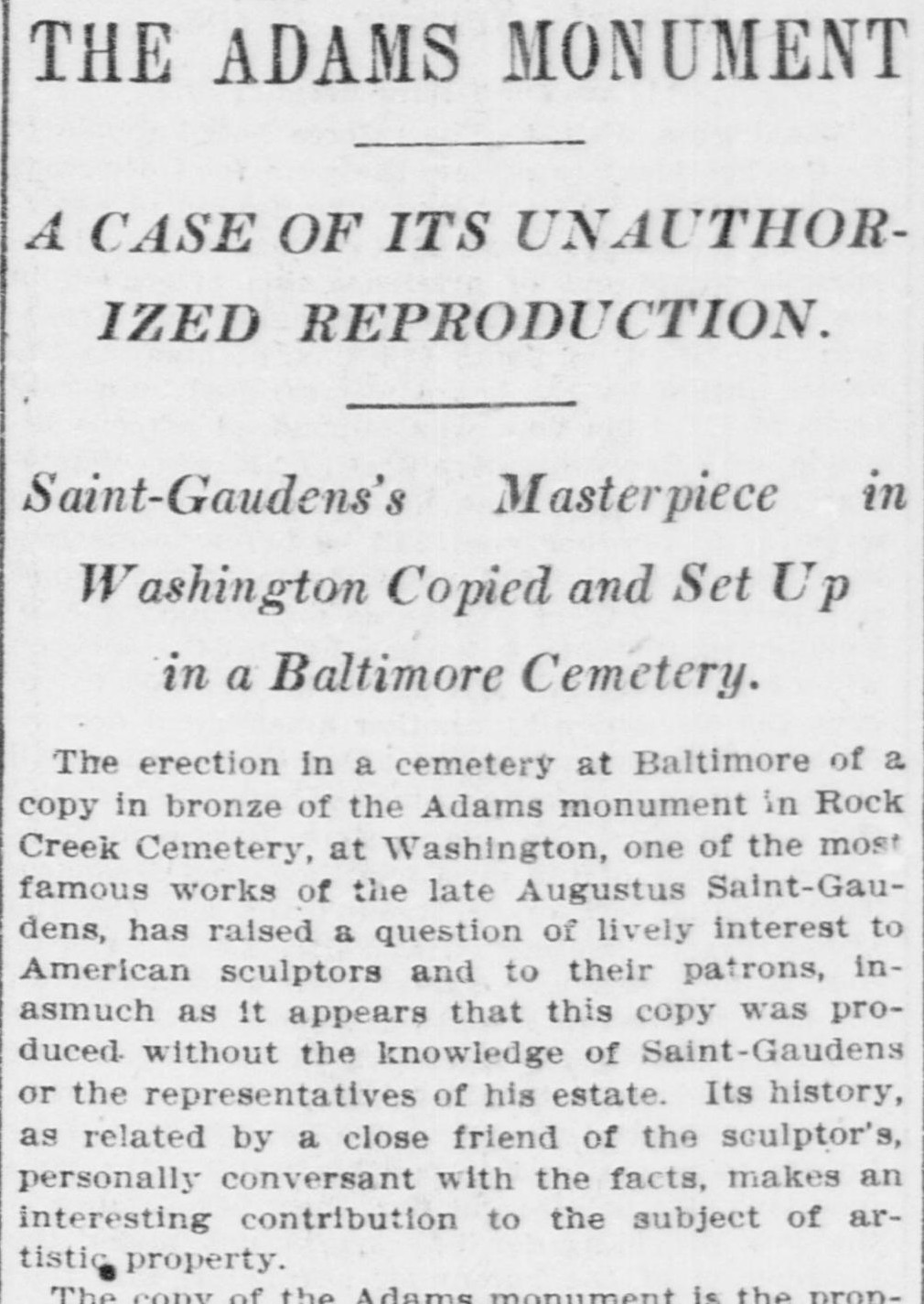
The whole thing came out on the front page of the New-York Tribune on February 5, 1909, as told by a close friend of Saint-Gaudens. Here’s how it began:
The erection in a cemetery at Baltimore of a copy in bronze of the Adams monument in Rock Creek Cemetery, at Washington, one of the most famous works of the late Augustus Saint-Gaudens, has raised a question of lively interest to American sculptors and to their patrons, inasmuch as it appears that this copy was produced without the knowledge of Saint-Gaudens or the representatives of his estate.
“It looks like plain stealing to me”
According to the Tribune, Saint-Gaudens’s family knew nothing about the copy until the autumn of 1908, when a friend came across it and told his widow. Mrs. Saint-Gaudens went to Druid Ridge and compared the bronze with photographs of the original.
With Henry Adams’s agreement, she offered, in the paper’s phrase, “to substitute, at cost,” a true replica of the Rock Creek monument for the bronze in Baltimore. Part of the point was to make sure the unauthorized copy got destroyed.
Agnus wasn’t giving up his copy first. He “declined to surrender the copy in his possession until a true replica is actually put in its place,” the paper reported, and with that the estate withdrew its offer. The copy stayed at Druid Ridge.

On February 6, 1909, the day after its front-page story, the Tribune ran the reactions of New York sculptors, and the general mood was indignation. Several of the artists saved their sharpest words for the people who made the copy and sold it to Agnus. Daniel Chester French, who later designed the statue of Abraham Lincoln in the Lincoln Memorial, didn’t mince words:
“It looks like plain stealing to me,” said Mr. French. “The monument was bought and paid for by Mr. Adams, and aside from the sentimental and artistic interest of Mr. Saint-Gaudens and his heirs in wishing that there should be no unauthorized copies of it extant, it was Mr. Adams’s personal property, placed by him on his own land. I should say that the transaction was dishonest and unprofessional.”
Karl Bitter, another of the artists in the story, wanted the copy itself gone. “That copy should not be allowed to stay,” he said. “That is outrageous.”
According to the Banner, Agnus later sued the dealer and won, and he kept the monument anyway. She would stand at Druid Ridge from 1907 to 1967.
Under the hooded figure
Annie Fulton Agnus died at the family’s winter home on Eutaw Place in March 1922, the Evening Star reported. Gen. Agnus died at his Baltimore home at 1:25 a.m. on October 31, 1925, according to the Associated Press.
Yes, he died on Halloween.
The University of Maryland Libraries, which hold his papers, say he was buried at Druid Ridge beneath the statue. According to the Banner, it’s a grave he shared with his wife.
Nobody seems sure when people started calling her Black Aggie, and when the Banner looked into it in 2024, it couldn’t pin that down either.
How a grave became a dare
According to the Banner, teenagers started coming for thrills shortly after Agnus died, and a visit to Black Aggie became a rite of passage, or a hazing ritual.
The folklore drew mischief and graffiti, according to the U.S. General Services Administration, which owns the statue today. In 1967, the GSA says, the cemetery asked the Agnus family to remove her.
Banished to Washington
In 1967 the family gave her to the Smithsonian, where experts confirmed she was an unlicensed copy and put her in storage.
There’s a nice irony there, because the Smithsonian American Art Museum owns an authorized cast of the Adams Memorial, made in 1969 by Roman Bronze Works.
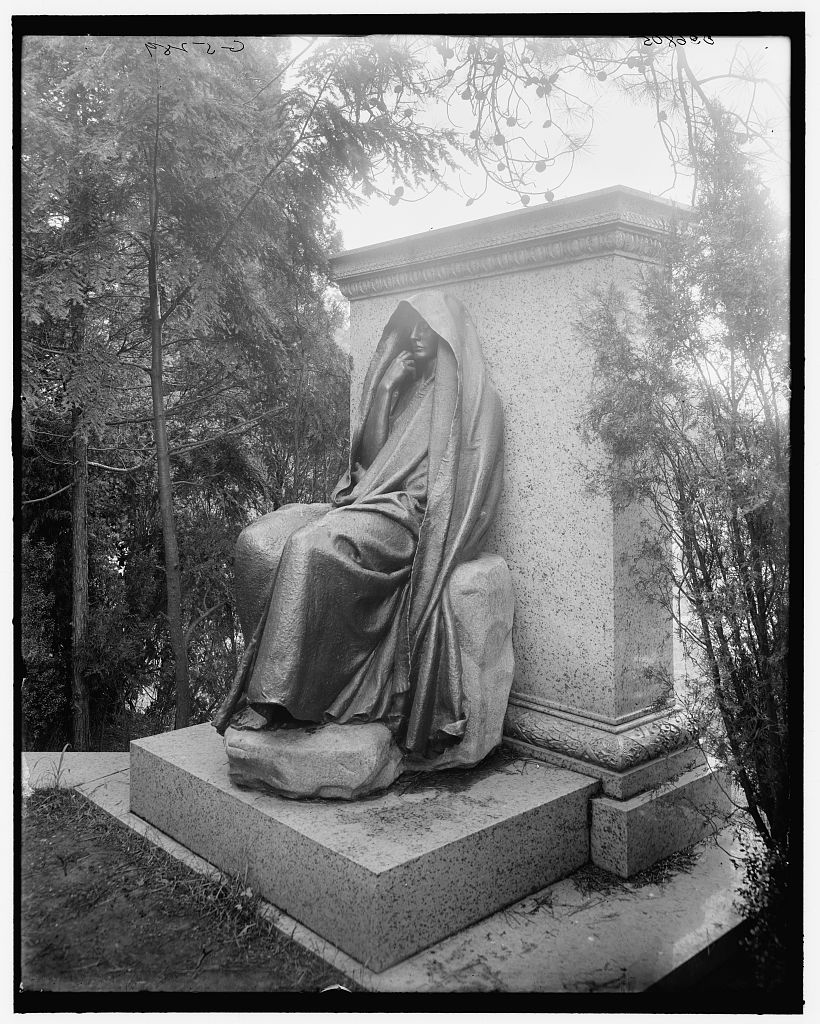
In 1987 Black Aggie was transferred to the GSA, which later put her on display in the courtyard behind the Dolley Madison House on Lafayette Square. The GSA’s catalog calls her the Agnus Memorial, an unauthorized copy of “Grief.”
The Banner reported in 2024 that the courtyard is open to the public Monday through Friday, 8 a.m. to 6 p.m.
Pikesville wants her back
On August 4, 2026, the Banner reported that a Pikesville civic group, backed by cemetery staff and local political leaders, was petitioning the GSA to send her back to Druid Ridge. She’d stand in an open area of the cemetery, not on the Agnus grave.
A GSA spokesperson told the paper the agency is “committed to preserving and publicly displaying the Agnus Memorial,” but wouldn’t say whether it would send her home.
WMAR followed up on October 28, 2026. Debra Wholey-Teets, the cemetery’s general manager, called Black Aggie “such a part of the culture of Pikesville.” The group’s vice president said they were still working out the procedure to get her moved.
The group’s president put it simply: “The statue’s history was started in Pikesville, and should stay in Pikesville.”
As of late October 2026, the knockoff Mrs. Saint-Gaudens wanted destroyed is still sitting in Washington, the same city as the original she was copied from.
Liked this one? Get more tomorrow.
Lost Baltimore stories in your inbox most mornings: the newest, plus a few from the archive.
 This storyBlack Aggie: The True Story of Pikesville’s Haunted Statue
 Before the Infamy: John Wilkes Booth’s Baltimore Debut
 Baltimore’s Claim for Civil War Damage to Lafayette Square
Free. Unsubscribe anytime.
AI helped research and write this story. Here’s how we use AI.Suggest a correction