
On August 29, 1911, the official returns from the Eighth precinct of the Twenty-third ward in South Baltimore gave J. Albert Hughes 102 votes for sheriff. Thomas F. McNulty got zero.
Not one vote. It was the Democratic primary, and the party machine, known around town simply as “the organization,” had put its weight behind Hughes. McNulty didn’t believe a word of those returns, so he went looking for his voters, door to door.
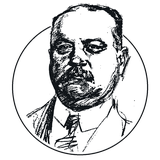
The face in our logo is his, taken from a drawing in the Baltimore Sun on August 13, 1911. The accompanying profile called him “Baltimore’s Most Famous Singer.” When we first wrote about him in 2013, it was mostly because he shared a name with the detective in HBO’s The Wire.
Twenty-one men who voted for him
The Sun followed him through the precinct on the evening of September 2, 1911. When McNulty showed up a little after 7 o’clock, the paper said he “was besieged by men, women and children.”
House after house, people told him they had voted for him. By the end of the night he had 21 names, with addresses on South Charles, Hanover, Clarkson and West Randall streets. He wasn’t asking for sworn statements, not yet:
“I am not looking for affidavits now,” said McNulty; “your word is enough at present. You are honest men and I know that you voted for me, but I am pleased to know that if it is necessary for me to get affidavits that you men are ready to make them.”
At each house, the Sun reported, “Seizing him by the hand, McNulty would say ‘God bless you, my friend.'” The women of the neighborhood turned out too.
He’d greet them with “Ladies, I am down here to see if I can find a few friends who voted for me,” and they’d answer, in unison, “Indeed you can.” How great is that?

The story of how he became a campaign singer comes largely from that profile, and keep in mind it ran sixteen days before the primary. It’s an admiring piece, full of childhood stories and accounts of his generosity.
A boy with a voice
McNulty was born on September 10, 1859, in the old “white house” at Monument and Forrest streets, according to the profile. His mother, Elizabeth Bainer, had sung in the Cathedral choir; his father, also Thomas, was an iron molder with the Baltimore and Ohio Railroad.
He left St. John’s Parochial School at 12 to run errands for a bootmaker. Customers kept asking him to sing, the Sun reported, delaying his return to the shop. At 16 he began learning house and sign painting.
The profile recounted offers from the touring Swiss Bell Ringers and Haverly’s Minstrels, whose manager gave him a tryout and offered “a large salary.” His mother refused to let him travel with either company.

He sang at St. Paul’s on Caroline Street, where choir members contributed 10 cents a week for music. The Sun recalled his answer when Father Donahue offered him a paid place in the Cathedral choir:
“I thank you for the offer of salary, but I don’t know how to take money for singing God’s praises with the voice God gave me.”
Singing for the Democrats
Congressional candidate Dr. William H. Cole brought him into campaign singing, according to the Sun, after noticing the crowds McNulty drew. The paper went so far as to call him “the father of political campaign singing in America.” Campaign songs had been a fixture of American elections long before his birth.
In 1884, at the request of Senator Arthur Pue Gorman, he toured Indiana, Ohio and West Virginia singing for Grover Cleveland, paying his own way. Cole won his seat that year and got McNulty a job as a painter at the Government Printing Office in Washington.
By 1887 he was back in Baltimore, where Ferdinand C. Latrobe (who would serve seven terms as mayor) was running again. McNulty had a song for him. Here’s the Sun on a Democratic rally at Raine’s Hall in October 1887:
Mr. Thos. McNulty, who has an excellent voice, sang the song, “That Old Gray Mare of Mine,” with telling effect. There are lots of verses in the song, and it is machine poetry, no doubt, but there is no use of discussing or criticising the song or its sentiments. It has “caught on” with the people. They cheered it again and again on Saturday evening, and Mr. McNulty had to repeat some of the verses.
Latrobe won. In 1932 the Sun remembered McNulty as the author of “The Old Gray Mare,” but the song has roots in an 1858 publication, before he was born. The 1887 report shows he sang the verses, but it doesn’t say who wrote them.
He went on to sing for Democratic candidates in Maryland and in presidential campaigns. The profile named Elihu Jackson, Frank Brown and William Jennings Bryan among those he helped; for Bryan, he sang “Bryan and Victory.”
The profile insisted he had never taken payment from a politician he helped, and said he returned a check from Frank Brown. Cash, no. But the government job Cole got him was a political reward of its own.
Whisky, the Elks and two losing races
His jobs included work in Baltimore’s City Tax Department and the liquor trade. According to the profile, a Georgia company bought his whisky business and hired him to manage its Washington branch at $5,000 a year.
He was exalted ruler of the Baltimore Elks and a national grand trustee. The 1911 profile credited him with opening and closing every International Association of Funeral Directors convention since 1889. (The undertakers, it reported, had made him an honorary member and promised him a free funeral.)
What he wanted was to be sheriff. In 1895 he lost the Democratic nomination, and in 1897 he got it and lost the general election to a Republican named Hoffman by 8,032 votes.
The campaigns left him deep in debt, and he lost his first home. He paid it all back, he said, the hard way:
“I then hypothecated my life,” says he, “to pay my obligations, but thank God, every cent is paid in full.”
He also wanted out of liquor. “Help me,” he said, “to get out of the whisky business. I never did like it.”
In 1911 he gave up the $5,000 job and became treasurer of the Riall-Jackson Company (an insurance firm).
The party singer
In October 1909 McNulty sang at a Democratic rally in Rising Sun supporting the Straus Amendment, a proposal to restrict Black Marylanders’ voting rights. Governor Austin Crothers appeared on the same program.
The speakers said so openly. As the Midland Journal reported, one argued it would “elevate the electorate of the State by eliminating the illiterate negro vote.” McNulty sang a number of campaign songs during the meeting, the paper said.
Voters rejected the amendment that November. Two years before McNulty challenged the suppression of his own supporters’ votes, he had lent his voice to a campaign to restrict the votes of Black men. The Journal doesn’t say which songs he sang or what he thought of the amendment.
A zero in the Twenty-third ward
Which brings us back to 1911, and to the zero in South Baltimore.
The Sun said McNulty’s canvass was meant to prove to the people of Baltimore that the primary law, as operated there, was “a cloak for fraud and corruption.” The case went to a grand jury, which had the precinct’s ballot box opened and the ballots counted.
The Sun’s headline on September 23 read: “Grand Jury Finds 49 Votes For McNulty; Officials Gave Him None.” The same report announced six arrests. A 1913 account put the recount at 44; the reports disagree on the number, but both contradict the official return of zero.
Recounts turned up bad returns in precinct after precinct, and by the Sun’s later count “several hundred indictments” followed. The recounts cut into Hughes’s lead but didn’t erase it. McNulty ran that November as an independent, and Republican Theodore P. Weis won the office.
The two Democratic election judges in the “zero precinct,” John Wagner and Albert Cochran, were convicted, won new trials on appeal, and were convicted again. On September 9, 1913, they dropped their appeals and went to jail for 80 days.
Sheriff at last
The day before those two judges went to jail, McNulty won the Democratic primary for sheriff. As the Sun put it, “It was a coincidence.” In November 1913 Baltimore elected him, and he took office that December.

The job paid $3,000 a year, and the office still ran on fees. In 1914 McNulty couldn’t collect enough to run it and had to cut his deputies’ pay.
A constitutional amendment ratified in 1914 established four-year terms beginning with the 1915 election and allowed the Baltimore sheriff to seek re-election. In 1916 the legislature raised the salary to $6,000. McNulty won again in 1915 and 1919, serving three terms over ten years.
He continued singing in office, including “The Star-Spangled Banner” for the Rotarians and at a 1917 suffrage meeting, with Mrs. McNulty at the piano. The 1911 profile had also described his singing for prisoners and his gift of a pulpit to the jail, both before he became sheriff.
Five lashes
Maryland law allowed a man convicted of beating his wife to be whipped, and the sheriff carried out the sentence.
On September 8, 1921, McNulty gave five lashes with a cat-o’-nine-tails to Cornelius Smith, a Black man convicted of beating his wife. The whipping took place in the main corridor of the city jail. The Washington Post’s next-day report described forceful blows that raised welts on Smith’s back.
A wire photo of the whipping appeared in newspapers around the country, sometimes with racist captions. Wisconsin’s Kenosha Telegraph-Courier printed it under the headline “BACK TO DAYS OF SLAVERY!”
In April 1926, the Washington Times described McNulty as weeping and applying the lash gently in 1921. That kinder picture was published five years later, and it doesn’t match the Post’s next-day account. Either way, it was McNulty who administered the whipping.
The last verse
By 1923 the organization had settled on a police magistrate, John E. Potee, for sheriff. McNulty was 63 (the Sun made him 65) and planned to run anyway.
“I am a Democrat and want to win as a Democrat,” he told the Sun that June. “I’ve got to talk to my friends. But I’m going to make the fight; that’s certain.”
In the September primary Potee won with 18,118 votes to McNulty’s 10,570, though McNulty still carried four wards.
He stayed close to the office. Years later, Sheriff Joseph C. Deegan made him a deputy. McNulty sang in public for the last time on St. Patrick’s Day in 1927.
He died early on the morning of May 25, 1932, at his home at 1405 North Caroline Street. He was 72.
He was married twice. His first wife, Clara Gertrude Magarity, died before 1911, and his second, Isabella Beatrice Hall (a soprano), survived him along with five daughters and a son. The funeral was a high mass of requiem at St. Paul’s, the little church whose choir he wouldn’t leave, and he was buried in New Cathedral Cemetery.
The Sun gave him an editorial the next morning:
Few men were better known or better liked in this city than “Tom” McNulty, three times Sheriff of Baltimore and for years an active and interesting figure in municipal politics. Gifted with rare Irish humor and with a fine tenor voice that he never wearied of using, he made hosts of friends and gave to the hustings a flavor and piquancy that they seem to lack these days.
It also gave him credit for the 1911 fight, calling him “the victim of machine politics.” In that race, the editorial said, the discovery of a “zero” precinct “led to exposures of election debauchery that had much to do with the reform of election methods.”
That’s how the memorials remembered him, the singer who fought the zero precinct. The Rising Sun rally and the whipping of Cornelius Smith are part of his story too. The Sun’s poet, signing himself “B. B.,” wrote in his May 26 tribute:
The spirit of a golden friend
Has perished, and his race is o’er–
But still his lingering lyrics send
Their messages to Baltimore!
We use AI to help research, write and edit stories across our sites. Here’s how we use AI.Suggest a correction
On the AtlasNewSee the 3 places in this storyThe "zero precinct": Eighth precinct · McNulty's birthplace · McNulty's home39.2715° N · 76.6152° W