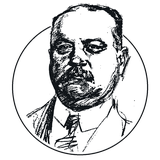


Lucy Branham of Baltimore wasn’t allowed to go to Alice Paul’s cell in the District jail in Washington. Paul, the National Woman’s Party leader, was serving her own sentence there after picketing for women’s voting rights. So Branham crept around the upper tier of cells until she could see Paul and call down to her.
Branham was one of 10 women released from that jail on Nov. 3, 1917, after serving their sentences for picketing the White House. We dug up her account in a Washington dispatch published by the Milwaukee Leader on Nov. 9, 1917.
“I will never forget how she looked standing close against her barred door,” said Miss Branham. “She is thinner than ever, and her eyes looked bigger. She put her hand through the bars to wave me good-bye, and her wrist watch was pushed up almost to her elbow.”
Just as Branham turned away, Paul called out one more request: “Try to make them give us better food.”
Paul also sent a message out with all 10 of the released pickets: “Go, get 100 women on the next picket line.”
So how did a woman from Baltimore end up creeping along a cell block in Washington? Here’s her story.
A Baltimore teacher with a Carnegie medal
Lucy Gwynne Branham had taught in Baltimore and St. Petersburg, Florida, where she saved two people from drowning. The Evening Star reported in November 1915 that she had been awarded a bronze Carnegie medal and $1,000 for the rescue.
The Maryland Suffrage News described how she saved a young woman from drowning in Coffee Pot Bayou, on Tampa Bay.
A workman had gone in after the woman, and a second workman who couldn’t swim got into deep water and grabbed him, so Branham freed the first workman too. The schoolteacher from Baltimore ended up rescuing one of the rescuers. How about that?
By the fall of 1916 she had started postgraduate work in sociology and economics at the University of Chicago. She put her studies aside to work in the Woman’s Party campaign in Wyoming against President Wilson.
Arrested at the White House
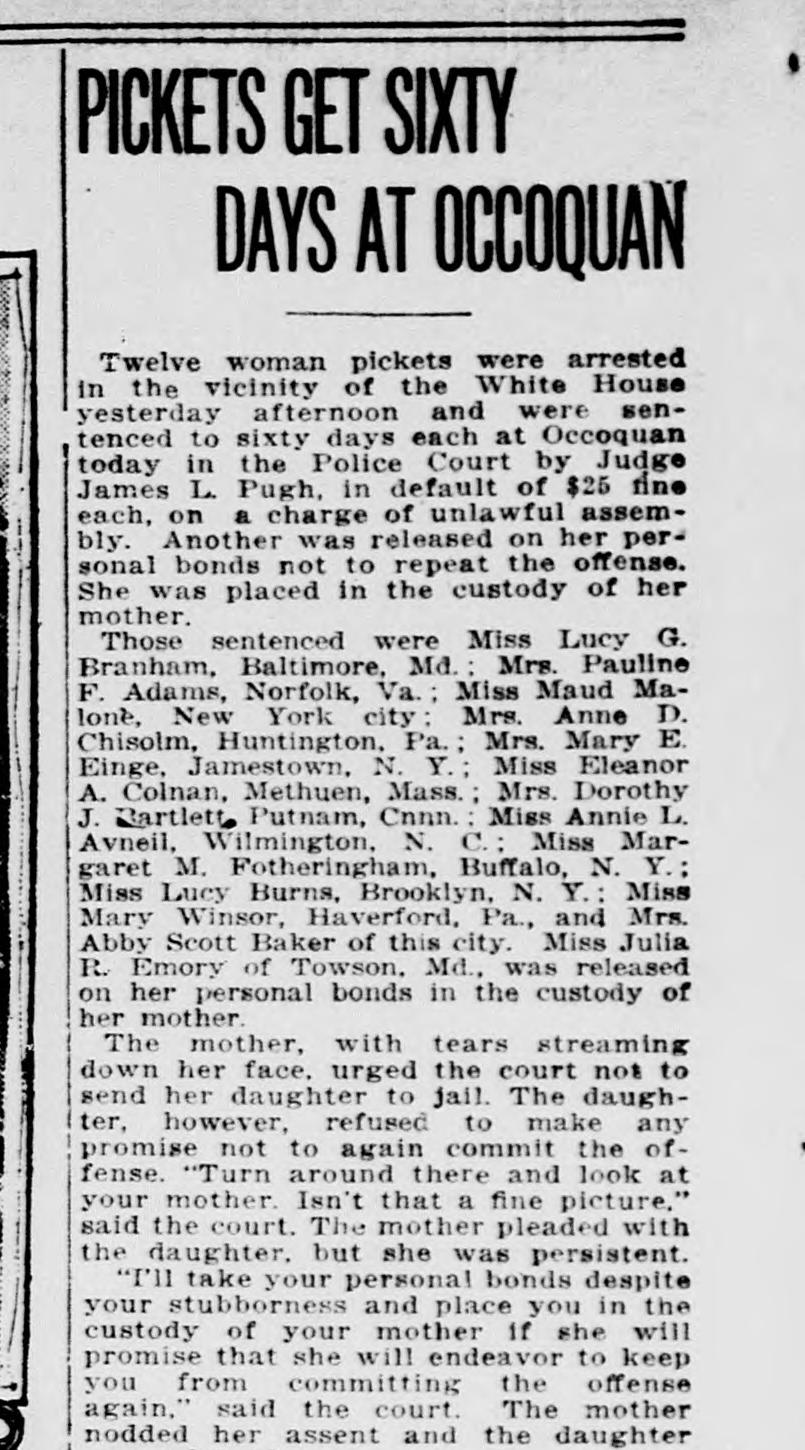
By the late summer of 1917, Branham was out on the White House suffrage picket line herself. Thirteen women pickets were arrested near the White House on the afternoon of Sept. 4, 1917, and Branham was one of them.

The next day, Sept. 5, 1917, Judge James L. Pugh of the Police Court sentenced her to 60 days at Occoquan on a charge of unlawful assembly, the alternative to a $25 fine. The Star’s report put “Miss Lucy G. Branham, Baltimore, Md.” at the top of the list of those sentenced.
The Washington Times said they all declined to pay, and that Pugh raised the jail alternative for picketing from 30 to 60 days with this group.
Branham was tried alongside Pauline Adams of Norfolk, and Adams told the judge that democracy would never be suppressed by prison walls.
Only one of the 13 got a different ending: Julia Emory, another Maryland picket. Her mother pleaded with the court, and the Evening Star caught Judge Pugh’s line to the daughter: “Turn around there and look at your mother. Isn’t that a fine picture.”
Emory still refused to promise she wouldn’t picket again, but Pugh released her on her personal bond in her mother’s custody.
Worms in the workhouse food
The District of Columbia used the Occoquan Workhouse in Lorton, Virginia, to hold prisoners. On Sept. 24, 1917, Branham’s mother, also named Lucy, went down there with a suffrage party that included Julia Emory to gather evidence on conditions.
On Sept. 26, 1917, Branham described the food and treatment to a group of visitors that included Maryland Congressman J. Charles Linthicum. The Baltimore Sun reported that “she had corralled a bottle of worms from her food.” She also said the slightest sign of rebellion was punished with solitary confinement.
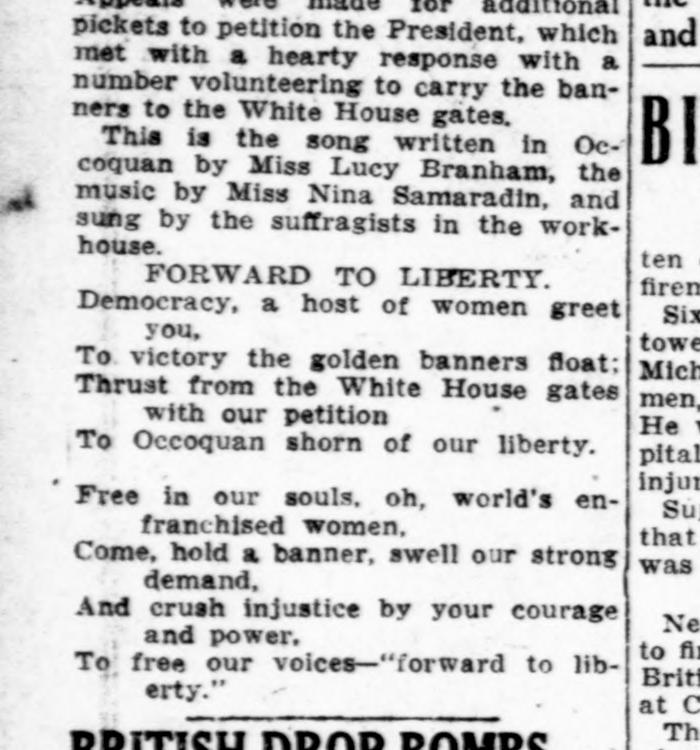
The Sun counted other Baltimoreans in the workhouse with her, including Miss Samaradin, “a Russian girl whose present home is in Baltimore,” and the two of them made music together. The Washington Herald reported that Branham wrote the words of a song at Occoquan called “Forward to Liberty,” with music by Miss Nina Samaradin, and the suffragists sang it in the workhouse.
Here are two lines from it:
Thrust from the White House gates with our petition / To Occoquan shorn of our liberty.
That’s pretty much her whole fall of 1917, set to music.
On Oct. 21, 1917, the picket prisoners at Occoquan who refused to work, Branham among them, were moved to the District jail in Washington and put in solitary confinement. Their 60-day commitments weren’t due to run out until Nov. 3.
Out on Nov. 3, 1917
That’s the jail Branham walked out of with nine other pickets on Nov. 3, 1917. The Milwaukee Leader’s dispatch said the 10 had all lost from 5 to 23 pounds.
Lucy Burns, who had come to Washington with Paul and organized the Congressional Union, warned in the same dispatch:
The life of Alice Paul is greatly endangered by the conditions at the district jail to which she has been sentenced for seven months.

In Baltimore, the Sun of Nov. 4, 1917, called her “the Baltimore girl” and reported that she would be a guest of honor that evening at a dinner at National Woman’s Party headquarters in Washington.
That headquarters was Cameron House, and the Washington Herald reported a home-coming party for the released pickets there that night. Branham told the party that jail had given her a clear understanding of “how poorly men run things over which they have control.”
Ha! You’ve got to love that.
Baltimore had plans for her, too. The Just Government League planned a tea in her honor at the Emerson Hotel in Baltimore on Tuesday, Nov. 6, 1917. The Sun expected her to tell her story and exhibit the “zoological specimens” she had reportedly captured in the workhouse food.
On Dec. 1, 1917, she shared the stage at Albaugh’s Theatre in Baltimore with Dudley Field Malone. Malone had resigned as Collector of the Port of New York over a disagreement with President Wilson on suffrage. He spoke in defense of the White House pickets, Branham spoke too, and Baltimore suffrage leader Mrs. Donald R. Hooker presided.
The Prison Special
Branham wasn’t done. According to the Sun, on Feb. 9, 1919, she was among 65 suffragists arrested after they burned President Wilson in effigy in front of the White House.
That same month the Chattanooga News found her traveling as a national organizer with the Prison Special, the National Woman’s Party’s train of former suffrage prisoners on a speaking tour.

The Milwaukee Leader reported that when Branham visited the Milwaukee County jail in March 1919, she wore a copy of the prison costume she had worn in the government workhouse.
In June 1920 the Sun reported that she would be among the National Woman’s Party pickets at the Republican National Convention in Chicago, representing Maryland.
In the 1919 photo at the top of this post, Branham is speaking outdoors in a striped prison-style dress. In another Harris & Ewing photograph from that year, she holds a poster that reads “To ask freedom for women is not a crime.”

Lost Baltimore stories, in your inbox.
The newest story, plus a few from the archive.
Free. Unsubscribe anytime.
AI helped research and write this story. Here’s how we use AI.Suggest a correction