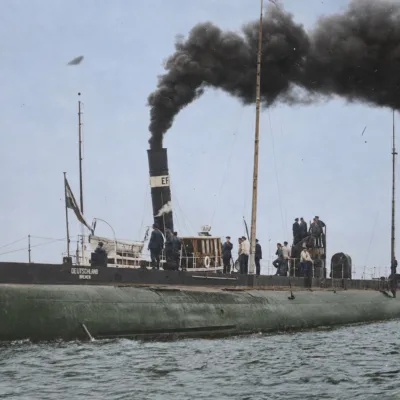


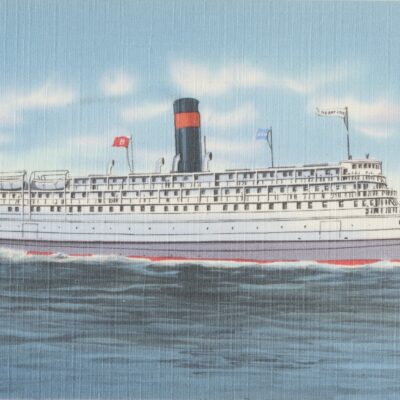
The refugee ship Exodus 1947 started life as a Chesapeake Bay night boat. Before the British boarded her off Palestine and brought her into Haifa, she was the President Warfield. She was the flagship of the Old Bay Line and the queen of its fleet on the run between Baltimore and Norfolk.
And Baltimore wasn’t just where she used to dock. She was readied for sea on the Baltimore waterfront, she made her first try for Europe from Baltimore, and Baltimore Zionist leaders later said Baltimoreans had paid for her.
So how does a Bay steamer that once had a Colonial-style main salon end up in a sea fight off Palestine?
The Old Bay Line’s flagship
Pusey & Jones built her of steel at Wilmington, Delaware, for the Baltimore Steam Packet Company, the Old Bay Line, and the Sun says she was launched there on Feb. 6, 1928. She was named for the line’s president, S. Davies Warfield.
In 1947 the Sun remembered her as “the last word in inland-water steamship construction,” with five decks and 200 staterooms.
For 14 years, from 1928 to 1942, she carried thousands of vacationists between Baltimore and Norfolk. Her Baltimore pier was Pier 10, Light Street, down on the old Light Street wharves.
She also had a little Prohibition adventure. In March 1929, Coast Guard patrol boats stopped her near Wolf Trap in the Bay by firing two blanks and then a solid shot across her bow. Here’s what they found aboard, as the Sun told it in 1947.
The Coast Guard said they found 129 gallons of contraband aboard; 123 gallons of gin were discovered in the rumble seat of a new automobile on board, and six gallons, labeled lobster and herring, were found in lockers.
Lobster and herring. Sure.
In May 1940 the Old Bay Line turned 100, and the President Warfield got the party. The Sun promised passengers in old-fashioned costumes and a band playing Stephen Foster songs when she sailed from Pier 10 for the celebration.
The Bay boat goes to war
According to Alexander Crosby Brown’s 1961 history of the Old Bay Line, the War Shipping Administrator requisitioned her at Baltimore on July 12, 1942, and turned her over to the British. On her convoy crossing that September, Brown writes, a torpedo passed only thirty feet away.
Brown says the British used her as a training and barracks ship and handed her back to the U.S. Navy in July 1943. She became USS President Warfield, took part in the Normandy invasion in 1944, and later carried troops on the Seine between Le Havre and Rouen.
Brown has her back home at Norfolk on July 25, 1945. Mayor McKeldin wrote her a tribute, and then, as the Sun couldn’t resist pointing out, called her the “General Warfield.”

The Old Bay Line looked her over and decided she would cost too much to turn back into a passenger boat. So she was laid up with the Maritime Commission’s idle fleet in the James River.
Bound for China (supposedly)
In 1946, Brown says, a Washington scrapping company bought her for $8,028. Two days later it resold her for $40,000 to the Weston Trading Company of New York, which Brown identifies as a front for the Haganah, the Jewish underground defense force in Palestine.
In January 1947 the Sun found her back in Baltimore at Pier 8, Lancaster Street, and said she would leave “in a few days on that long trip to China.” Capt. William C. Ash, a marine surveyor, told the paper that about $25,000 had been spent there to get her ready for sea.
The Sun’s Sunday magazine gave its Feb. 2, 1947, picture spread a perfect title: From Canton To Canton. On the Bay run, the magazine explained, she used to take on her fuel at Canton in Baltimore. Now she was supposedly headed for the Hong Kong to Canton run in China.
The magazine also caught her mid-refit: “Now the main salon is bare. The steamer once was furnished in Colonial style.”
The China story was a cover. Palestine was under a British mandate, and Jewish refugees had no permission to land there, so ships like her had to run a British blockade. By the end of January 1947, the United States Holocaust Memorial Museum says, a crew of nearly 40 American Jewish volunteers had been assembled in Baltimore.
Leaving Baltimore
She left Baltimore on Feb. 25, 1947, flying the Honduran flag and bound for Marseille. The next afternoon, the AP reported from Norfolk, she radioed the Coast Guard that she was in trouble 75 miles east of Diamond Shoals, off the North Carolina coast.
Her forward hold was flooded and she was listing to starboard, and two tankers and the Coast Guard cutter Cherokee went to her.

The old boat limped back into the Chesapeake under her own power. After a survey at Norfolk, Brown says, she went to Philadelphia for repairs, and her captain, William S. Schlegel, left her there. He insisted he knew nothing about her future beyond orders to deliver her at Marseille.
In Brown’s telling, she slipped away again that spring, patched up and with a new skipper, after what the Sun later called “one false start from Baltimore.” The records disagree on her port and date this time.
Her cargo manifest listed 1,290 pounds of used mess kits and 102 pounds of canteens. Her captain said she’d stop at Marseille and go on to China, though she carried no Pacific charts.
Getting to China without charts would have been quite a trick.
She becomes the Exodus 1947
She crossed by way of the Azores to Portovenere, Italy, and then to Sete, France. There, in mid-July, Jewish refugees came aboard by the thousands. Brown, citing the journalist Ruth Gruber, sets the count right next to her old Bay license.
the staggering number of 4,554 Jewish would-be immigrants to Palestine boarded the steamer which in a previous incarnation on the Chesapeake Bay had been licensed to carry no more than 540 passengers.
Once she was at sea she got her new name, painted on canvas banners lashed to the bow: Exodus 1947. She was 19 years old.
On July 18, 1947, the AP filed this from Haifa, and the Sun put it on the front page.
Five British destroyers brought 4,550 Jewish immigrants into Haifa aboard their battered old excursion steamer today after a violent hours-long sea battle in which the Jews said two boarding parties were defeated.
The British said the interception came off Rafah, near the Egyptian border. By their account, smoke bombs, steam jets, fuel oil and fireworks were used, with tear gas and small arms on both sides. A broadcast from the ship said the resistance lasted three hours and called the boarding outside territorial waters an “act of piracy.”
Three people died. A British officer told the AP that two passengers were killed in the fight. The third was the ship’s first mate, a 24-year-old former U.S. merchant seaman from Los Angeles named Bernstein, who died later of head injuries.
The AP counted 17 people seriously hurt, though the ship’s own broadcast gave different numbers. In the AP’s words, the passengers “walked across 30 feet of their Promised Land to the British deportation vessels.”

Baltimore paid for her
Then Baltimore found out how close to home this story was. The Sun’s Aug. 3, 1947, story began like this.
Between 40 and 50 Baltimore Zionists not only paid for the Exodus 1947, the former Chesapeake Bay steamer President Warfield, which was turned back from Palestine with 4,500 refugees, but they have also purchased five other ships for transporting European Jews to Palestine, it was disclosed yesterday by Zionist leaders here.
Dr. Herman Seidel, chairman of the Pro-Histadrut, a Labor Zionist group, put the Warfield’s cost with repairs at $125,000 to $130,000. Brown says that total included the purchase price. The $40,000 price and the Baltimore refit come to only about $65,000, and no source itemizes the rest.
The same leaders said fifteen Baltimoreans had enlisted in the Haganah, with four of them in British refugee camps on Cyprus, eight in Palestine and three back home.
Dr. Seidel gave the volunteers their physicals. He checked one of them, a former Navy pharmacist’s mate, on obstetrics, because many pregnant women sailed on the refugee ships. Seidel said there had been 600 aboard the Exodus 1947.
Turned back to Europe
The British put the passengers on three ships, the Ocean Vigour, Runnymede Park and Empire Rival, and took them back to France, where most refused to land.
On Aug. 25, 1947, the Sun reported that Baltimore’s Orthodox Jews would keep a dawn-to-dusk fast. The shofar was to sound in every Orthodox synagogue to mark the shipment of 4,400 of the passengers to Germany. Every source counts the passengers a little differently, and none explains the gaps.
The AP reported from Hamburg on Sept. 8, 1947, that British troops had put 1,406 of them ashore that day from the Ocean Vigour, the first of the three to be unloaded. They went to a guarded displaced-persons camp at Poppendorf, and some of them shouted at the soldiers that this was as bad as Hitler.
The ship herself stayed at Haifa, still in port in February 1952.

On Aug. 26, 1952, the hulk caught fire at Haifa and burned. According to the Holocaust Memorial Museum, she sank off Shemen beach near Haifa in 1964, during an attempt to salvage her.
That’s a long way from Pier 10, Light Street, and the night run to Norfolk.
Liked this one? Get more tomorrow.
Lost Baltimore stories in your inbox most mornings: the newest, plus a few from the archive.
 This storyThe Old Bay Line Steamer That Became the Exodus 1947
 An 1894 Topographic Map of Baltimore
 Lunch Hour at the Bethlehem-Fairfield Shipyard, 1943
Free. Unsubscribe anytime.
AI helped research and write this story. Here’s how we use AI.Suggest a correction