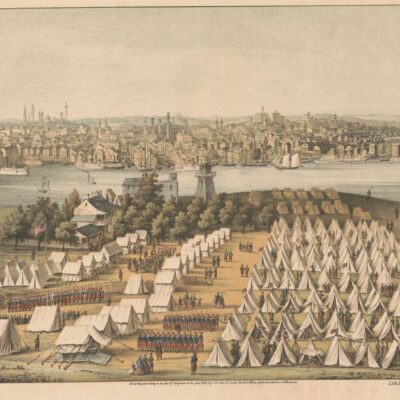


Saturday, Feb. 23, 1861, was supposed to be Baltimore’s big day with Abraham Lincoln. The president-elect was scheduled to come down from Harrisburg on the Northern Central Railway and arrive at Calvert Station, and Baltimore turned out by the thousands to see him.
There was just one problem. Lincoln had already come and gone, riding through town in a sleeping car before dawn that morning while Baltimore was in bed.
Detectives had warned him that assassins were waiting for him here. The Sun, Baltimore’s own paper, called the whole story a lie, and the argument over whether there ever was a plot started that same week. So how did a president-elect end up sneaking through a city in the middle of the night?
A warning in Philadelphia
The warning came on Feb. 21, 1861, at the Continental Hotel in Philadelphia. Lincoln told the historian Benson Lossing that he met Allan Pinkerton, a police detective from Chicago, in Norman B. Judd’s room there. Here’s what Lincoln said Pinkerton told him:
Pinkerton informed me that a plan had been laid for my assassination, the exact time when I expected to go through Baltimore being publicly known.
Lincoln didn’t buy it, at least not at first. Pinkerton wanted him to go straight on to Washington that night, but Lincoln had promised to visit Harrisburg and then Baltimore, and he meant to keep his word. “I could not believe that there was a plot to murder me,” he said.

Then Frederick Seward showed up. His father was Sen. William H. Seward of New York, soon to be Lincoln’s secretary of state, and Frederick came with a message from him and Gen. Winfield Scott. Lincoln told Lossing what happened next:
he told me that he had been sent, at the instance of his father and General Scott, to inform me that their detectives in Baltimore had discovered a plot there to assassinate me. They knew nothing of Mr. Pinkerton’s movements. I now believed such a plot to be in existence.
Two separate sets of detectives had brought him the same warning, and that did it.
A special train and a sleeping car
Judd described the plan years later, in an 1867 letter to Pinkerton printed in the detective’s 1868 pamphlet on the trip. After the reception at Harrisburg, a secret special train of one baggage car and one passenger car would carry Lincoln back to Philadelphia.
From there, railroad president Samuel M. Felton of the Philadelphia, Wilmington and Baltimore (the PW&B) would hold the 11 p.m. Baltimore train. Mrs. Warne, who ran the female detective department of Pinkerton’s agency, would book berths in the sleeping car.
The telegraph would go quiet, and Ward H. Lamon of Illinois would ride along with Lincoln. Lincoln later said he picked Lamon, a man “whom nobody knew,” because better-known company might give him away. Felton’s railroad was footing Pinkerton’s bill, by the way, as one of its men reminded Pinkerton in an 1867 letter.

Judd told Lincoln the plan on the train to Harrisburg and said the rest of the party ought to hear it, too. Lincoln’s answer is one of the best lines in the whole story: “I reckon they will laugh at us Judd, but you had better get them together.”
The PW&B wasn’t taking any chances on its own line, either. A Wilmington report in the Philadelphia Inquirer, reprinted by the Sun, has a great detail. Watchmen sworn in to guard the railroad’s bridges between Philadelphia and Baltimore spent the day whitewashing them, “so that they might make their observations.” How’s that for an undercover job?
The secret special left Harrisburg on the evening of Friday, Feb. 22. Back in Philadelphia, railroad man H. F. Kenney had his own little trick. In an 1867 letter for Pinkerton’s pamphlet, he said he held the night train with a cover story. He told the conductor to wait for an important parcel bound for a Mr. E. J. Allen at Willard’s Hotel in Washington. Remember that name.
Through Baltimore before dawn
The night train’s Baltimore stop was the PW&B’s President Street Station, at President and Fleet streets, a depot the railroad had built in 1849 and 1850. Waiting there was William Stearns of the PW&B, who described the moment to Pinkerton years afterward, in 1867:
I met you in our depot at Baltimore, went into the sleeping car and whispered in your ear “all is right,” which seemed to be welcome news to you
That has to be the understatement of the whole trip.

The Sun’s own report had Lincoln “passing through Baltimore about four o’clock on Saturday morning.” Lincoln remembered the stop, too, and here’s how he told it to Lossing:
We were a long time in the station at Baltimore. I heard people talking around, but no one particularly observed me.
Trains didn’t run straight through Baltimore in those days. Lossing wrote in 1866 that cars coming into the President Street Station had to be moved through the city streets to the Camden Street station, the depot for Washington.
Two months later, on April 19, 1861, the 6th Massachusetts Regiment made that same trip toward the Washington Branch station car by car. Washington’s Evening Star said the troops went “in the midst of a shower of stones, bricks, and other missiles.” Keep that cross-town trip in mind, because it turns up again in the plot story the New York Times printed.
Breakfast at Willard’s
William Stearns of the railroad rode on with them from Baltimore. When the train reached Washington, he followed Lincoln and Pinkerton and saw them safely into a carriage bound for the Willard Hotel.
The Star caught what happened next on Feb. 23, 1861. Shortly before 6 o’clock that morning, the Star said, William H. Seward made his way down to Willard’s,
where he remained almost solitary and alone in the hall in front of the office, to the wonder of the few persons about at that hour; evidently looking for some one to arrive by the train momentarily expected.
Lincoln walked in with just two friends, whom the Star named as Mr. E. J. Allen of New York and Mr. Lammon (the Star’s spelling of Lamon). Sound familiar? E. J. Allen was almost certainly Pinkerton under his working name, since the railroad men’s letters put Pinkerton and Lamon on the train with Lincoln.
The Star had Lincoln at breakfast in his sitting room at half past nine, and then off with Seward to call on President James Buchanan, the Cabinet and Gen. Winfield Scott. That’s not a bad first morning in Washington.

Waiting at Calvert Station
Back in Baltimore, hardly anyone believed it. When word came Saturday morning that Lincoln was already in Washington, the Sun said “nine out of every ten believed it a ruse” to keep the crowds away from Calvert Station.
By noon, people filled the streets leading to the station and crowded the hills of Franklin and Courtland streets overlooking the depot. Marshal George P. Kane, the head of Baltimore’s police, brought a strong body of his men to North Calvert Street. The Sun called the police arrangements the most thorough ever made for a public occasion in Baltimore, with over 270 men on special duty.
The crowd started betting. Here’s the Sun:
many asserting that like a “fly-by-night” wide-awake, he had passed this community while it slept, and others maintaining that he would not come and go “like a thief in the night,” but, like any other honest man, in his usual way.
Between noon and one o’clock, the Sun put the crowd at 10,000 or 15,000 people, packed into the depot, onto the platforms and through the streets around it. A bulletin posted at the entrance announcing that Lincoln had already passed through couldn’t send them home.

At a quarter to one, an ordinary local train from York pulled in first. The crowd, sure it was Lincoln’s, leaped onto it and “mounted to the tops of the cars like so many monkeys, until, like a hive of bees, they swarmed upon them.”
Precisely at one o’clock, the announced special train from Harrisburg, the one Lincoln was supposed to be on, arrived. Conductor George Rawlings came out on the platform to tell everyone that Lincoln wasn’t aboard, only Mrs. Lincoln, the family and the rest of his traveling party. In the crush, people were knocked off the platforms and trampled, and one man had his coat ripped right off his back.
Spare a thought, too, for the committee of Baltimore Republicans sent to bring Lincoln down from Harrisburg. They came home on that train without him, “looking pretty much like the cat that, playing with a mouse, sees it escape into a hole.”
The rest of the party went to the Eutaw House, and Mrs. Lincoln dined at the home of Col. John S. Gittings. Meanwhile, baggage wagons piled with trunks marked “A. L.,” “Mrs. A. L.” and “R. T. L.” drew a crowd of their own, and somebody had a theory about the biggest trunk:
it was suggested that the lost President elect might have been stowed away in one of them, to be smuggled through, but his great reputed length at once dissipated that idea.
He was too tall for the luggage, apparently. Ha!
That afternoon, the Sun reported, the party left the B&O’s Camden Station, on Camden Street between Eutaw and Howard streets, at 3:10 p.m. on a train pulled by engine No. 25. B&O president J. W. Garrett waited on Mrs. Lincoln in the car himself.
Poor Robert Lincoln, the “R. T. L.” on one of those trunks, got the last word from Baltimore. Someone pressed up to the car window and asked him, “Say Bob, how’s your old man?”
So was there a Baltimore Plot?
Nothing we’ve found settles it. Writing in 1866, Lossing noted that “there has never been a public legal investigation concerning the alleged plot,” though he believed the detectives’ testimony justified assuming one was formed. Even Lincoln said the word from Pinkerton, waiting for him back in Philadelphia, was that it was doubtful whether the conspirators “had the nerve” to try it.
In February 1861, it depended on whom you asked. A New York Times extra of Feb. 23, 1861, reprinted in the Sun, laid out the plan. First, throw Lincoln’s train off the track, and if that failed, surround his carriage on the way from depot to depot in Baltimore and kill him with a dagger or a pistol. It added this line:
Statesmen laid the plan, bankers endorsed it, and adventurers were to carry it into effect.
A New York Herald correspondent, reprinted by the Sun on Feb. 27, 1861, said the plot was “concocted in Baltimore” and uncovered by “a detective officer.”
The Sun wasn’t having any of it. Its Feb. 25, 1861, report said the stories of a conspiracy were “as false as they were ridiculous,” and its editorial page went much further:
It is, however, in whole and in all its parts, a lie, a gross and shameless lie, concocted with a view to shield from the ignominy of his disgraceful flight the President elect of the United States, at the expense of the people of Baltimore.
The same editorial pointed out that he had left his wife to ride the very route where the cars were supposed to be thrown from the track. “So, there is to be some pluck in the White House, if it is under a bodice,” the Sun sneered. Ouch.
The New York Tribune said the men who urged Lincoln’s course owed the public facts and names. “Of course the New York Tribune believes there was a plot to assassinate Mr. Lincoln,” the Sun sniffed on Feb. 26, 1861, before happily reprinting the Tribune’s zinger:
If the alleged conspiracy was real, Mr. Lincoln may live a hundred years without finding another so good a chance to die.
The Scotch cap and the cartoons
The New York papers supplied the detail that stuck. The Times’s Harrisburg dispatch of Feb. 23, 1861, said Lincoln left Harrisburg in “a Scotch plaid cap and a very long military cloak, so that he was entirely unrecognizable.” Nobody we’ve found who was actually there backs that up, but the Herald repeated the Scotch cap, and it became part of the joke.
The Sun kept it going on Feb. 27, 1861, mocking Lincoln’s “artificial” fright and his “forced midnight march to Washington.” Remember what Lincoln told Judd on the train to Harrisburg? They did laugh.
And the etching below? It’s Adalbert J. Volck’s “Passage Through Baltimore,” from his Confederate War Etchings, which the Metropolitan Museum of Art dates to 1861-63. Volck drew it to mock Lincoln, so think of it as a jab from the other side, not a picture of what actually happened on that train.


Pinkerton and Lincoln did get their picture taken together, for real. On Oct. 3, 1862, Alexander Gardner photographed the two of them standing at Antietam with Maj. Gen. John A. McClernand. That’s Lincoln in his tall hat, with no Scotch cap in sight.
Lost Baltimore stories, in your inbox.
The newest story, plus a few from the archive.
Free. Unsubscribe anytime.
AI helped research and write this story. Here’s how we use AI.Suggest a correction