

For almost half a century, anyone driving along East 33rd Street passed a ten-story wall of stainless-steel letters dedicating Memorial Stadium to Baltimore’s war dead. Its last line read “Time will not dim the glory of their deeds.”
Memorial Stadium was home to the Orioles from 1954 to 1991 and to the Colts for three decades. The Ravens played their first two seasons there too. The wall is gone now, and a YMCA and a youth ballfield stand on the ground.
Before Memorial Stadium: the 1922 bowl
The ground under Memorial Stadium hosted big crowds long before the Orioles arrived. In May 1922 the city broke ground on a municipal stadium in Venable Park, according to the Society for American Baseball Research’s history of the ballpark. It promised to finish the job in time for the Army and Marine Corps football game that December.
The bowl was mostly earth and wooden bleachers, and the seven-month job cost the city $458,000. On December 2, 1922, thousands of soldiers and Marines paraded through Baltimore to the new stadium. The Marines beat the Army team, 13 to 12.
The New York Herald reported that the game “signalized the opening of Venable Stadium, Baltimore’s new municipal amphitheater.” The Secretaries of War and the Navy and Gov. Albert Ritchie were in the stands. The Washington Times put the crowd at 50,000, while the Herald estimated 40,000.
Over the next two decades the stadium went by Venable Stadium, Baltimore Stadium and Municipal Stadium. Its wooden seats rotted faster than the city could replace them. In 1940 building inspectors condemned 20,000 of them as unsafe, according to the SABR history.
Then, on July 4, 1944, a fire destroyed Oriole Park, home of the minor league Orioles. The team moved to Municipal Stadium for the rest of the season and drew big crowds that fall, including 52,833 for a Little World Series game.
Sportswriter Grantland Rice pointed out that the crowd beat a World Series game in St. Louis the same day. He argued that Baltimore deserved a big league team.
Building Memorial Stadium, 1949 to 1954
In 1947 Baltimore voters approved a $2.5 million loan for a new stadium on the same site. It turned out to cover only part of the cost.
The name took longer to settle. After Babe Ruth died in August 1948, Mayor Thomas D’Alesandro Jr. and some Park Board members wanted the new stadium to do two jobs. It would be dedicated to Maryland’s World War II dead and named Babe Ruth Stadium.
The Park Board made the Ruth name official on August 8, 1949, and put up a sign. Gold Star Mothers and others objected and asked for a memorial name instead.
On December 6, 1949, the board met with a veterans’ committee that included the American Legion, Jewish War Veterans and Catholic War Veterans. It rescinded the Babe Ruth vote and unanimously renamed the Thirty-third Street bowl Baltimore Memorial Stadium.
The Sun said the bowl was renamed “as a tribute to the city’s World War II dead.” The veterans asked that the old sign come down at once.
Work went in phases, starting with a bigger permanent seating bowl on the old site. The 1949 dedication plaque, photographed inside the stadium in 2000, credits the design to the architects Hall, Border and Donaldson.

The new single-deck stadium was in use by 1950, but the upper deck had to wait for steel. The city needed approval from the federal National Production Authority, which controlled the metal. On December 2, 1951, the Sun reported that the agency had ruled out the steel to finish the stadium.
The National Production Authority finally came through in January 1953. The Sun’s Carroll E. Williams reported on January 9 that the upper deck, which people were calling the roof, would add 22,500 seats. On top of the existing 40,000, that made 62,500 in all, with $2.4 million available for the work.

Meanwhile the Colts were coming back. Baltimore’s pro football team since 1947, they had left the NFL after the 1950 season. In September 1953 they returned and opened their season at Memorial Stadium by beating the Chicago Bears before 23,715.
On September 29, 1953, the American League approved the St. Louis Browns’ move to Baltimore, where they became the Orioles. Work on the upper deck ran into 1954, and part of it was never finished. All told, the Sun noted in 2001, the stadium took more than five years to build.
When the Historic American Buildings Survey documented the stadium in 2000, it photographed the uncompleted end of the west upper deck. It also photographed the pylons for an extension that was never built.
A memorial to the war dead
The stadium’s south front on 33rd Street was a tall, curved wall under the words MEMORIAL STADIUM, covered in rows of steel letters. Here’s what the letters said, as photographed by the Historic American Buildings Survey in 2000:
ERECTED BY THE CITY OF BALTIMORE 1954
DEDICATED BY THE MAYOR AND THE CITY COUNCIL AND THE PEOPLE OF BALTIMORE CITY IN THE STATE OF MARYLAND
AS A MEMORIAL TO ALL WHO SO VALIANTLY FOUGHT AND SERVED IN THE WORLD WARS WITH ETERNAL GRATITUDE TO THOSE WHO MADE THE SUPREME SACRIFICE TO PRESERVE EQUALITY AND FREEDOM THROUGHOUT THE WORLD
TIME WILL NOT DIM THE GLORY OF THEIR DEEDS
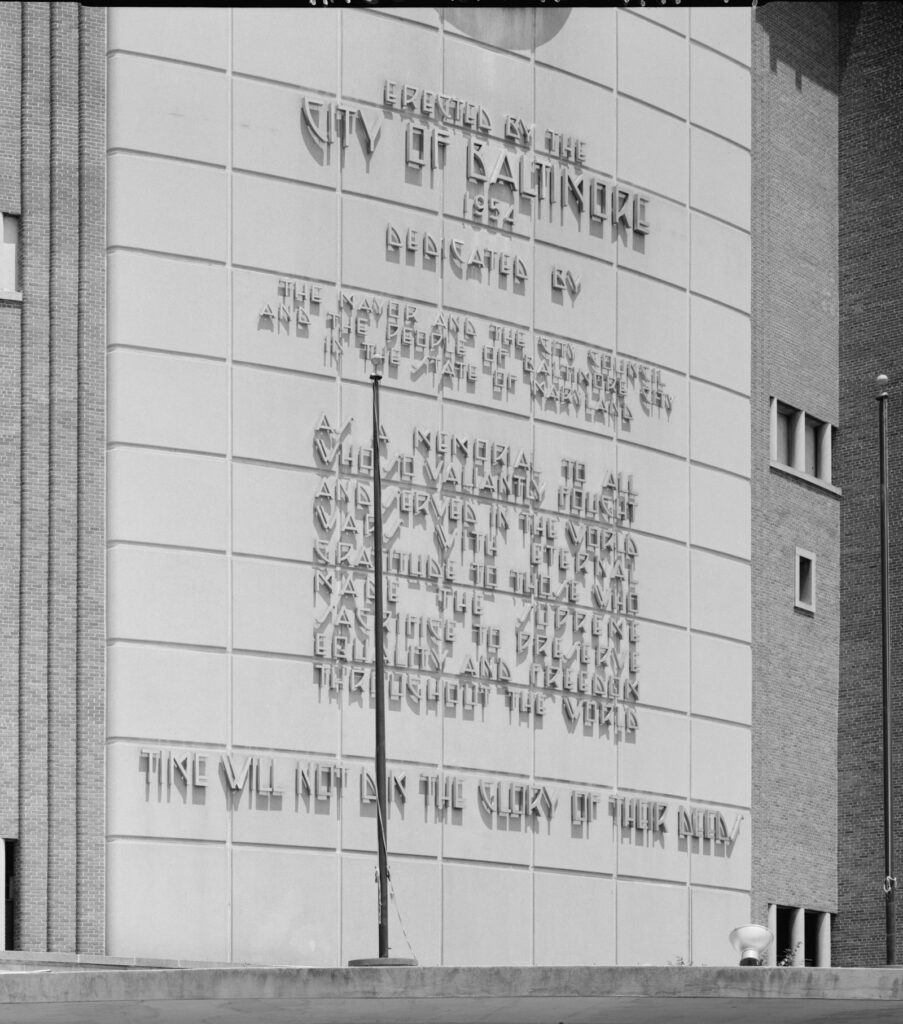
That’s a lot of stainless steel, every letter of it facing 33rd Street. The formal dedication came on Memorial Day 1956, between games of an Orioles and Red Sox doubleheader.
According to the Sun, 33,791 people watched Mayor D’Alesandro dedicate the bowl to the dead of World War I, World War II and the Korean conflict. There were color guards, firing squads and a huge floral Gold Star flag. Ted Williams of the Red Sox and Chuck Diering of the Orioles, both veterans, escorted the Gold Star Mothers’ flowers to the center-field flagpole.
The mayor also handed a brass urn to James C. Anderson, president of the Park Board. Anderson was to take it to France and fill it with earth from all the American military cemeteries in Europe. The urn ended up in an alcove in the stadium’s Memorial Hall, the main entry hall just inside the front.
The Orioles arrive
The Orioles’ first home game was on April 15, 1954, and Baltimore threw itself a party. The Sun’s front page the next morning reported 350,000 people along the parade route and Vice President Richard Nixon throwing out the first ball.
Two 15-year-old girls from Milford Mill High School had been at the bleacher window since 4:45 that morning for the first 75-cent tickets. A paid crowd of 46,354 watched the Orioles beat the Chicago White Sox, 3 to 1. SABR’s history puts the full crowd at about 48,000, with Bob Turley pitching the win.
John Van Camp’s story caught the weather. Rain started about noon and was still drizzling when the Army Field Band marched out. Then, as the Orioles lined up along the first base line, the sun broke through for less than two minutes.
“Well, will you look at that,” one spectator said. Nixon called it “a great day for baseball and a great day for Baltimore.”
Pitcher Joe Coleman caught Nixon’s first ball. Clint Courtney hit the first home run for the new Orioles in the new stadium. When he did, Van Camp wrote, “the applause turned from a barrage to a bombardment.”

On September 9, 1954, Mayor D’Alesandro sealed a time capsule into the stadium’s cornerstone before a game against the Yankees. The typed document inside described the stadium as 99.9 percent complete.
Four decades on 33rd Street
Over the next four decades, most of Baltimore’s biggest sports days happened on 33rd Street. On July 8, 1958, the city hosted its first All-Star Game, and the American League won, 4 to 3, before 48,829.

The Colts brought the stadium its first championships, winning the NFL title in 1958 and again in 1959. The 1959 game was played at Memorial Stadium, where they beat the New York Giants 31 to 16 before 57,545. Chicago Tribune writer Cooper Rollow once called a Colts crowd there “the world’s largest outdoor insane asylum.”
The stadium also kept its older job as a home for high school and college football. That included the City-Poly rivalry and games like this 1955 Poly matchup.

The Orioles’ first World Series title came in 1966, and they finished it at home. On Sunday, October 9, 1966, Dave McNally shut out the Los Angeles Dodgers 1 to 0 before 54,458. The only run was Frank Robinson’s fourth-inning home run off Don Drysdale.

Four years later the Orioles clinched another title at home, beating the Cincinnati Reds 9 to 3 to win the 1970 World Series. They also played in the Series in 1969, 1971 and 1979 and won again in 1983. SABR notes that Jim Palmer pitched for them in all six.
Palmer had a rougher afternoon on September 18, 1983. The Milwaukee Brewers knocked him out in the second inning, and the Orioles trailed 7 to 3 going into the eighth.
Eddie Murray’s grand slam put them ahead, and the Brewers’ Mark Brouhard tied it with a home run in the ninth. In the bottom of the ninth, John Stefero’s single to right brought Glenn Gulliver home for a 10 to 9 Orioles win before 35,804.
Seven years earlier, on December 19, 1976, about ten minutes after a Colts playoff game ended, a small plane crashed into the upper deck.
The Colts leave, and the Orioles move downtown
The Colts played their last game at Memorial Stadium on December 18, 1983, beating the Houston Oilers 20 to 10 before just 20,418. On March 28, 1984, Mayflower moving vans left the stadium carrying the team’s belongings to Indianapolis.
The Orioles stayed until 1991 and then moved downtown to Oriole Park at Camden Yards. Their last game on 33rd Street was October 6, 1991, a 7 to 1 loss to the Detroit Tigers before a sellout crowd of 50,700. That crowd helped the 1991 team set the ballpark’s season attendance record of 2,552,753, according to SABR.
Mike Flanagan came out of the bullpen in the ninth and struck out the two batters he faced. Cal Ripken Jr. hit into the final double play.
After the game, 78 former Orioles took the field, starting with Brooks Robinson at third base. Frank Robinson made one last run from third to home. Then the grounds crew dug up home plate and sent it by limousine to Camden Yards.
After the Orioles: the Ravens’ two seasons
The stadium kept hosting teams after 1991. The minor league Bowie Baysox played their first season there in 1993. Baltimore’s Canadian Football League team, the Stallions, played there in 1994 and 1995 and won the league championship in their second season.
In 1996 the NFL returned when Art Modell moved the Cleveland Browns to Baltimore, and fans picked the name Ravens in a Sun telephone poll. While their new stadium went up at Camden Yards, the Ravens played at Memorial Stadium. They won their first game there on September 1, 1996, beating the Oakland Raiders 19 to 14 before 64,124.
That first season ended at 4-12, though quarterback Vinny Testaverde threw for 4,177 yards and 33 touchdowns. In 1997 the Ravens opened with a 28 to 27 loss to Jacksonville before 61,018.
On December 14, 1997, the Ravens played the last NFL game at Memorial Stadium. They beat the Tennessee Oilers 21 to 19 before a sellout crowd of 60,558.
The day included salutes to former Colts and the armed forces. In February 1998 crews pulled up the stadium’s grass and moved it downtown to the Ravens’ new stadium at Camden Yards, known today as M&T Bank Stadium.
The final years and demolition
With both teams gone, the stadium stood empty. In 2000, a Historic American Buildings Survey photographer documented it room by room, from the press box to the locker rooms. In the locker rooms his photographs show Jim Palmer’s and Cal Ripken Jr.’s names still taped above empty stalls.


The city chose a plan called Stadium Place: senior housing by the church-based Govans Ecumenical Development Corp., along with a new YMCA. It was the only proposal that required tearing the stadium down.
In January 2001 the Board of Public Works voted 2 to 1 to give the Maryland Stadium Authority $5.85 million for demolition. Comptroller William Donald Schaefer cast the no vote.
Preservation Maryland fought it in court and lost. “It is so easy to tear things down,” Schaefer told Capital News Service. “It is so difficult to keep them up.”

The preservationists did win one concession, Capital News Service reported in May 2001. The developer and Mayor Martin O’Malley agreed to save the 116-foot facade on 33rd Street.
Demolition began in early 2001, and by August, the Sun reported, the wrecking crews of Potts & Callahan had reduced most of the stadium to rubble. The memorial wall was still standing on 33rd Street. After considerable debate, though, O’Malley reversed course late in 2001 and decided to take the wall down too, promising a new memorial downtown.
On January 17, 2002, former mayor Thomas J. D’Alesandro III watched as the 1954 time capsule was opened. Inside were a game program, a signed baseball and 36 cents in coins. The Sun reported that demolition of the wall was expected to begin late the next week.
What stands there now
In 2003 a veterans memorial was dedicated outside the Camden Yards gates, at the south end of the B&O Warehouse on Eutaw Street. Its granite wall, MLB.com wrote in 2020, spells out “Time will not dim the glory of their deeds” in the old facade’s original stainless-steel letters. The urn of earth from the military cemeteries is there too, under glass.
On 33rd Street, the site is now Stadium Place, with senior housing, a youth center and the Weinberg Y in Waverly. The Y gives its address as 900 East 33rd Street, the same number SABR uses for the stadium. The Historic American Buildings Survey listed the stadium at 1000 East 33rd Street.
The Y’s turf field, the Ripken Memorial Stadium Ball Field, was dedicated by the Cal Ripken Sr. Foundation in November 2010. Its home plate sits where the big league plate used to be. A marker on the backstop tells the story of the stadium, and on a summer afternoon kids still play ball on the same ground.
Lost Baltimore stories, in your inbox.
The newest story, plus a few from the archive.
Free. Unsubscribe anytime.
We use AI to help research, write and edit stories across our sites. Here’s how we use AI.Suggest a correction