

The site of one of Babe Ruth’s father’s saloons is under center field at Oriole Park at Camden Yards. Archaeologists found it in 1990, and the rowhouse where Ruth was born is two blocks from the ballpark.
Babe Ruth’s Baltimore was about that small. He was born on Emory Street and grew up above his father’s saloons a few blocks away. From there he learned the game at St. Mary’s Industrial School and pitched his first professional season for Jack Dunn’s Orioles in 1914.
Born on Emory Street
The house is 216 Emory Street, a three-story brick rowhouse just off the 600 block of West Pratt Street. In 1895 it was the home of Pius Schamberger, an upholsterer, whose daughter Kate was married to George Herman Ruth. As the Sun’s James H. Bready explained in 1961, she came back to her parents’ house during her first pregnancy.
On February 6, 1895, she gave birth to George Herman Ruth Jr., known to the grownups around him as Little George. Bready pointed out that a document at the Bureau of Vital Records attested to the date.
Ruth got it wrong on at least one document of his own. On his 1920 passport application, he swore he was born in Baltimore on or about February 7, 1894.
The 1900 census found the family at 339 South Woodyear Street. George Sr., 29, was listed as a lightning rod agent, Kate was 25, and their son George Jr. was 5, born February 1895.

Kate told the census she had given birth to three children and only one was living. Bready wrote that the Ruths had eight children over the years, and only two of them, George and his sister Mary, lived to adulthood.
Life above the saloon
George Sr. didn’t stay in lightning rods. He came from a family of Baltimore Germans who had worked as grocers, lightning rod manufacturers and saloonkeepers. He chose the saloon, and the family lived upstairs.
According to Bready, he moved so often that buildings on Conway, Camden and Eutaw streets could each be pointed to as a Ruth saloon. All of them are within a few blocks of Emory Street.
Archaeologists dug up one of them in 1990. The Sun reported then that George Sr. had owned or operated at least five saloons in the Camden area. That one was Ruth’s Cafe at Conway and Little Paca streets, where the family lived upstairs from 1906 to 1912.
From the saloon to St. Mary’s
Little George didn’t stay above the bar for long. His sister, Mary Ruth Moberly, told the Sun’s Michael Olesker in 1992 that he simply refused to go to school.
“He was a mischievous boy, but not a bad one,” she said. He also gave her a nickname, Mamie, just to annoy her, and she said everybody picked it up.
Allan Wood’s SABR biography says his parents had him sent to St. Mary’s Industrial School shortly after his seventh birthday. The school stood at Caton and Wilkens avenues. Olesker described it as a reform school that was also a home for orphans and for boys from broken homes.
Olesker, though, put his first stay at age 8. Both say it lasted about a month, and that he went home, came back, and within a couple of years was there to stay.
The sources don’t quite agree on which saloon he left from. Bready placed it at 426 West Camden Street. The 1990 Sun story tied his truancy and St. Mary’s to the years on Conway Street, when he was 11.
At St. Mary’s he met Brother Matthias, who taught him to read and write and spent afternoons hitting a worn baseball out to the boys. According to Wood, Ruth later called Matthias the father he needed, and he copied the brother’s swing, gripping the bat down at the knob.
The school taught him shirtmaking too, but Bready wrote that his preference was baseball. His family could visit only once a month, Mary remembered, and they’d bring him candy and cakes.
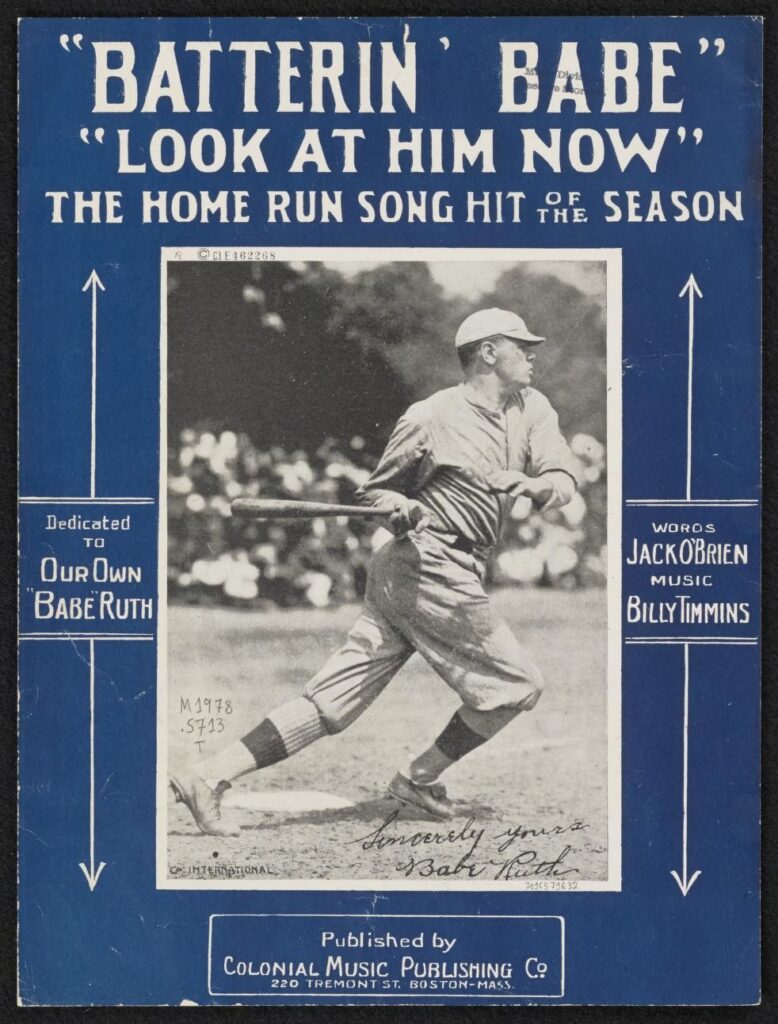
The school’s name turned up again once he was famous. In 1919 a Boston publisher put out a song in his honor, “Batterin’ Babe, Look at Him Now.” A later printing of it names St. Mary’s Industrial School as the publisher.

Jack Dunn signs a local kid
On Saturday, February 14, 1914, Orioles owner Jack Dunn signed him. Dunn was building up his club to compete with the new Baltimore Federals, and the Sun gave the signing a single paragraph the next morning:
The Oriole magnate signed another local player yesterday. The new Bird is George H. Ruth, a pitcher, who played with teams out the Frederick road. Ruth is six feet tall and fanned 22 men in an amateur game last season. He is regarded as a very hard hitter, so Dunn will try him out down South.
The Sun called him George H. Ruth, and he was 19. The nickname came later, and Mary remembered only that once he started playing ball for a living, the family heard people were calling him Babe.
Three weeks later the Orioles were at their spring camp in Fayetteville, North Carolina. On March 7, 1914, in a seven-inning practice game between Captain Ben Egan’s Buzzards and Scout Steinmann’s Sparrows, Ruth hit one into a cornfield. Here’s the Sun’s staff correspondent:
Fayetteville, N. C., March 7.--George Ruth, a pitcher Jack Dunn picked off the lots of Baltimore, is credited with making the longest hit ever seen by Fayetteville fans. In the Oriole’s first game of the season this afternoon, with Cottrell on second base, the youngster landed on a fast ball and circled the bases before Billy Morrisette had picked it up in deep right field.
Jim Thorpe, the famous Indian athlete, now a member of the New York Giants, held the previous record. Local fans who watched the Birds play their seven-inning contest are confident Ruth’s hit was much longer than that made by Thorpe. The ball went far over Morrisette’s head and landed in a cornfield. The battle of the Buzzards and Sparrows resulted in a 15 to 9 victory for the former, and Ruth’s batting featured. He made two hits and scored as many runs. The pitcher played shortstop well, handling the three chances without a slip-up.
Ruth learned to play ball at St. Mary’s Industrial School and can play any position. He pitched the last inning of today’s contest, and while one run was scored during his stay on the mound, he had little difficulty in disposing of the batters. The youngster is left-handed, has plenty of speed and can bat from either side of the plate.
Not a bad way to introduce yourself. His first home run in an Orioles uniform came in a practice game between teammates. Ruth was playing shortstop before he took the mound for the last inning, and the box score lists him as “ss,p.”

A shutout at Oriole Park
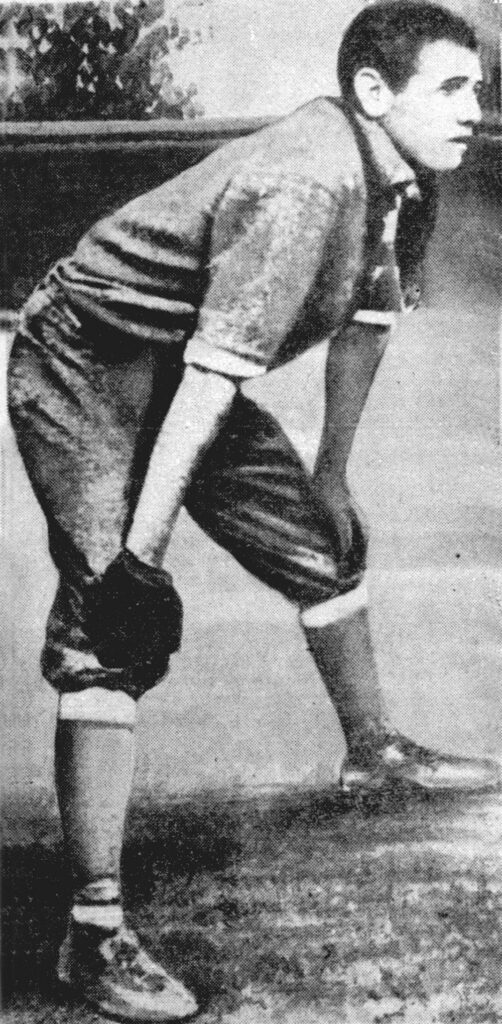
On April 22, 1914, at Oriole Park, he shut out the Buffalo Bisons, 6 to 0, in an International League game. Jesse A. Linthicum’s story in the Sun opened with “Gilt-edge pitching by George Ruth, Jack Dunn’s sensational southpaw.” He noted that fine plays passed almost unnoticed “for there were less than 200 fans in the stands.”

Sold to Boston
On July 9, 1914, Dunn sold Ruth, pitcher Ernie Shore and Captain Ben Egan to the Boston Red Sox. C. Starr Matthews opened his Sun story the next morning with “Going! Going! Gone!” By then the paper was calling him Babe.
Matthews wrote that Dunn was selling his men cheap to make up for what he had lost in the fight with the Federal League in Baltimore. Dispatches from Boston put the price at more than $25,000, but the Sun believed Dunn got no more than $20,000 for all three players. Matthews predicted Ruth would earn back his price in Boston ticket sales.

Some of the Boston money found its way back to the saloons. Bready wrote that his father’s last pub, at Eutaw and Lombard streets, was financed in part out of Babe’s Red Sox earnings.
The 1918 fight at Eutaw and Lombard
Ruth’s mother, Kate, died in 1912, while he was still at St. Mary’s, according to Bready. By 1918 George Sr. had a new wife, Martha, and was running the saloon at Eutaw and Lombard.
That August a family argument spilled out of the bar. According to the Sun, Benjamin H. Sipes, a 30-year-old fireman, had come by to give money to his sister, Mrs. Beefelt, who was living with Mrs. Ruth. He argued in the bar with her husband.
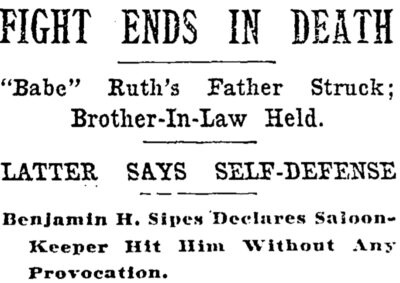
The Sun called Sipes George Sr.’s brother-in-law without spelling out exactly how they were related. Sipes then walked across the street to a cigar store. What happened next comes from his account, as the Sun reported it, and the “Ruth” in it is George Sr.:
A few moments later Ruth emerged from the side entrance of the saloon and approached him. Sipes said Ruth walked up and hit him on the cheek. He reeled and another blow felled him. While on the pavement, he says Ruth kicked him, but he managed to get up and struck Ruth.
Ruth was on the edge of the curb and, losing his balance, fell backward into the street, striking his head. Several men carried Ruth into the saloon. All efforts to restore him failed.
The Sun put the fight on Saturday night, August 24, while the Washington Times later called it an early Sunday morning fight. George Ruth Sr. died early Sunday, August 25, at University Hospital.
Sipes was locked up at the Western Police Station, but not for long. A coroner’s jury heard the testimony and freed him. The evidence showed Ruth had struck the first blow, the Washington Times reported on August 27, and the jury upheld Sipes’s plea of self-defense.
The Sun listed the survivors as his wife, Martha, his daughter, Mamie, and his son George, the Red Sox pitcher. Babe was 23.
The saloon in center field
You’ll hear at the ballpark that Oriole Park at Camden Yards was built on the site of Babe Ruth’s father’s saloon. The saloon in question is Ruth’s Cafe at 406 West Conway Street, one of the five or more Ruth saloons around Camden. It’s the one where the family lived from 1906 to 1912.
In January 1990, archaeologists from R. Christopher Goodwin Associates, working for the Maryland Stadium Authority, found the saloon’s foundation walls and its backyard privy. Both were under the asphalt of an old warehouse loading dock, and the team had located them with 90-year-old insurance maps.
The Sun reported that the spot would be short center field when the new stadium opened in 1992. Goodwin also told the Sun that the front of the saloon, entrance and all, had been destroyed. That happened when West Conway Street was widened some time after the building came down.
When Mary Ruth Moberly heard about the find, her first question, Goodwin told the Sun, was “Which bar was it?” Fair question, from a woman the paper said was 90.
Babe Ruth Stadium was one of the names floated for the new ballpark before it became Oriole Park at Camden Yards.
The birthplace today
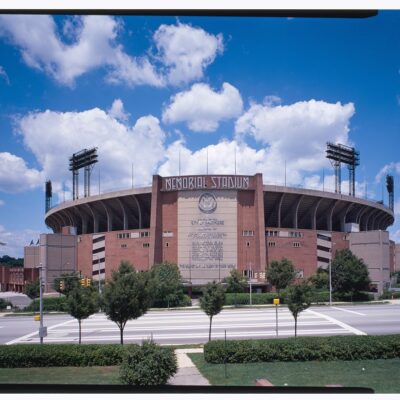
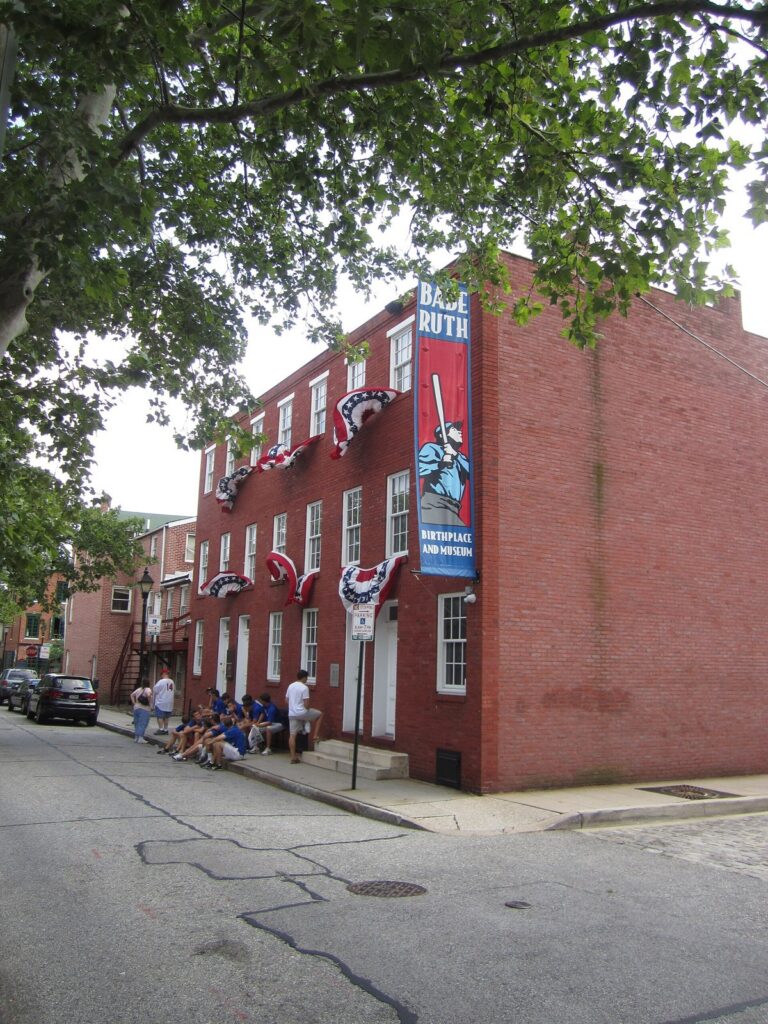
The house on Emory Street survived, though in 1961 Bready complained that it didn’t even have a plaque. He also reported that the city had turned down a 1960 proposal to take the house apart. The plan was to rebuild it beyond the outfield fence at Memorial Stadium, then the Orioles’ home field.
The house opened as a shrine and museum on Friday, July 19, 1974, as Mayor Schaefer and the Babe Ruth Birthplace Foundation had announced. The next morning’s Sun showed a small crowd on Emory Street. Mrs. Ruth, Governor Marvin Mandel, the Babe’s sister, Mary Ruth Moberly, and Mayor Schaefer were getting ready to open the door.
A bigger dedication, with Hank Aaron, was planned for July 29, but it didn’t happen that day. On July 24 the Sun reported that the formal dedication had been postponed because Aaron, “baseball’s new home run king,” couldn’t come.
Paul Welsh, president of the Babe Ruth Birthplace Foundation, said Braves officials had told him so. A new date would be set, he said, “when a firm, nonconflicting appearance by Aaron can be arranged.”
The house did get a famous visitor that fall. When the Orioles hosted Oakland in the 1974 playoffs, the Sun announced a visit from Willie Mays. He would be at the shrine on Tuesday, October 8, from 11 a.m. to noon.
It’s now the Babe Ruth Birthplace and Museum, two blocks from Oriole Park. The house where he was born and the ground over his father’s old bar are still only a short walk apart.
Lost Baltimore stories, in your inbox.
The newest story, plus a few from the archive.
Free. Unsubscribe anytime.
We use AI to help research, write and edit stories across our sites. Here’s how we use AI.Suggest a correction