
Shortly before noon an automobile drove up to the main entrance of the Union Memorial Hospital. Two men got out and assisted a third, identified as Capone, from the machine.
That’s the Baltimore Sun on November 17, 1939, describing Al Capone’s arrival at Union Memorial the morning before. He had walked out of federal prison a few hours earlier. He came to Baltimore for treatment of general paresis, brain damage caused by untreated syphilis.
Johns Hopkins wouldn’t take him, so he checked into Union Memorial as “Mr. Martini.” He stayed in Baltimore about four months, first in a hospital suite and then in a rented house in Mount Washington. Hospital lore says he left behind a weeping cherry tree, and it was still blooming on 33rd Street in 2015.
From Alcatraz to Lewisburg
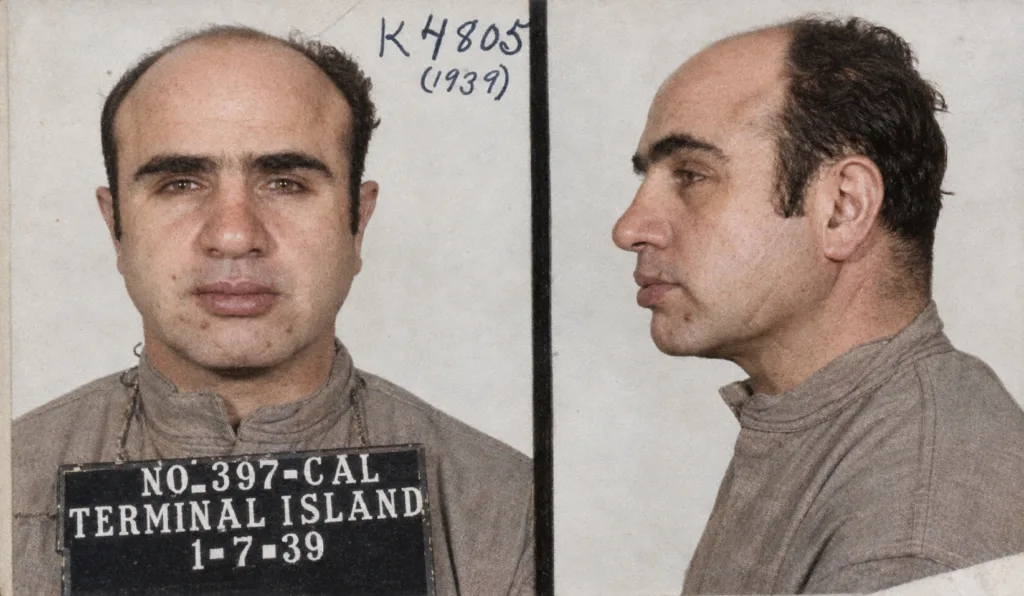
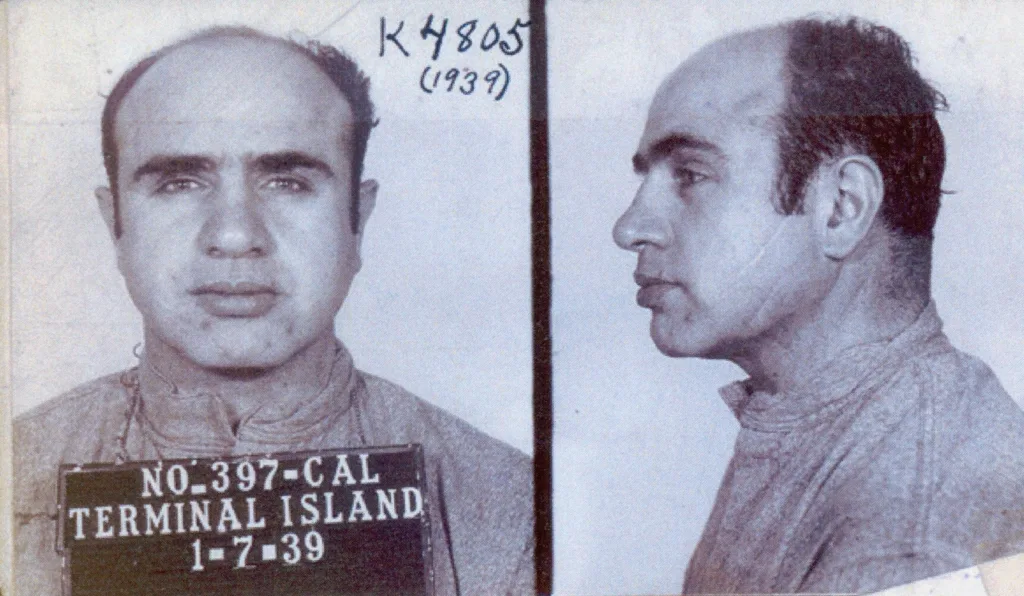
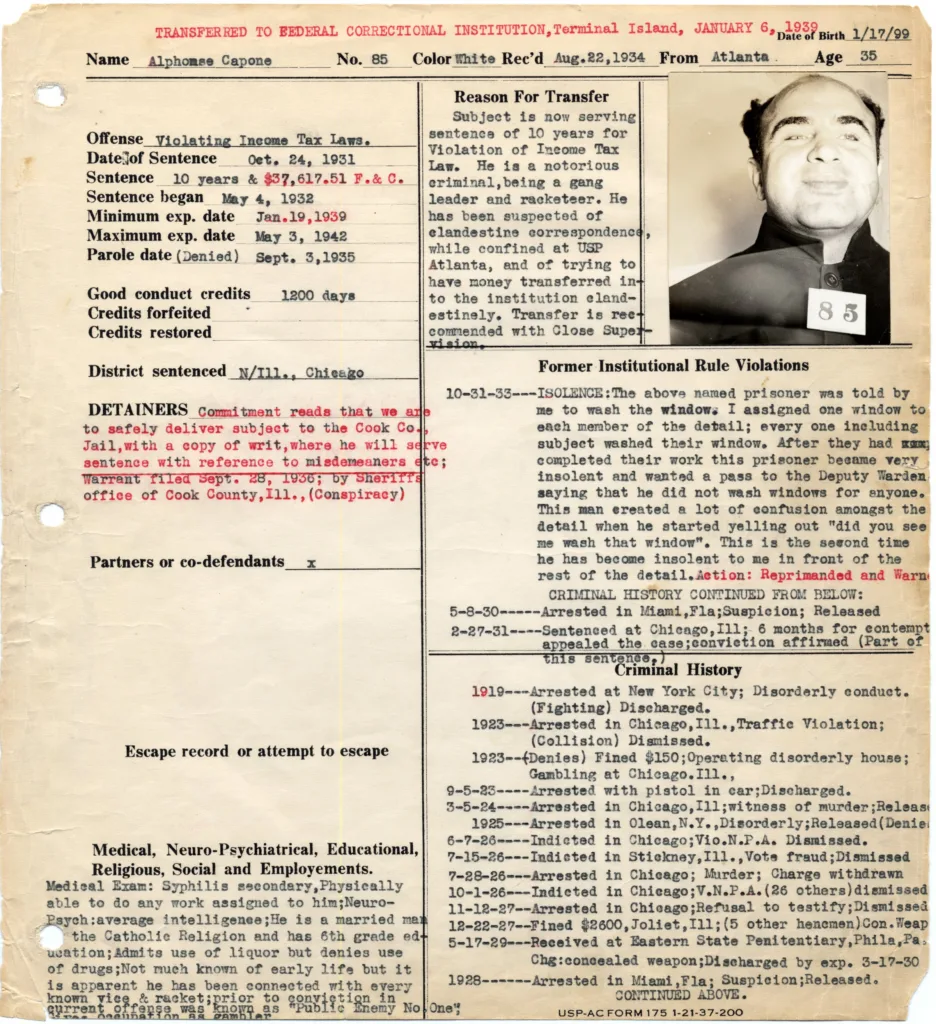
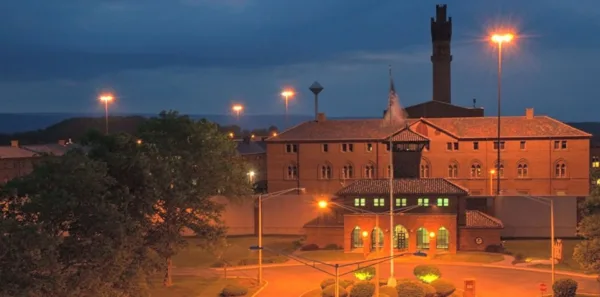
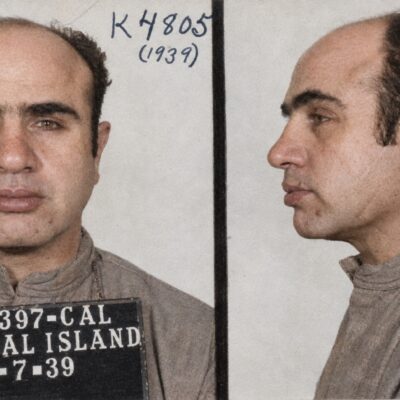
Capone had been in federal prison since May 1932, serving time for income tax violations. He reached Alcatraz in August 1934. His Alcatraz record card shows a transfer to Terminal Island, California, on January 6, 1939, and the papers said it was because of his health.
That November, prison officials brought him east by train. According to federal prison director James V. Bennett, he rode without handcuffs. With him were three federal officers and Dr. George Hess, Terminal Island’s chief medical officer.
The Sun reported that the party left the train at Harrisburg at 3:54 a.m. and drove the sixty miles to Lewisburg. He was released there early on November 16. That was three days ahead of the announced date, thanks to credit for three days he’d spent in custody in 1931.
He left in prison-issued clothes. The Evening Star noted his pockets didn’t even hold the $10 that federal convicts usually got on discharge.
Straight to Union Memorial
The first reported sighting in Baltimore came at breakfast. According to the Sun, diners in a downtown hotel cafeteria saw a man they took for Capone walk in with five or six others. The hotel denied it.

A few hours later he was at Union Memorial in a light camel’s hair topcoat and a soft hat. Hospital employees in the lobby recognized him, and the Sun described a “pudgy, dark-haired man with a scar on his face.”
The hospital’s director, Dr. Clyde D. Frost, confirmed that Capone had been admitted for treatment and observation. He was the patient of Dr. Joseph E. Moore, who had run the syphilis division of the Johns Hopkins medical clinic for ten years.
So why not Hopkins? H. L. Mencken, a friend of Moore’s, took that up in his diary on November 29. He wrote that the Hopkins superintendent had agreed to admit Capone, but the hospital’s lay board of trustees objected.
Union Memorial, where many Hopkins doctors had privileges, became the compromise, Jacques Kelly later wrote in the Sun. Union Memorial had its own lay board, and Mencken wrote that some of its women members objected as well. The hospital’s medical board answered that a hospital couldn’t ethically turn away a sick man.
Moore and Frost made the same point in a joint statement the Sun printed on November 18.
Mr. Alfonse Capone is ill and is in need of hospital care. It has become our duty as his physicians to give him that hospital care. The ethics of the medical profession obligate us to treat him as a patient requiring medical attention and not as a public personality.
A $30-a-day suite on the fifth floor
Capone had two rooms on the fifth floor at $30 a day, according to both the Associated Press and Mencken. A male nurse and a female nurse sat outside. The Sun said nurses who might come in contact with him had been pledged to secrecy.
His wife, mother and brother Ralph were in town, and Ralph had arranged the treatment with Moore. Nurses told the Sun that Capone was “very pleasant” and introduced everyone who came in to his mother.
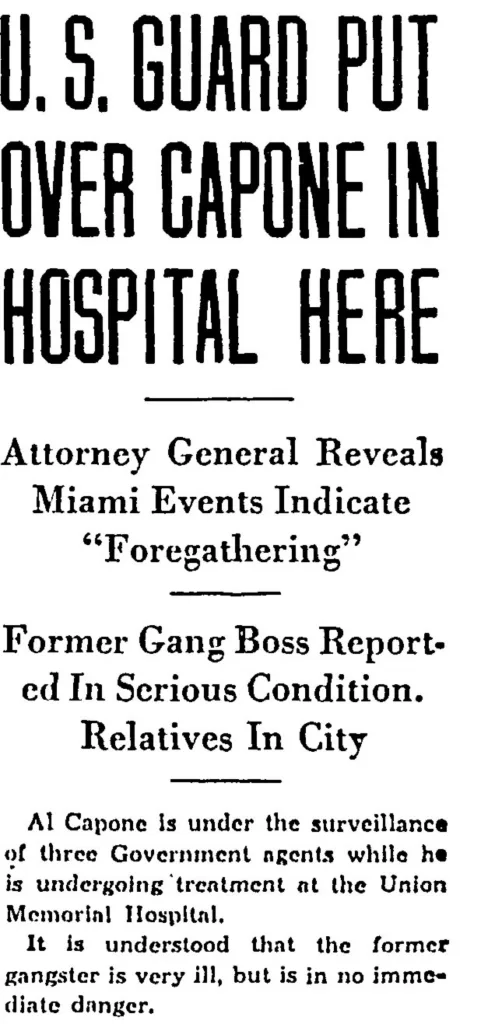
So who was guarding him? The papers couldn’t agree, and neither could the attorney general. On November 16, Frank Murphy announced that three government agents were watching Capone because “certain things have come to our attention.”
The next day Murphy said Capone had not been under federal guard since he was delivered to the hospital. The prison guards who rode east with him had been doing their customary job, he said, and any bodyguard now was Capone’s own.
The United Press reported heavy police details around the hospital. The AP quoted Police Commissioner Robert E. Stanton saying no city police were on duty inside.
By November 29, Mencken was describing a much looser arrangement. He wrote that the FBI had told Moore it knew of no plot against Capone, and that no guard was being kept.
A game of dominoes
The Sun reported that Capone spent his first night playing cards with Ralph. At a press conference the next evening, his brother John described a game of dominoes with Al.
“I was playing some dominoes with him,” John answered to a question as to what Al had done his first night in the hospital. “Were there any stakes?” “I don’t think anybody collected anything,” he smiled. “We weren’t playing for any money.”
You have to like a reporter who asks Capone’s brother whether the dominoes game had stakes.
Fever treatment and a long winter
Hospital sources told the AP that Capone would get one of the modern fever treatments, either malaria or a heated cabinet. Mencken wrote that he got the malaria therapy and had already run a temperature as high as 106 degrees Fahrenheit.
His wife, Mae, moved a cot into his room every night, Mencken noted. He also wrote that Capone was popular with the staff, especially the orderlies, partly because he was “likely to leave large tips.”
Meanwhile, Capone’s representatives went house-hunting. The Sun reported that a real estate firm drew up a $250-a-month lease on a furnished house in Guilford, then backed out when it learned who the tenant was. A second real estate agent wasn’t interested either, even when Capone’s people raised the offer to $300 a month.
The house on Pimlico Road
On January 8, 1940, after 53 days in the hospital, Capone moved into a brick house at 5708 Pimlico Road in Mount Washington. The Sun said it was rented from Harry K. Smart (he lived in the same block).
Moore said his patient had shown “some improvement” and could take short walks, but still needed medical care. It would be months before doctors could judge the outcome of his treatment.
The family used the name Rossi on Pimlico Road. In March 1940, the Sun reported that their arrival had escaped the neighbors’ notice:
Capone’s removal was so quiet and his family so unobtrusive that neighbors and the family who lived in the third floor of the house into which he moved were unaware that the former gangster had entered the neighborhood.
Neighbors told the Sun that Capone lived quietly with his wife, mother and another brother, Albert, and reportedly never went outside during the day.
Captain Katz remembers it differently
In 1975, the Sun‘s Sunday magazine ran a memoir by a retired Maryland State Police captain, Menasha E. Katz, who remembered Capone as his “paying guest.”
Katz, a state police sergeant in 1939, said Smart was a private detective who called him for help. As Katz told it, the family took the second floor of Smart’s house at 5708 Pimlico Road. Capone and two bodyguards rented two rooms in Katz’s old farmhouse at Pimlico Road and Oswego Avenue.
Katz said he cleared it first with the State Police superintendent and the Baltimore police commissioner. He often rented rooms to jockeys and trainers during the Pimlico meets.
Katz’s little girl thought Capone looked like Edward G. Robinson, the star of the gangster movie Little Caesar.
When Katz passed that along, Capone grinned a little and said, “Don’t tie me in with that guy.” I love that line.
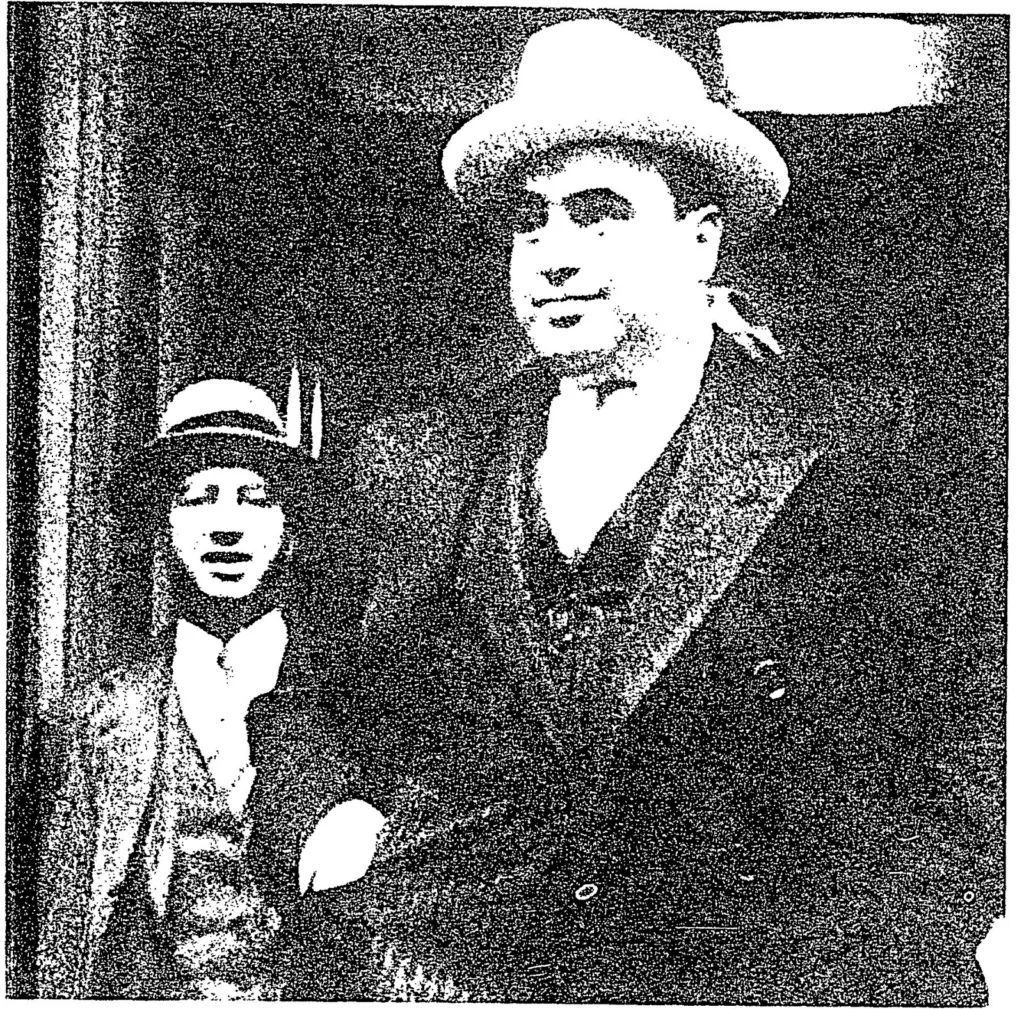
Katz wrote 36 years after the fact, and his timeline doesn’t match the 1939 papers. He has Capone at the Emerson Hotel and then at his house before checking into the hospital. The Sun put Capone in Union Memorial before noon on his first day.
He also had Capone back at the farmhouse from January to March. The Sun reported in both January and March 1940 that Capone himself lived at 5708 Pimlico Road.
Then there’s the food. Capone’s family came over and cooked Italian dishes for him, Katz wrote, and sometimes a bodyguard went out for takeout. Gilbert Sandler later added in the Sun that Maria, of Maria’s Restaurant in Little Italy, always claimed Capone ordered only from her.
Gone by seven
Neighbors told the Sun that a dust-covered car pulled up to 5708 Pimlico Road on Tuesday, March 19, 1940. Around 7 a.m., Capone and a brother left in it.
The rest of the family left the next day, some by taxi, and that night the house was dark. Even Moore was caught by surprise. He told the Sun that as far as he knew, his patient was still in Baltimore.
By March 22 Capone was at his estate on Palm Island in Miami Beach. His brother John confirmed he had come from Baltimore, and Moore told the AP, “He is still ill and will continue under medical care.”
Capone died at Palm Island on January 25, 1947, at 48. The AP reported the cause as pneumonia and heart failure after a stroke.
What about the cherry tree?
Union Memorial kept one souvenir of him, or so the story goes. In 2010 a hospital spokeswoman told Kelly that Capone gave the hospital a pair of weeping cherry trees after his stay. One was later cut down for a new wing.
Back in 1997, Kelly had called it a legend, writing that “no one has ever proven this to be true.” We didn’t find the gift in any 1939 or 1940 paper we read.
Before the February 2010 blizzard, the hospital had an arborist take cuttings from the surviving tree. Kelly reported that some were planted around the campus and at least one in the 33rd Street median (between Calvert Street and Guilford Avenue).
The remaining tree, just east of the hospital’s 33rd Street front, lost a major limb in the blizzard of February 6, 2010. It survived, and Baltimore blogger Meg Fairfax Fielding found it blooming in April 2015.
Capone spent four months in Baltimore trying not to be noticed. The one thing he may have left behind was still blooming in public 75 years later.
Liked this one? Get more tomorrow.
Lost Baltimore stories in your inbox most mornings: the newest, plus a few from the archive.
 This storyAl Capone in Baltimore: His Four Months After Prison, 1939-40
 When Public Enemy No. 1 Hid Out in Baltimore as Edward Maxwell
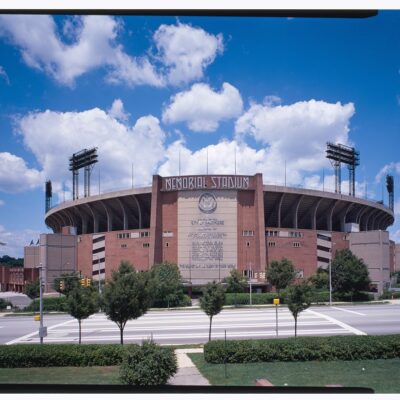 Memorial Stadium: The Story of Baltimore’s Ballpark on 33rd Street
Free. Unsubscribe anytime.
AI helped research and write this story. Here’s how we use AI.Suggest a correction